Air Cylinder connected to a Lever that drives a Pulley for Applying Belt Tension

Click For Summary

Discussion Overview

The discussion revolves around calculating the required power of an air cylinder that operates a lever assembly to apply tension to a belt wrapped around a pulley. Participants explore the mechanics of the system, including the relationship between the air cylinder's movement and the resulting belt tension, with a focus on the calculations needed for achieving a specific tension of 4500 lbs.

Discussion Character

  • Technical explanation
  • Mathematical reasoning
  • Debate/contested

Main Points Raised

  • One participant seeks guidance on calculating the necessary power of the air cylinder based on the tension required in the belt and the mechanics of the lever assembly.
  • Another participant questions the relationship between the distance moved by the roller and the belt tension, emphasizing the need for the belt to be precalibrated.
  • A participant provides details about the belt's elasticity, noting it stretches only about 3/8" and mentions the importance of determining the air cylinder size based on the tension increase over a short travel distance.
  • There is a clarification regarding whether the 4500 lbs refers to total force or belt tension, with a suggestion that the air cylinder force approaches zero at full belt tension due to the geometry of the setup.
  • A participant recommends using single line diagrams to visualize the mechanics of the system and suggests calculating the cylinder force at various stages of belt tension to determine the appropriate air cylinder size.
  • One participant later confirms that they followed the suggested steps and successfully operated the machine, recalling the use of a 2.25" diameter cylinder.

Areas of Agreement / Disagreement

Participants express differing views on the calculations required and the mechanics involved, particularly regarding the relationship between the air cylinder force and the belt tension. The discussion includes multiple competing perspectives, and no consensus is reached on the exact calculations or assumptions needed.

Contextual Notes

Participants mention various assumptions, such as the negligible friction in the initial movement and the importance of the angle between the lever components, which may affect the calculations. The discussion also highlights the need for careful consideration of the belt's elasticity and the geometry of the lever system.

Jeremy Sawatzky
Messages
33
Reaction score
13
TL;DR
I need to apply 4500lbs of force to a belt using an air cylinder and a lever Assembly. How do I calculate the required air cylinder size?
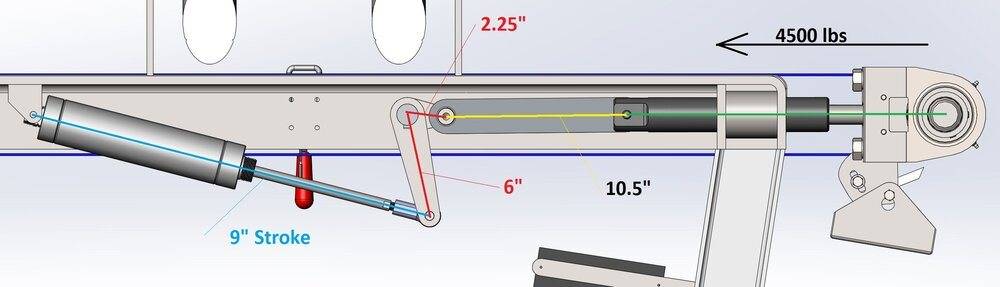
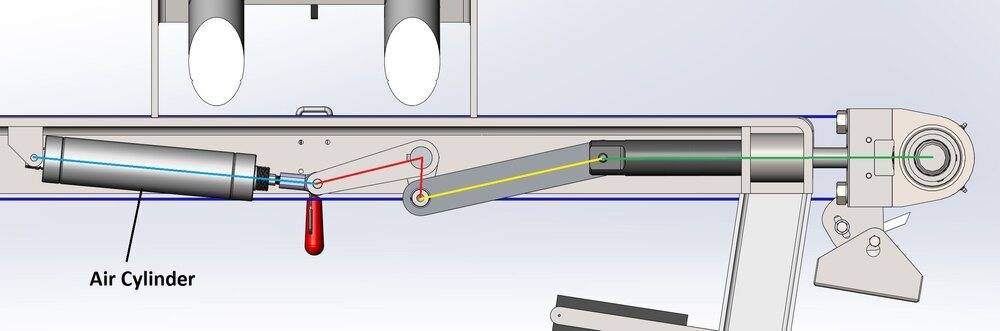
Hi, I am looking for some guidance on how to approach this calculation. I have an air cylinder operating a lever assembly that then applies pressure to a pulley of which a belt is wrapped around. I need the belt to have about 4500 lbs of tension. How do I work backwards to figure the required power of the air cylinder?

In the first image, the belt will be totally slack so effectively I am only overcoming the friction of the pivot points and the sleeve guides that support the pulley assembly. I have prior experience with this assembly and know the friction to be negligible and not important to the initial movement of this assembly. However I am sure that it plays a part later on.

In the second image, the air cylinder is fully extended putting the full tension on the belt. The belt is returning 4500lbs of force. The belt tension increases rapidly towards the end of the air cylinder stroke as it barely stretches at all. I would hazard a guess that 99% of the work is done in the last 3" of the air cylinder stroke.

Thanks!
Belt tension 1.JPG
Belt tension 2.JPG
 
Last edited by a moderator:
Engineering news on Phys.org
The distance moved by the roller is decided by the length of the 2.25” crank.
That will not decide the belt tension unless the belt is precalibrated. How elastic is the belt ?
 
The belt is very strong and will stretch maybe 3/8" I have a rough idea of how tight I need the belt to be. The final belt tightness is set by another screw adjustment further down the line. I just need to figure if the belt tension increases from 0-4500lbs in about 0.5" of travel, how large of an air cylinder will I need.
 
Question: 4500 lbs total force on the belt pulley, or 4500 lbs belt tension = 9000 lbs total force?

This problem requires more than one simple calculation. With the setup in your sketch, the air cylinder force at peak belt tension approaches zero as the angle between the 2.25" link and the connecting rod approaches 180 degrees. The peak air cylinder force occurs when the belt is at partial tension. Be aware that, since the peak cylinder force occurs before the belt is fully tight, the cylinder will jump forward and slam to a stop. An air cylinder with built in cushions is recommended.

Assumption: The belt tension is set by the screw adjustment with the angle between the 2.25" link and connecting rod exactly 180 degrees. Then you can calculate the link angles when the belt starts to tighten, and for a series of steps from there to fully tight. Calculate the cylinder force at each step. Plot the results. The peak cylinder force determines the size of the air cylinder.

The easiest way to do these calculations is to start with single line diagrams. Each link is a single line, with a small circle for the pivots. The first diagram is the point of initial contact with the belt, the last diagram with the air cylinder fully extended. Then do 4 or 5 more diagrams at equal intervals in between. These diagrams are the blue, yellow, and red lines in your sketch with some added information. The fully extended diagram will show the 4500 lb force, the initial contact diagram will show zero force, and the intermediate diagrams will show force calculated using linear interpolation.

Do that, post the diagrams, come back, and we will coach you through the next steps.
 
I should have replied back, I followed these steps, the machine operated beautifully. If I remember right, I think I used a 2.25" diameter cylinder.
 
  • Like
Likes   Reactions: berkeman and Tom.G

Similar threads

  • · Replies 3 ·
Replies
3
Views
2K
Replies
5
Views
3K
  • · Replies 12 ·
Replies
12
Views
7K
  • · Replies 15 ·
Replies
15
Views
7K
  • · Replies 27 ·
Replies
27
Views
11K
  • · Replies 6 ·
Replies
6
Views
3K
  • · Replies 2 ·
Replies
2
Views
1K
  • · Replies 4 ·
Replies
4
Views
2K
Replies
8
Views
27K
  • · Replies 15 ·
Replies
15
Views
8K