Amount of single photons to make white light?

Click For Summary

Discussion Overview

The discussion revolves around the nature of single photons and their relationship to color perception, particularly in the context of white light and the visible spectrum. Participants explore the concept of color as it relates to photons, questioning the minimum number of photons required to perceive color and the wavelengths associated with single photons.

Discussion Character

  • Exploratory
  • Debate/contested
  • Conceptual clarification

Main Points Raised

  • Some participants suggest that color is a human perception and that there is no universal consensus on color boundaries, advocating for the use of frequency as a more precise measure.
  • Others argue that the spectrum is continuous and that classifications like "green" and "yellow" are arbitrary, with no physical relevance to the concept of "base photons."
  • It is proposed that while a single photon can have any wavelength, it cannot be perceived as a color due to the limitations of human vision.
  • Some participants note that a collection of photons is necessary to stimulate the color-sensitive receptors in the eye sufficiently to produce a perception of color.
  • There is a discussion about the nature of light, with some emphasizing that light is typically a mixture of frequencies rather than a single frequency.
  • One participant mentions that while a single photon does not produce a perception of color, it can have any frequency, thus addressing the question of what frequency a single photon can possess.
  • There is a suggestion that the perception of color is influenced by the proportions of different wavelengths that stimulate the receptors in the eye.

Areas of Agreement / Disagreement

Participants generally agree that a single photon cannot be perceived as a color, but there is disagreement on the implications of this regarding the nature of photons and color perception. Multiple competing views remain on how to best describe the relationship between frequency, wavelength, and color perception.

Contextual Notes

Limitations include the dependence on human perception and the arbitrary nature of color classifications. The discussion also highlights the complexity of light as a mixture of frequencies and the challenges in defining color in physical terms.

Who May Find This Useful

This discussion may be of interest to those studying optics, color theory, or the physics of light, as well as individuals involved in applications related to visual perception and design.

Sterling Lutes
Messages
4
Reaction score
0
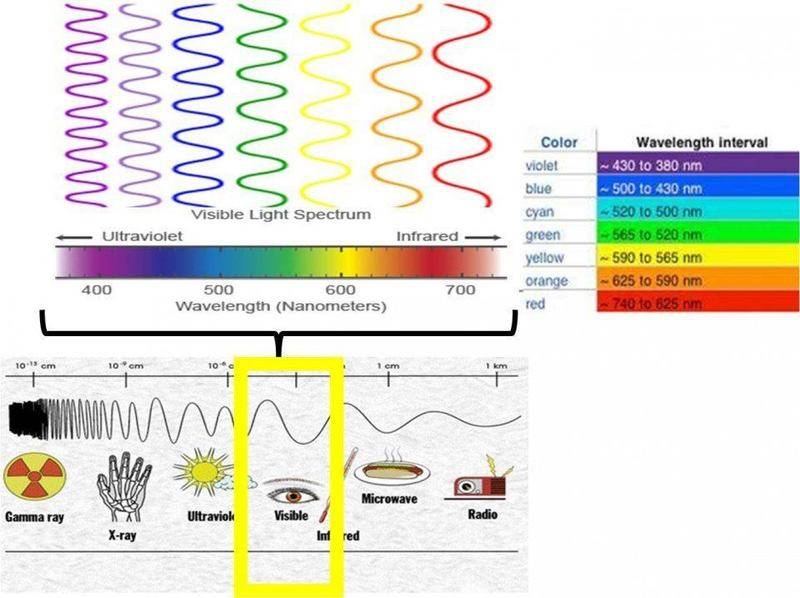
First off I hope I'm putting this in the correct forum. My question is more than just the minimum amount of photons to make a single blip of white light, but more so the base photons in the visible spectrum of light. We have all seen a prism split light into violet, blue, cyan, green, yellow, orange, and red waves of light, but what are the colors possible from a single photon of light. Example cyan is really a mixture of blue and green light, so I'm guessing a single photon could be blue or green but not cyan?

I feel like I'm starting to ramble on with all of my thoughts about this, but my real question is what are the colors a single photon of light can be?
picture1.jpg
 
Science news on Phys.org
This is a little vague. Color is human perception, and there is no universal consensus on the finer color boundaries. You can always unambiguously refer to the frequency of a photon (in a particular frame) though, and since frequency ultimately determines the color the human eye sees, it seems like a good quantity to use instead of color.
 
There are no "base photons". The spectrum is continuous without gaps or steps, classifications like "green" and "yellow" are arbitrary and have no physical relevance.

"White" is a subjective perception, you can generate that impression with light of three wavelengths (computer monitors do that), but you can also generate it with four, 100, or the full continuous spectrum. You certainly need more than a few photons, however, because our eyes are not sensitive enough.
 
mfb said:
There are no "base photons". The spectrum is continuous without gaps or steps, classifications like "green" and "yellow" are arbitrary and have no physical relevance.

"White" is a subjective perception, you can generate that impression with light of three wavelengths (computer monitors do that), but you can also generate it with four, 100, or the full continuous spectrum. You certainly need more than a few photons, however, because our eyes are not sensitive enough.

So is it possible for a single photon to be any wavelength/color in the visible spectrum of light?
 
PWiz said:
since frequency ultimately determines the color
The colours you see are almost never due to a single frequency, but combinations of different frequencies. (Where would you find a natural monochromatic source of light?)
BTW, for someone to perceive an actual colour you need a lot of photons. It's easier to talk in terms of light flux than photons here. Rod receptors are claimed to be able to detect the presence of individual photons but just as a brief 'twinkle'.

mfb said:
you can generate that impression with light of three wavelengths
Again.not strictly true, in practice, because the phosphors used (and specified) are not monochromatic and, particularly with the green phosphor, are a significant distance from the spectral curve. It's a matter of compromise to have good, bright phosphors that are near enough to the spectral curve on the CIE chart to encompass as many displayed colours as possible. It's really best never to confuse colour and wavelength.
 
Sterling Lutes said:
o I guess I'm asking more or less the specific wavelength a photon can be.
Every wavelength is possible. As I said, there are no steps or gaps.
Sterling Lutes said:
Is a photons wavelength comparable to an electrons energy level where it has to be a certain wavelength and not in-between another?
It is not. Unless you confine the photon to be between two mirrors, for example, then you can get similar energy levels.
Sterling Lutes said:
you cannot emit a single photon that is white, it would have to consist of certain photons I am just wondering what those would be?
A collection that excites the color-sensitive receptors in the eye in some fraction that is similar to the fraction we get from the sun. That is more biology than physics.
 
Color is how our brain interprets the signals it receives from our optic nerves when the cells of of the retina are stimulated by incoming light, so when someone says "red light", they're using those words as a convenient shorthand for the more precise "light of a wavelength that most people (but not necessarily those with some forms of colorblindness) will perceive as red".

Generally this is OK, but it can confuse us into thinking that light has a color - it doesn't, it has a wavelength and frequency. Light in the 500-520 nanometer wavelengths stimulates the retina and is interpreted by the brain the same way as a mixture of light in the 430-500 and 520-565 wavelengths.
 
mfb said:
A collection that excites the color-sensitive receptors in the eye in some fraction that is similar to the fraction we get from the sun. That is more biology than physics.
Biology is crammed full of interesting Physics.
One photon can only stimulate one receptor so you would need enough photons for enough of the cone receptors to produce a statistically significant set of signals that the optical processing could 'decide' what colour to recognise / categorise - on the basis of the proportions of each receptor group excited.
 
Nugatory said:
it doesn't, it has a wavelength and frequency.
Light is usually a mixture of frequencies and not just one. It's only the 'colours' of monochromatic light that correspond to particular frequencies. It is very limiting to equate colour and frequency. eg Pink = ?, bottle green = ?, purple = ?
 
  • #10
sophiecentaur said:
The colours you see are almost never due to a single frequency, but combinations of different frequencies. (Where would you find a natural monochromatic source of light?)
While that is true, it does not seem to address the OP's question here:
Sterling Lutes said:
but my real question is what are the colors a single photon of light can be?
 
  • #11
PWiz said:
While that is true, it does not seem to address the OP's question here:
Possibly but it's helpful to re-phrase a question when necessary in order to give a proper answer, (imo.)
I gave an answer to the OP. The answer was that it couldn't be perceived as a colour.
 
  • #12
PWiz said:
While that is true, it does not seem to address the OP's question here:
but my real question is what are the colors a single photon of light can be?
The answer to that is simple and has been given. None. A single photon does not impinge on the optic nerves sufficiently to produce any perception of color.

If the question is what frequency can a single photon have, then that has also been answered. Anything you like.
 
  • #13
sophiecentaur said:
Light is usually a mixture of frequencies and not just one. It's only the 'colours' of monochromatic light that correspond to particular frequencies. It is very limiting to equate colour and frequency. eg Pink = ?, bottle green = ?, purple = ?

This is correct - it would only be under artificial conditions (a well-tuned laser comes pretty close) that we might encounter true monochromatic light, let alone superpositions of monochromatic light. Just about all the cyan that I'll ever see, including the color I saw when I smashed a used inkjet printer cartridge just to see what was inside it, is a mixure of frequencies that my brain is interpreting as a single color.

(In writing that post you're quoting I was soooooo hoping not to have to go there... :smile:)
 
  • #14
phinds said:
The answer to that is simple and has been given. None. A single photon does not impinge on the optic nerves sufficiently to produce any perception of color.

If the question is what frequency can a single photon have, then that has also been answered. Anything you like.
Is this specifically directed towards me, or are you just answering the OP?
 
  • #15
PWiz said:
Is this specifically directed towards me, or are you just answering the OP?
Both.
 
  • #16
Thanks everyone for your responses. The current IOS game we (www.tapgods.com) are designing is centered around your character (a photon) and involves a lot of physics involving light and you all have helped greatly in our rough design.

Our site is currently getting a bit of a facelift. Some things may be misbehaving
 
  • #17
phinds said:
Both.
Um, thanks for giving me those facts, but I sort of knew them already.
 
  • #18
phinds said:
The answer to that is simple and has been given. None. A single photon does not impinge on the optic nerves sufficiently to produce any perception of color.

Good point... The color-sensitive cone cells in our retina aren't triggered by the amount of energy carried in a single photon of visible light. The rod cells, which are more binary off/on in their behavior can be triggered by a single photon, and this is why we lose color vision in dim light.
 
  • #19
Sterling Lutes said:
Thanks everyone for your responses. The current IOS game we (www.tapgods.com) are designing is centered around your character (a photon) and involves a lot of physics involving light and you all have helped greatly in our rough design.
Since you say the character will be a photon, I'm assuming you are not planning on using real physics, right? I mean, there is no such thing as "the point of view of a photon".
 
  • #20
phinds said:
Since you say the character will be a photon, I'm assuming you are not planning on using real physics, right? I mean, there is no such thing as "the point of view of a photon".

It is to early in the production to release to many details. I can say certain aspects of the game will use correct or close to correct physics and others will be completely fantasized.
 
  • #21
Sterling Lutes said:
Thanks everyone for your responses. The current IOS game we (www.tapgods.com) are designing is centered around your character (a photon) and involves a lot of physics involving light and you all have helped greatly in our rough design.

Hmmmm... I find myself thinking that you're starting with a misunderstanding of what a photon is... your first post suggests that you may be thinking of a photon as a little particle of light, and that a beam of light is a stream of photons the way that a flowing river is made up of water molecules. This picture is very common in the non-technical press (it's almost impossible to escape it once you hear the word "particle") but also very misleading.

You'll find a bunch of posts in the quantum mechanics subforum here discussing what a photon is and is not.
 

Similar threads

  • · Replies 207 ·
7
Replies
207
Views
14K
  • · Replies 40 ·
2
Replies
40
Views
4K
  • · Replies 5 ·
Replies
5
Views
2K
  • · Replies 2 ·
Replies
2
Views
2K
  • · Replies 9 ·
Replies
9
Views
2K
  • · Replies 6 ·
Replies
6
Views
3K
  • · Replies 4 ·
Replies
4
Views
2K
  • · Replies 9 ·
Replies
9
Views
2K
  • · Replies 21 ·
Replies
21
Views
5K
  • · Replies 2 ·
Replies
2
Views
2K