Daniel Petka
- 147
- 16
Violet itself is weird, because it lays at the other side of the spectrum than red, yet it can be easily mimicked with red and blue. The more powerful the violet light, the more it resembles white.
My hypothesis: Violet tricks our eyes by activating not only blue, but also red and... with more power even green receptors.
(Please prove it wrong if its possible)
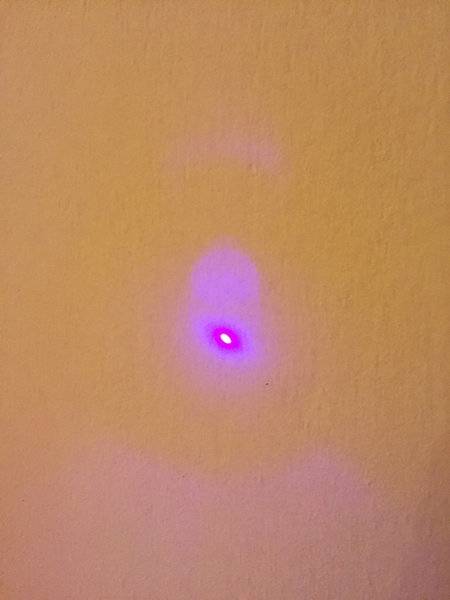
(Photo: middle white just like in reality (actually closer to cyan cause the wall is yellow, no idea why- pure observation- comment if you know y :p))
Observation: I've been playing with (not too powerful) lasers since I was a kid. One thing I noticed, was the unexpected color of the dot's center. It mostly seemed to be white- just like a camera picks it up. The red lasers couldn't achieve it, all I got from fairly powerful pointers (~100mW) was yellow in the middle. The green, however glowed clear white in the center of the dot.
There's more- the violet laser is not bright- even higher powers of 405nm can't outshine cheap green lasers. The dot though fairly change color with increasing power. That means violet laser dot looks kinda white; in a yellow environment almost cyan.
Thanks for reading this nonsense. ;)
I'll be happy if you prove my hypothesis wrong.
My hypothesis: Violet tricks our eyes by activating not only blue, but also red and... with more power even green receptors.
(Please prove it wrong if its possible)
(Photo: middle white just like in reality (actually closer to cyan cause the wall is yellow, no idea why- pure observation- comment if you know y :p))
Observation: I've been playing with (not too powerful) lasers since I was a kid. One thing I noticed, was the unexpected color of the dot's center. It mostly seemed to be white- just like a camera picks it up. The red lasers couldn't achieve it, all I got from fairly powerful pointers (~100mW) was yellow in the middle. The green, however glowed clear white in the center of the dot.
There's more- the violet laser is not bright- even higher powers of 405nm can't outshine cheap green lasers. The dot though fairly change color with increasing power. That means violet laser dot looks kinda white; in a yellow environment almost cyan.
Thanks for reading this nonsense. ;)
I'll be happy if you prove my hypothesis wrong.