Analysing a double capacitor circuit with no battery

Click For Summary
SUMMARY

The discussion focuses on analyzing a double capacitor circuit with no battery, where capacitor C1 starts with a charge Q0 and capacitor C2 is initially uncharged. Participants explore the energy stored in each capacitor, the variation of current over time, and the power dissipated in resistors. Key equations discussed include the relationship between charge, voltage, and current through capacitors, specifically using differential equations. The final charge on capacitor C2 is derived, demonstrating that while charge is conserved, energy is not, leading to a decrease in total energy after the capacitors reach equilibrium.

PREREQUISITES
  • Understanding of capacitor charging and discharging principles
  • Familiarity with Kirchhoff's laws (KCL and KVL)
  • Knowledge of differential equations related to electrical circuits
  • Basic concepts of energy conservation in electrical systems
NEXT STEPS
  • Study the application of Kirchhoff's laws in RC circuits
  • Learn about the energy conservation principle in capacitor circuits
  • Explore differential equations for capacitor discharge and charge analysis
  • Investigate the impact of resistance on capacitor charging and energy loss
USEFUL FOR

Electrical engineering students, circuit designers, and anyone interested in understanding the dynamics of capacitor circuits and energy conservation principles in electrical systems.

Felipe Lincoln
Gold Member
Messages
99
Reaction score
11
Problem: At the instant ##t=0## the capacitor C1 has a charge ##Q_0>0## and the capacitor C2 has no charge. (I forgot to draw the switch to close and open the circuit), so the switch is closed and the current start flowing. Let the circuit goes to ##t\to\infty##. a) What's the energy stored in each capacitor? b) How does the current vary over time? c) What's the power dissipated in each resistor at an instante ##t>0## ?
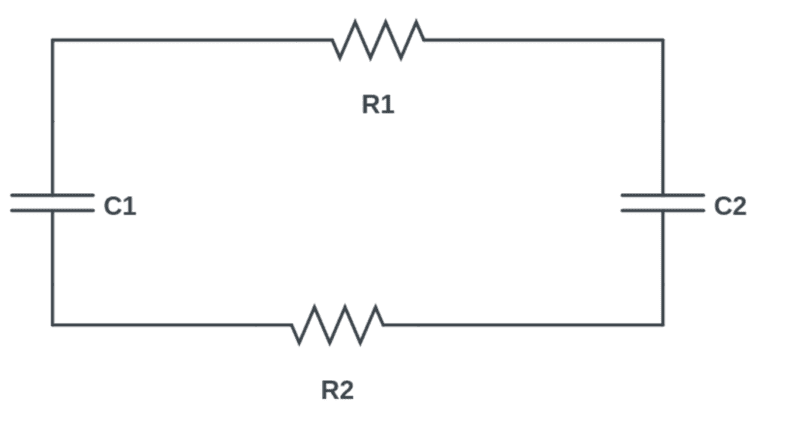
xxxxxxxxxxxxxxxxxxx.png


How I'm trying: The energy in each capacitor would be ##\frac{1}{2}CV_F^2## and this ##V_F## will be the same in both capacitor because there will be no current flowing once there's no moving charge. Ok, but how can I find this ##V_F##? I had no success on trying kirchhoff mesh law because I ended with two function of charge over time and couldn't solve the differential equation. $$\dfrac{Q_1(t)}{C_1} = (R_1+R_2)i(t) + \dfrac{Q_2(t)}{C_2}$$
Here is where I stopped, can't get any further than this.
 

Attachments

  • xxxxxxxxxxxxxxxxxxx.png
    xxxxxxxxxxxxxxxxxxx.png
    3.9 KB · Views: 534
  • xxxxxxxxxxxxxxxxxxx.png
    xxxxxxxxxxxxxxxxxxx.png
    3.8 KB · Views: 670
Physics news on Phys.org
Welcome to the PF.

(In the future, please use the Template you are provided when starting a new schoolwork thread. Thank you.)

Are you familiar with the differential equation that relates the current through a capacitor to the voltage across it? I would use that with either KCL or KVL to work toward the solution...
 
You need a relation between ##Q_1(t)## and ##Q_2(t)##. How do they relate to the current?
 
berkeman said:
Are you familiar with the differential equation that relates the current through a capacitor to the voltage across it?
Not really, I'm a bit confused.
Orodruin said:
You need a relation between ##Q_1(t)## and ##Q_2(t)##. How do they relate to the current?
The problem didn't gave me this information, I don't know how I can relate them.
 
Felipe Lincoln said:
Not really, I'm a bit confused.

The problem didn't gave me this information, I don't know how I can relate them.
The prolem should not need to.
 
I can relate one with other through the stored energy, but I don't think the energy conserves so I can use ##\frac{1}{2}Q_0^2/C_1 = \frac{1}{2}Q_1^2/C_1+\frac{1}{2}Q_2^2/C_2##. Is there another way that I'm missing?
 
Felipe Lincoln said:
Not really, I'm a bit confused.
Well, then following Orodruin's hints, are you familiar with the differential equation that relates the current through a capacitor to the change in the charge Q on that capacitor?

If not, how have you been doing other calculations on RC circuits up to now?
 
berkeman said:
Well, then following Orodruin's hints, are you familiar with the differential equation that relates the current through a capacitor to the change in the charge Q on that capacitor?

If not, how have you been doing other calculations on RC circuits up to now?
Hm.. I just know how to deduce each of them, V, Q and I and how to apply them into a trivial case, battery, resistor and capacitor. This is the first problem out of my preview experiences that I'm facing.
 
Have you taken any simple calculus? Do these equations look familiar?

i(t) = C \frac{dv(t)}{dt}

i(t) = \frac{dQ(t)}{dt}
 
  • #10
Yes, I took. And they are familiar. So, the current measured from one capacitor is the same as if I measure from the other, uh? I was thinking in them separately, oh god.
 
  • #11
Felipe Lincoln said:
So, the current measured from one capacitor is the same as if I measure from the other, uh?
Yes, and Orodruin's method is probably a little easier than using the equation that I first suggested. So you have the same current flowing around the whole circuit, which discharges one capacitor and charges the other until they reach the same voltage, when the current decays to zero. Can you try working with that?
 
  • #12
Sure! Let me see:
For the capacitor 2 we have a current:
$$ i(t) = C_2\dfrac{\mathrm{d}v_2(t)}{\mathrm{d}t} = C_2\dfrac{\mathrm{d}}{\mathrm{d}t}\left[ v_f(1-\mathrm{e}^{-t/RC_2})\right] = C_2\dfrac{v_f}{RC_2}\mathrm{e}^{-t/RC_2} = \dfrac{Q_f}{RC_2}\mathrm{e}^{-t/RC_2} $$
Being ##v_f## and ##Q_f## the voltage and charge this capacitor will have.
For the capacitor 1.
$$ \dfrac{\mathrm{d}Q_1(t)}{\mathrm{d}t} = \dfrac{\mathrm{d}}{\mathrm{d}t}\left[ Q_0\mathrm{e}^{-t/RC_1}\right] = -\dfrac{Q_0}{RC_1}\mathrm{e}^{-t/RC_1}$$
Now
$$ \dfrac{Q_f}{RC_2}\mathrm{e}^{-t/RC_2} = -\dfrac{Q_0}{RC_1}\mathrm{e}^{-t/RC_1}$$
$$ \dfrac{Q_f}{C_2}\mathrm{e}^{1/C_2} = -\dfrac{Q_0}{C_1}\mathrm{e}^{1/C_1}$$
$$ Q_f= -Q_0\dfrac{C_2}{C_1}\mathrm{e}^{C_2/C_1}$$

Is it right?
I have some basic questions.. What resistance should I consider when I'm writing my RC equations? The equivalent resistance between the capacitor terminals? And another even more fundamental, by the equations above, I see that the final charge in the capacitor 2 doesn't depends on the resistance of the circuit, which means that it conserves, I have the idea that if I lost energy on the resistor I'm losing charge, why is it not true?
 
  • #13
Felipe Lincoln said:
What resistance should I consider when I'm writing my RC equations?
I would just combine the 2 resistors into their series sum. The same current flows through both of them.
Felipe Lincoln said:
I see that the final charge in the capacitor 2 doesn't depends on the resistance of the circuit, which means that it conserves, I have the idea that if I lost energy on the resistor I'm losing charge,
Charge is conserved (there is nowhere else for it to go), but energy is not. This is very similar to the classic problem where you have 2 capacitors, one charged and one not. Then you connect them in parallel. Using Q=CV and the fact that charge is conserved, you can calculate the final voltage in terms of the initial charged cap's voltage. But then you are asked to use those values to calculate the initial and final energies E = 1/2 CV^2, and it turns out to be less than the initial energy. :smile:
 
  • #14
berkeman said:
This is very similar to the classic problem where you have 2 capacitors, one charged and one not. Then you connect them in parallel. Using Q=CV and the fact that charge is conserved, you can calculate the final voltage in terms of the initial charged cap's voltage. But then you are asked to use those values to calculate the initial and final energies E = 1/2 CV^2, and it turns out to be less than the initial energy. :smile:
http://www.users.on.net/~ithilien/tam/electronics/CapacitorParadox.html
 
  • Like
Likes   Reactions: Felipe Lincoln
  • #15
I'll read it, thanks for sharing your knowledge, and thank you too Orodruin, :biggrin:
 
  • Like
Likes   Reactions: berkeman

Similar threads

  • · Replies 6 ·
Replies
6
Views
3K
Replies
9
Views
2K
  • · Replies 4 ·
Replies
4
Views
2K
Replies
20
Views
2K
  • · Replies 30 ·
2
Replies
30
Views
3K
  • · Replies 4 ·
Replies
4
Views
2K
  • · Replies 1 ·
Replies
1
Views
2K
Replies
3
Views
2K
Replies
6
Views
1K
  • · Replies 11 ·
Replies
11
Views
3K