Analyzing AC Circuits: Finding Current and Thevenin Impedance

Click For Summary

Discussion Overview

The discussion revolves around analyzing an AC circuit to find the current through a capacitor and an inductor, as well as determining the Thevenin equivalent impedance between two points in the circuit. Participants are exploring calculations related to impedance, admittance, and the effects of reactive components in the circuit.

Discussion Character

  • Technical explanation
  • Mathematical reasoning
  • Debate/contested

Main Points Raised

  • One participant expresses uncertainty about their calculated phase difference for the capacitor current, suggesting it may be too high.
  • Another participant points out potential errors in the calculations for the capacitor and inductor currents, specifically regarding the assignment of angles in the calculations.
  • There is a question about whether to include the inductor when calculating the Thevenin equivalent impedance, with some participants suggesting that the resistor should also be considered.
  • One participant realizes they confused impedance and admittance in their calculations, leading to unexpected current values that exceed the initial current.
  • Another participant explains that in LC circuits, it is possible for voltages and currents to exceed input values due to energy storage and resonance effects.
  • There is a discussion about finding the equivalent impedance and the Thevenin equivalent, with clarifications requested on the definitions and differences between the two concepts.
  • A participant expresses confusion about the approach to beginning the problem and how to determine the voltage drop across the terminals.

Areas of Agreement / Disagreement

Participants do not reach a consensus on the calculations for the capacitor and inductor currents, as well as the proper approach to finding the Thevenin equivalent impedance. Multiple competing views remain regarding the inclusion of components in the calculations and the interpretation of circuit parameters.

Contextual Notes

Participants mention potential confusion between impedance and admittance, as well as the need to clarify the definitions of equivalent impedance and Thevenin equivalent. There are also indications of uncertainty regarding the voltage drops across components in the circuit.

dcrisci
Messages
45
Reaction score
0
Here I have a problem I am dealing with. I answered the question and have it shown on the picture but I would like a double check on it as I think I am getting wrong values. The circuit is shown at the top of the page. If you can't see the values are 10 ohms for the resistor, 3.2 mF for the capacitor, and 160 mH for the inductor. The question asks to find the current through the capacitor and the current through the inductor.

I think I am getting wrong values because for the current through the capacitor I am getting a phase difference of 185 degrees, which seems a little high for me.
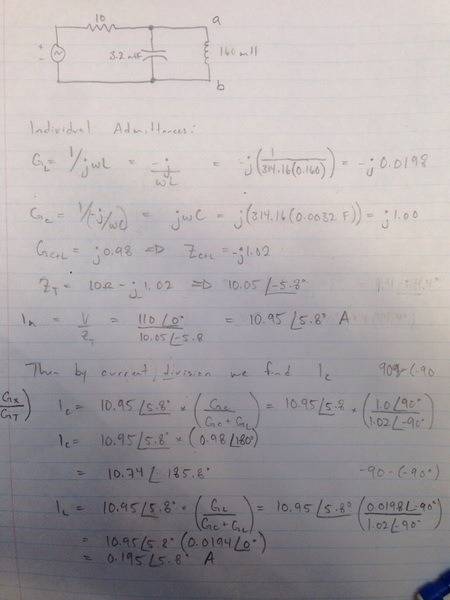
ImageUploadedByPhysics Forums1394059083.473237.jpg

Also the question also asks for the thevenins equivalent impedance through points a and b. Would we neglect the inductor in this case and the impedance would be only the resistor and capacitor? Or does the inductor need to be included?
 
Physics news on Phys.org
Your conductances and total current values look okay, but somethings gone awry in your calculations for the capacitor and inductor currents. For the capacitor, note that you found GC+L to be +j0.98 before, but have assigned a -90° angle to it in the cap current calculation.

For the inductor current calculation, check your math I think. I'm finding a different magnitude (slightly larger).
 
Actually for the last part. For finding the real and imaginary values for the thevenins equivalent impedance would it be the impedance of the inductor between the two terminals a and b? But in this case there would be no value for the real part of the equivalent impedance. If this is the case then I don't understand what kind of effect the resistor would have on the equivalent impedance
 
dcrisci said:
Actually for the last part. For finding the real and imaginary values for the thevenins equivalent impedance would it be the impedance of the inductor between the two terminals a and b? But in this case there would be no value for the real part of the equivalent impedance. If this is the case then I don't understand what kind of effect the resistor would have on the equivalent impedance

Looking "into" the circuit from a-b you will "see" the entire network including the resistor.

Use the usual method for finding the Thevenin equivalent: Determine the voltage across points a-b, and then suppress the source and find the impedance between points a-b.
 
gneill said:
Your conductances and total current values look okay, but somethings gone awry in your calculations for the capacitor and inductor currents. For the capacitor, note that you found GC+L to be +j0.98 before, but have assigned a -90° angle to it in the cap current calculation.
For the inductor current calculation, check your math I think. I'm finding a different magnitude (slightly larger).
Okay I will try this right now. I see what I did. I must've glanced both at the c+L impedance and admittance at the same time and mixed up my angles.
 
gneill said:
Looking "into" the circuit from a-b you will "see" the entire network including the resistor.
Use the usual method for finding the Thevenin equivalent: Determine the voltage across points a-b, and then suppress the source and find the impedance between points a-b.
Okay I'll try this out to and get back to you
 
gneill said:
Your conductances and total current values look okay, but somethings gone awry in your calculations for the capacitor and inductor currents. For the capacitor, note that you found GC+L to be +j0.98 before, but have assigned a -90° angle to it in the cap current calculation.
For the inductor current calculation, check your math I think. I'm finding a different magnitude (slightly larger).
Okay now I'm confused. I actually was using the impedance of C+L instead of the admittance in both calculations of the current flowing through the capacitor and inductor. Instead of G=j0.98 I was using Z=-j1.02 in the place of G[C+L]. Upon correcting this I obtained a value for the current flowing through the capacitor being larger than the initial voltage. Being 11.1 A, but the initial current is only 10.95A. What is going wrong here?
 
dcrisci said:
Okay now I'm confused. I actually was using the impedance of C+L instead of the admittance in both calculations of the current flowing through the capacitor and inductor. Instead of G=j0.98 I was using Z=-j1.02 in the place of G[C+L]. Upon correcting this I obtained a value for the current flowing through the capacitor being larger than the initial voltage. Being 11.1 A, but the initial current is only 10.95A. What is going wrong here?

Try summing the current phasors.

In LC circuits it's quite possible to have voltages and currents that exceed inputs. This is an effect of energy storage and trading by the reactive components. In other words, it's related to resonance.
 
gneill said:
Try summing the current phasors.
In LC circuits it's quite possible to have voltages and currents that exceed inputs. This is an effect of energy storage and trading by the reactive components. In other words, it's related to resonance.
Okay that makes me feel a bit better now hahah.

And my last thing. To find the equivalent impedance I'm finding the voltage through the terminals a and b so that would be equal to the voltage drop through the inductor? and that can be found by V = initial current / impedance of the inductor?

But would that give thevenins voltage right? This is only asking for the equivalent impedance so how would it relate to that
 
  • #10
dcrisci said:
Okay that makes me feel a bit better now hahah.

And my last thing. To find the equivalent impedance I'm finding the voltage through the terminals a and b so that would be equal to the voltage drop through the inductor? and that can be found by V = initial current / impedance of the inductor?

But would that give thevenins voltage right? This is only asking for the equivalent impedance so how would it relate to that

Can you clarify whether you want to find the equivalent impedance that the source sees, or the Thevenin equivalent for the source and network as seen across the terminals a-b? They are two different things.

The Thevenin equivalent would consist of a voltage source in series with an impedance, those being the so-called Thevenin Voltage and Thevenin Impedance. The equivalent impedance would be a single impedance value representing what the source "sees" as its net load.

A small technical point about jargon: Currents go though components, voltages (potential differences) are across components.
 
  • #11
gneill said:
Can you clarify whether you want to find the equivalent impedance that the source sees, or the Thevenin equivalent for the source and network as seen across the terminals a-b? They are two different things.
The Thevenin equivalent would consist of a voltage source in series with an impedance, those being the so-called Thevenin Voltage and Thevenin Impedance. The equivalent impedance would be a single impedance value representing what the source "sees" as its net load.
A small technical point about jargon: Currents go though components, voltages (potential differences) are across components.
https://www.physicsforums.com/attachments/67298
Edit: this picture didn't load so the question states "determine the real and imaginary part of the thevenin equivalent impedance of the circuit between points a and b"

The exact wording of the question. I assume it only means the thevenins equivalent for the source and network.

I just get really confused when it comes to beginning a question as every circuit is different and don't know how to approach it.

Let's say I want to simplify the whole thing (because this way it'll show me how to do it all) starting from the beginning I would want to find the voltage drop across the terminals. I don't know what this would be because I am unsure if it would only be the voltage across the inductor or the sum of the voltage drop across the inductor and the capacitor.

After the voltage drop I want to 'turn off' the source, so I'd neglect the voltage source and then calculate the impedance through the resistor and capacitor? Or all three components would be involved? If all three are involved wouldn't this just be equal
To the equivalent impedance of the circuit in its normal form?
 
  • #12
dcrisci said:
https://www.physicsforums.com/attachments/67298
Edit: this picture didn't load so the question states "determine the real and imaginary part of the thevenin equivalent impedance of the circuit between points a and b"

The exact wording of the question. I assume it only means the thevenins equivalent for the source and network.

I just get really confused when it comes to beginning a question as every circuit is different and don't know how to approach it.

Let's say I want to simplify the whole thing (because this way it'll show me how to do it all) starting from the beginning I would want to find the voltage drop across the terminals. I don't know what this would be because I am unsure if it would only be the voltage across the inductor or the sum of the voltage drop across the inductor and the capacitor.
It would be the potential across the points a-b, which is also the potential across the inductor, which is also the potential across the capacitor; The inductor and capacitor are in parallel so they must share the same potential difference.

After the voltage drop I want to 'turn off' the source, so I'd neglect the voltage source and then calculate the impedance through the resistor and capacitor? Or all three components would be involved?
All three are involved. To suppress a voltage source you replace it with a short circuit (a wire). To suppress a current source you replace it with an open circuit (remove the component completely).

If all three are involved wouldn't this just be equal
To the equivalent impedance of the circuit in its normal form?
Nope, because the equivalent impedance of the network is the net load that the source sees.

attachment.php?attachmentid=67299&stc=1&d=1394075764.gif


whereas, the Thevenin impedance is the equivalent "source" impedance that a load connected across terminals a-b would see.

attachment.php?attachmentid=67301&stc=1&d=1394076183.gif


According to your latest attachment, part (a) of the question addresses the Thevenin Equivalent Impedance of the circuit, where the output of the circuit is taken to be at terminals a and b. So the diagram immediately above suits that.
 

Attachments

  • Fig1.gif
    Fig1.gif
    3.1 KB · Views: 519
  • Fig2.gif
    Fig2.gif
    2.2 KB · Views: 547
  • #13
gneill said:
It would be the potential across the points a-b, which is also the potential across the inductor, which is also the potential across the capacitor; The inductor and capacitor are in parallel so they must share the same potential difference.


All three are involved. To suppress a voltage source you replace it with a short circuit (a wire). To suppress a current source you replace it with an open circuit (remove the component completely).


Nope, because the equivalent impedance of the network is the net load that the source sees.

attachment.php?attachmentid=67299&stc=1&d=1394075764.gif


whereas, the Thevenin impedance is the equivalent "source" impedance that a load connected across terminals a-b would see.

attachment.php?attachmentid=67301&stc=1&d=1394076183.gif


According to your latest attachment, part (a) of the question addresses the Thevenin Equivalent Impedance of the circuit, where the output of the circuit is taken to be at terminals a and b. So the diagram immediately above suits that.

Sorry I did not get back to you til now. But this helped me out so much, I used this this morning and approached my teacher to see if I did it correctly and other than a few minor calculation mistakes he said I actually did it right!
 

Similar threads

  • · Replies 2 ·
Replies
2
Views
923
  • · Replies 1 ·
Replies
1
Views
2K
  • · Replies 9 ·
Replies
9
Views
863
  • · Replies 4 ·
Replies
4
Views
2K
  • · Replies 7 ·
Replies
7
Views
3K
  • · Replies 3 ·
Replies
3
Views
3K
  • · Replies 1 ·
Replies
1
Views
2K
  • · Replies 3 ·
Replies
3
Views
4K
  • · Replies 2 ·
Replies
2
Views
2K
  • · Replies 6 ·
Replies
6
Views
3K