Analyzing Reactions of a Pin and Bracket Supported System

Click For Summary

Discussion Overview

The discussion revolves around analyzing the reactions in a pin and bracket supported system involving a cable and a pulley. Participants explore the calculations of tension, reactions at the hinge, and the geometry of the system as the pulley moves. The scope includes analytical approaches and computational methods using software like MATLAB and Excel.

Discussion Character

  • Technical explanation
  • Mathematical reasoning
  • Debate/contested

Main Points Raised

  • Member ABC is supported by a pin and bracket at C and by a cable over a pulley, with various forces acting on it, including a vertical load P.
  • Some participants propose calculating the tension T in the cable and the reactions at hinge C as functions of the distance s.
  • There is uncertainty about how to approach the problem, particularly regarding the geometry and the movement of the pulley.
  • One participant mentions breaking down the force P into its X and Y components and questions how to account for the cable's geometry.
  • Another participant suggests that the member must pivot around C to maintain tension in the cable as the pulley moves.
  • There is a discussion about whether the member remains horizontal or if the pulley moves vertically as well, which affects the geometry of the system.
  • One participant expresses a need for assistance in deriving equations for the system to implement in MATLAB.

Areas of Agreement / Disagreement

Participants express differing views on the movement of the member and the pulley, leading to unresolved questions about the system's behavior and geometry. There is no consensus on the approach to take for the calculations.

Contextual Notes

Participants note the complexity of the geometry involved and the potential need for additional clarifications regarding the assumptions about the movement of the pulley and the member.

Who May Find This Useful

Individuals interested in mechanics, structural analysis, or those working on similar engineering problems may find this discussion relevant.

mannyk29
Messages
3
Reaction score
0
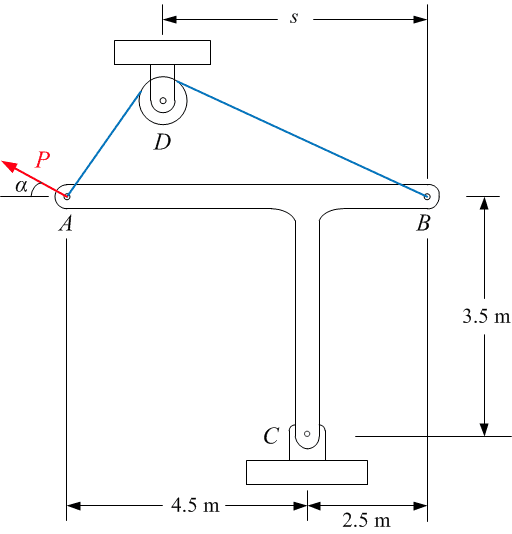
Member ABC is supported by a pin and bracket at C and by an inextensible cable of length
L  7.8 m that is attached at A and B and passes over a frictionless pulley at D. Assuming
P  450 N and   35 and neglecting the mass of ABC and the radius of the pulley, simplify
the problem as much as possible analytically and, for 0  s  6 m, use MS Excel and/or
MATLAB to:
(a) Calculate and plot the tension T in the cable as a function of s ;
(b) Calculate and plot the magnitude of reactions x C and y C at hinge C as a function of s ;
(c) Calculate and plot the magnitude of the reaction at hinge C as a function of s ;
(d) Calculate and plot the angle  of the reaction at hinge C (with respect to +x-axis) as a
function of s ;
(e) Determine the maximum tension max T and the corresponding value of s ;
(f) Determine the (absolute) maximum reactions x C & y C and the corresponding values of s ;
(g) Determine the (absolute) maximum reaction C and the corresponding value of s;
(h) If it exists, determine the value of s at which x y C  C and the corresponding value of y C .
upload_2014-10-13_20-27-39.png
I don't know how to approach this. I think I should look at it when s=0 because it is then a right triangle. I have been told that the member does not move and that only the pulley moves from s=0 to s=6. I continued on after doing some reading and looked at the moment about C and without in cluding tension its a lil over 2100 Nm. Also I broke up P into X and Y components, now the rope of known length is attached to body at 2 points. do i count it twice? If so how do I get the angle it forms at A??
 
Last edited:
Physics news on Phys.org
Hi mannyk29! http://img96.imageshack.us/img96/5725/red5e5etimes5e5e45e5e25.gif

If the T-member did not rotate at all, the the rope would go slack as the pulley moves horizontally to the right. So I expect what you'll find is that the member pivots around C in order to keep the rope taut. Force P, tending to lift end A, ensures there is tension in the rope and this adjusts the shape of ΔABD to maintain a triangle having a fixed perimeter, fixed at whatever it is as you see it pictured now.
 
Last edited by a moderator:
Please note: I have adjusted the thread title to better reflect its content - gneill
 
Thanlk you for the welcome! I can certainly agree with that. could you please show me how I would get the equations for this? I need to get an understanding because I also need to enter this into MATLAB once I solve it.
 
NascentOxygen said:
Hi mannyk29! http://img96.imageshack.us/img96/5725/red5e5etimes5e5e45e5e25.gif

If the T-member did not rotate at all, the the rope would go slack as the pulley moves horizontally to the right. So I expect what you'll find is that the member pivots around C in order to keep the rope taut. Force P, tending to lift end A, ensures there is tension in the rope and this adjusts the shape of ΔABD to maintain a triangle having a fixed perimeter, fixed at whatever it is as you see it pictured now.
I double checked about that and I was told it doesn't move. However I was able to solve for tension at s=3.5 drawing a vertical line creating 2 right triangles. now my final issue is how do I write the tension in terms of S? please help. my time limit for this is getting down to the wire
 
Last edited by a moderator:
You checked with your lecturer and were told that AB remains horizontal? I would have expected this to be made clear, either on the diagram or in the accompanying text.

If that is so, then what needs to happen is that the pulley moves vertically as well as horizontally. With AB remaining horizontal, geometry dictates that the pulley when above the middle of AB needs to be about 1 metre more distant from AB than when the pulley is near A or B.

If our observations commence with the pulley positioned above B, then as it moves towards A the member will be held stable up until a point is reached by the pulley which sees the beam begin to rotate. You could label this distance from B as Smax.

We'll have to hope someone else can help you with this, I'm afraid I've lost my way in the algebra for this arrangement.
 
Thread has been closed by OP request.
 

Similar threads

  • · Replies 1 ·
Replies
1
Views
3K
Replies
7
Views
3K
  • · Replies 6 ·
Replies
6
Views
3K
  • · Replies 17 ·
Replies
17
Views
3K
  • · Replies 6 ·
Replies
6
Views
3K
  • · Replies 2 ·
Replies
2
Views
10K
  • · Replies 3 ·
Replies
3
Views
2K
Replies
1
Views
2K
  • · Replies 1 ·
Replies
1
Views
2K
  • · Replies 4 ·
Replies
4
Views
4K