Angle of repose - Trying to understand the formula

Click For Summary

Discussion Overview

The discussion revolves around the concept of the angle of repose and the associated friction forces acting on an object on an inclined plane. Participants explore the relationship between the angle of the slope, friction force, and the conditions under which an object begins to slide.

Discussion Character

  • Technical explanation
  • Conceptual clarification
  • Debate/contested

Main Points Raised

  • One participant expresses confusion regarding the formula for friction force, suggesting it contradicts their understanding of how friction behaves as the slope increases.
  • Another participant clarifies that the friction force is calculated as Fr = W x sin(phi) for an object that does not slide, indicating that friction does indeed increase with the slope until a maximum is reached.
  • It is noted that gravity pulls the object down the slope with a force of mg sin(phi), which is countered by the friction force acting upwards along the slope.
  • Participants discuss the transition from static to sliding friction, emphasizing that static friction can vary up to a maximum value, while sliding friction is considered constant under specific conditions.
  • One participant mentions the variability of sliding friction due to real surface irregularities, suggesting that it may not be a fixed magnitude in practice.

Areas of Agreement / Disagreement

Participants exhibit some agreement on the mechanics of friction and the definitions of static and sliding friction, but there remains confusion and differing interpretations regarding the implications of the friction formula and the behavior of friction as the slope increases.

Contextual Notes

There are unresolved assumptions regarding the definitions of friction forces and the conditions under which they apply, particularly in relation to the transition from static to sliding friction.

k.udhay
Messages
167
Reaction score
13
I recently posted a question on similar line and got few good explanations as well. Still, I am unable to understand clearly. Hence I am going more specific this time.

In the given picture taken from internet, friction force acting between an inclined plane and an object is defined as Fr = W x sin (phi).

Does it mean the friction force (acting upwards!) increases with slope of the gradient? In practice, the object starts falling down as the slope increases. That should mean that the friction force reduces with slope, shouldn't it? I feel the formula and actual are contradicting. Though, I am sure I am mistaken somewhere. Pl. help. Thanks.
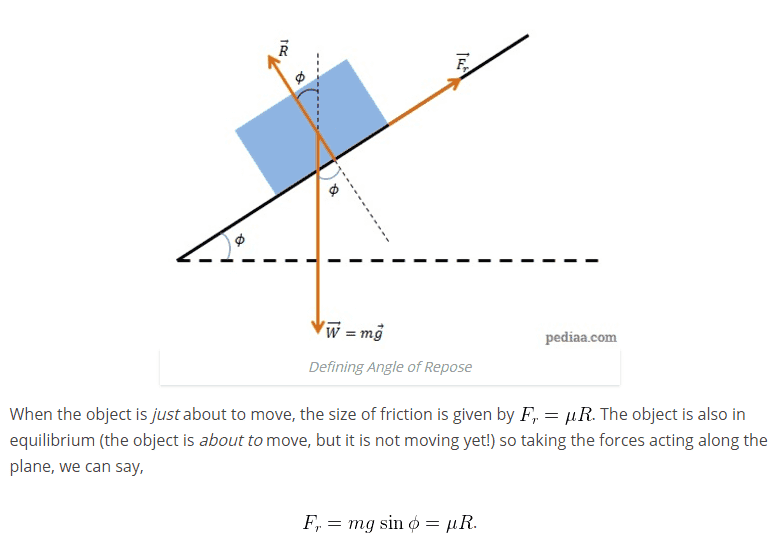
upload_2016-11-7_21-48-26.png


@haruspex @mike.Albert99 @sophiecentaur
 
Physics news on Phys.org
Let's try to be precise, then:

k.udhay said:
In the given picture taken from internet, friction force acting between an inclined plane and an object is defined as Fr = W x sin (phi)
Should be:
friction force acting between an inclined plane and an object that does not slide is calculated to be as Fr = W x sin (phi)
k.udhay said:
Does it mean the friction force (acting upwards!) increases with slope of the gradient?
That is correct. ##\ \phi = 0 \ \Rightarrow \ F_{\rm friction} = 0##
You can see it from Fr = W x sin (phi) as well.

k.udhay said:
That should mean that the friction force reduces with slope, shouldn't it?
No. Gravity is pulling downwards along the plane with a force ##mg\;\sin\phi##. As long as the block doesn't start sliding, this downward pulling component of gravity is offset by the friction force, which is acting in an upward direction along the slope.

If you gradually increase the angle, there comes a moment when the maximum friction force ##\mu \;mg\;{\bf \cos} \phi## is reached and for any ##\phi## above that the block will slide.

At this maximum ##\phi## you can write ## \mu \;mg\;{\bf \cos} \phi + (-\;mg\; \sin \phi ) = 0 \ \Rightarrow \ \mu = \tan\phi_{\rm max}\ ##

With the minus sign I indicate the force is acting in a direction opposite the ##\mu \;mg\;{\bf \cos} \phi##, i.e. I choose downward along the plane as positive.

[edit] Sorry -- someone should have corrected this:
With the minus sign I indicate the force ##\;mg\; \sin \phi\ ## from gravity is acting in a direction opposite the force ##\mu \;mg\;{\bf \cos} \phi## from friction, i.e. I choose upward along the plane as positive, and I take the numerical value of ##g## as positive.
 
Last edited:
To expand now with less precision, yes the force of friction changes with the applied forces to prevent motion right up to the point that the required force exceeds the maximum possible force as indicated by the coefficient of static friction. At that point the box slips and the force of friction drops to the "constant" value of sliding friction. (Constant in quotes because real surfaces are irregular and the force of sliding friction will vary as the conditions vary while sliding.). So sliding friction is a force of a fixed magnitude (in fixed conditions), but static friction is a force of constraint (there's a correct term, but I can't think of it) taking on any value necessary to oppose motion (up to a maximum). So is the normal force in this problem, by the way.
 
mike.Albert99 said:
To expand now with less precision, yes the force of friction changes with the applied forces to prevent motion right up to the point that the required force exceeds the maximum possible force as indicated by the coefficient of static friction. At that point the box slips and the force of friction drops to the "constant" value of sliding friction. (Constant in quotes because real surfaces are irregular and the force of sliding friction will vary as the conditions vary while sliding.). So sliding friction is a force of a fixed magnitude (in fixed conditions), but static friction is a force of constraint (there's a correct term, but I can't think of it) taking on any value necessary to oppose motion (up to a maximum). So is the normal force in this problem, by the way.
That's all good.
 

Similar threads

  • · Replies 12 ·
Replies
12
Views
12K
  • · Replies 37 ·
2
Replies
37
Views
5K
  • · Replies 25 ·
Replies
25
Views
3K
  • · Replies 24 ·
Replies
24
Views
5K
  • · Replies 20 ·
Replies
20
Views
5K
  • · Replies 10 ·
Replies
10
Views
2K
  • · Replies 6 ·
Replies
6
Views
2K
  • · Replies 5 ·
Replies
5
Views
3K
  • · Replies 4 ·
Replies
4
Views
13K
  • · Replies 4 ·
Replies
4
Views
3K