Another angle of "Why do you need a line 2 on a circuit?"

Click For Summary
SUMMARY

The discussion centers on the necessity of having both line 1 and line 2 in an alternating current (AC) circuit, as highlighted by user anorlunda's explanation that current cannot leave the power source on line 1 without an equal return on line 2. The analogy of current as a bicycle chain, presented by phinds, emphasizes that all current must move simultaneously. The conversation explores the underlying physics, questioning whether a single wire can carry current in two directions and the implications of charge imbalance in conductors. Ultimately, it concludes that without a potential difference, neither AC nor direct current (DC) circuits can function as proposed in the user's diagrams.

PREREQUISITES
  • Understanding of alternating current (AC) and direct current (DC) circuits
  • Basic knowledge of electrical potential difference (voltage)
  • Familiarity with electrical resistance and its role in circuits
  • Concept of charge imbalance in conductors
NEXT STEPS
  • Research the principles of AC and DC circuit design
  • Study the concept of electrical potential difference and its effects on current flow
  • Learn about charge distribution in conductors and its implications for circuit functionality
  • Explore analogies in electrical circuits, such as water flow, to deepen understanding
USEFUL FOR

Electrical engineering students, hobbyists working with circuits, and anyone interested in understanding the fundamental principles of alternating current and its requirements.

timmeister37
Messages
124
Reaction score
25
TL;DR
On an AC circuit, current won't leave the power source on line 1 unless the same amount of current returns to the power source on line 2 instantaneously. Someone else told me that current is like a bicycle chain, either all of it moves or none of it moves. Why cannot some current move without all of it moving?
I know that on an alternating current circuit, you have to have both a line 1 and a line 2 to have a circuit. Here is a pictorial diagram of an alternating current circuit:
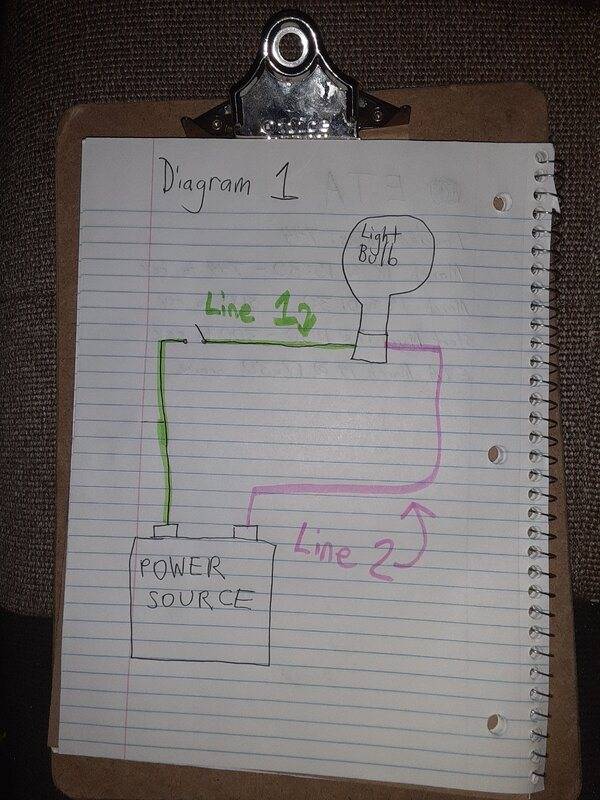
Circuit Diagram 1.jpg


In a previous thread, I asked why would an AC circuit like in Diagram 2 not work? Here is a photograph of diagram 2:
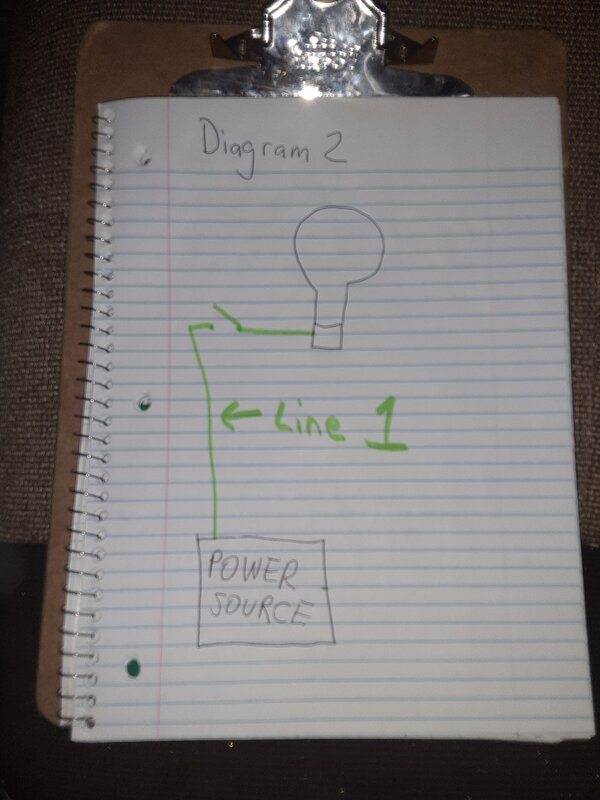
Circuit Diagram 2.jpg


In my previous thread "Why do you need a line 2 on an AC circuit" , PF member anorlunda told me that an AC circuit like in Diagram 2 would not work because on an AC circuit, current won't leave the power source on line 1 unless the same amount of current returns to the power source on line 2 instantaneously. phinds told me that current is like a bicycle chain: either all of it moves or none of it moves.

My previous thread "Why do you need a line 2 on an AC circuit" was closed before I could fully understand this. Why cannot current not act like a bicycle chain? Why cannot some current move WITHOUT all current moving? I'm trying to understand this at a very deep level.

I have no formal training in physics and chemistry beyond high school courses that I took 20+ years ago. So please understand that when you answer my thread.

Is there some law of physics or chemistry that binds electrons together so that current is like a bicycle chain, either all of it moves or none of it moves? If there is such a law, what is the name of this law of physics or chemistry?
 
Engineering news on Phys.org
Two equivalent electrons cannot be in the same location. If you push an electron into a conductor you are pushing the electron into a atomic orbital with existing electron which then pushes its way into another atom and so forth until the last atom, then where does it go? In a radio transmitter antenna, AC electrons release their energy into light energy (radio waves). Ground is the concept that the Earth is one huge conductor that can absorb electrons or energy. One line circuits like antennas are usually referenced to ground which completes the circuit.
 
  • Like
Likes russ_watters
shjacks45 said:
Two equivalent electrons cannot be in the same location. If you push an electron into a conductor you are pushing the electron into a atomic orbital with existing electron which then pushes its way into another atom and so forth until the last atom, then where does it go? In a radio transmitter antenna, AC electrons release their energy into light energy (radio waves). Ground is the concept that the Earth is one huge conductor that can absorb electrons or energy. One line circuits like antennas are usually referenced to ground which completes the circuit.

I appreciate your effort, but I still don't understand why on a circuit, some current cannot move without all the current moving.
 
If you have more of a mechanical mind, you can replace the battery with two tanks, one filled with pressurized water (negative side), the other one empty (positive side). The lines can be replaced with pipes and the light with a turbine.

The goal is to transfer the pressurized water from the first tank to the empty one. So they must be somehow connected together. As soon as you connect them together, the water will transfer by itself from the pressurized tank to the empty one by creating a current in the pipe, until the water stabilized to the same pressure in both tanks.

The turbine is put somewhere on the pipe (splitting it into two pipes, one connected to each tank). The turbine creates a resistance and the moving water turns the turbine.

Now replace the droplets of water with electrons and you essentially have an electrical circuit.

Can you move one droplet of water without moving the one besides it? Pretty much impossible. When one moves, it pushes the one next to it until the one close to the empty tank fall into the empty tank.
 
  • Like
Likes russ_watters
jack action said:
If you have more of a mechanical mind, you can replace the battery with two tanks, one filled with pressurized water (negative side), the other one empty (positive side). The lines can be replaced with pipes and the light with a turbine.

The goal is to transfer the pressurized water from the first tank to the empty one. So they must be somehow connected together. As soon as you connect them together, the water will transfer by itself from the pressurized tank to the empty one by creating a current in the pipe, until the water stabilized to the same pressure in both tanks.

The turbine is put somewhere on the pipe (splitting it into two pipes, one connected to each tank). The turbine creates a resistance and the moving water turns the turbine.

Now replace the droplets of water with electrons and you essentially have an electrical circuit.

Can you move one droplet of water without moving the one besides it? Pretty much impossible. When one moves, it pushes the one next to it until the one close to the empty tank fall into the empty tank.

I don't believe that the answer is that it is simple mechanical force that makes it so that current is like a bicycle chain.
 
Personally I think it is much simpler than discussing electron orbital...

Consider a conductor where charge ( electrons) move in only one area ( so not uniformly around a circuit)... what is the result? A charge imbalance.. what does that charge imbalance do? It works to keep all of the charge uniform in the conductor, so a force is created to restore the uniform distribution of the charge.

There are exceptions BUT in circuit ( a roughly circular line, route, or movement that starts and finishes at the same place ) analysis we generally do not consider them.
 
As I told you in one of your other threads and in a PM, a single wire cannot carry current in two directions, it simply has a net current. Saying that a wire can have two different currents at the same time, rather than a sum of currents, is exactly like saying that a point in a circuit can have two different voltages at the same time instead of a sum of voltages.

Thus, your trying to use a single wire to carry current out and current back at the same time just doesn't work.
 
timmeister37 said:
I don't believe that the answer is that it is simple mechanical force that makes it so that current is like a bicycle chain.
Have you ever worked on an automobile? The radiator has two pipes, one for in and one for out.
Same reason here.
i
 
phinds said:
As I told you in one of your other threads and in a PM, a single wire cannot carry current in two directions, it simply has a net current. Saying that a wire can have two different currents at the same time, rather than a sum of currents, is exactly like saying that a point in a circuit can have two different voltages at the same time instead of a sum of voltages.

Thus, your trying to use a single wire to carry current out and current back at the same time just doesn't work.

You're just begging the question. In other words, you are using circular reasoning.

timmeister37: Why cannot an AC circuit function as a circuit with just a line 1 and without a line 2 with the electrons traveling from the power source to the load for 1/60th of a second, and then from the load back to the power source for the next 1/60th second?

Phinds: Because current is like a bicycle chain. EIther all of it moves or none of it moves.

timmeister37: Why is current like a bicycle chain with it all either moving or all not moving at the same time?

phinds: Because a single wire cannot carry current in two directions.

timmeister37: Why cannot a single wire carry current in two directions?

phinds: Current is like a bicycle chain. It either all moves or none of it moves.

__________________________________________________________________________________________

You are not getting to any underlying cause.
 
  • #10
timmeister37 said:
You're just begging the question. In other words, you are using circular reasoning.
Can a water pipe carry water in two directions at once??
Same reason.
 
  • #11
hutchphd said:
Can a water pipe carry water in two directions at once??
Same reason.
I disagree with you. But I just realized the answer to this. Next post will have answer.
 
  • #12
No. I don't have the answer to this lol---sorry----I truly thought i had the answer but i don't
 
  • #13
hutchphd said:
Can a water pipe carry water in two directions at once??
Same reason.

It does not have to be at the same time!
 
  • #14
timmeister37 said:
It does not have to be at the same time!
Now I'M beginning to agree that you are a troll.
 
  • Like
Likes davenn and Vanadium 50
  • #15
So if it is direct current you see that it is impossible?
 
  • #16
Hold on.

You cannot have a AC circuit like my diagram 2 because there is no potential difference to induce the current.

I'm not sure if this explains why current is like a bicycle chain though.
 
  • #17
hutchphd said:
So if it is direct current you see that it is impossible?

You cannot have a DC circuit like my diagram 2 or an AC circuit like my diagram 2 because there is no potential difference to induce the current.
 
  • #18
It is not like a bicycle chain. It is like an electrical current! All similes are flawed.
 
  • Like
Likes timmeister37
  • #19
hutchphd said:
It is not like a bicycle chain. It is like an electrical current! All similes are flawed.
Do you agree with my post #17?
 
  • #20
Depending on the details yes.
 
  • #21
In my diagram 2, I now think that the fact that there is nothing to induce the current in my diagram 2 ENTIRELY explains why you cannot have either a DC circuit or an AC circuit like my diagram 2.

No analogy with bicycle chains is necessary to understand this entirely.
 
  • Like
Likes hutchphd
  • #22
If you have an AC current, the only difference is that the "pressure" never stabilize. The liquid goes from the pressurized tank to the empty tank until the second tank is fully pressurized and the the first tank is empty. Then the cycle works in reverse, with the current going in the other direction. The potential difference (voltage) is equivalent to the pressure difference between the tanks.

Analogy-to-water-tank.jpg

timmeister37 said:
hutchphd said:
Can a water pipe carry water in two directions at once??
Same reason.

It does not have to be at the same time!

If it is not at the same time, then where do the water (electrons) go? You cannot store electrons in a resistance (the light bulb in your drawings). A resistance is essentially a pipe of smaller diameter. If it was a capacitor, you could. A capacitor is essentially a tank with a energy storage mechanism (usually represented by an elastic membrane, see image below).

main-qimg-bdf229c924ef0b44e550acbdf4b2fe02.png
 
  • #23
hutchphd said:
Can a water pipe carry water in two directions at once??

And he wants to be a plumber.
 
  • Haha
  • Like
Likes phinds and timmeister37
  • #24
timmeister37 said:
I appreciate your effort, but I still don't understand why on a circuit, some current cannot move without all the current moving.
Well strictly speaking, some current *can* and does move without all the current moving -- for a short time. When you flip a switch, the current starts flowing in a wave. The wave flows through the wire, where in front of it there is no current and behind it, there is current.

I know if you go deep there are QM explanations that differ from the mechanical, but I really like the water and valve analogy for this. In a pipe, water starts flowing when you open a valve, in pretty much exactly the same way. And it can't continue to be an uneven flow because the water can't accumulate anywhere in the pipe unless the pipe expands.

This part really should be self-evident and I have no idea what it is that you are thinking that is causing you to not accept it. You're telling us we're not explaining, but really it is you who needs to explain exactly what it is about the explanations you have gotten that you are having trouble with. For example, where do you think the current could be going? This would help us figure out what your issue is. Again, for example, a common misunderstanding is that some people think current/electrons are being consumed in the light bulb. Do you hold that misunderstanding?

Now, there can be an open circuit of water or electricity when you have a large source or sink. But there still needs to be two wires connected to the load to have water/electricity flowing through it from one reservoir to another.
 
  • #25
timmeister37 said:
I don't believe that the answer is that it is simple mechanical force that makes it so that current is like a bicycle chain.
This response is not acceptable. It is a requirement of PF that you make an effort to make the thread productive, and this is not sufficient. You need to explain what you are having trouble with. Otherwise, this thread will need to be closed, for the same reason as the others; your approach here is unproductive.
 
  • #26
Current through a surface in the wire, with arbitrarily oriented unit vector to the surface ##\hat{n}##, is the surface integral of ##\vec{J} \cdot \hat{n} dS##. This is the net charge per second through that surface, in the direction of ##\hat{n}##. Theoretically it could consist of positive charges moving one way, negatives the other, a mixture of both (think of an electrolytic cell), but in all cases the individual charges will move down a gradient of their individual electric potential energy. At all points in a wire, current is defined by a single scalar ##I## and a reference direction ##\hat{n}##.

I don't know why you make such a fuss over this. Just go with the flow, man.
 
  • #27
When I
russ_watters said:
This response is not acceptable. It is a requirement of PF that you make an effort to make the thread productive, and this is not sufficient. You need to explain what you are having trouble with. Otherwise, this thread will need to be closed, for the same reason as the others; your approach here is unproductive.
The thread can be closed. I'm through with the thread. When I remembered that you cannot have a circuit in my diagram 2 because there is no potential difference, I was through with the thread and knew all I sought to know.
 
  • #28
timmeister37 said:
When I
The thread can be closed. I'm through with the thread. When I remembered that you cannot have a circuit in my diagram 2 because there is no potential difference, I was through with the thread and knew all I sought to know.
Fair enough, thread closed. But please keep what I said in mind for future participation at PF.

[edit] Also, let's put a fork in this entire line of discussion. Do not post any more threads on this topic.
 
  • Like
Likes davenn, berkeman, DaveE and 1 other person

Similar threads

Replies
13
Views
2K
  • · Replies 22 ·
Replies
22
Views
2K
  • · Replies 39 ·
2
Replies
39
Views
4K
  • · Replies 7 ·
Replies
7
Views
2K
Replies
12
Views
3K
  • · Replies 1 ·
Replies
1
Views
746
  • · Replies 3 ·
Replies
3
Views
2K
Replies
8
Views
3K
Replies
3
Views
2K
Replies
20
Views
2K