Another Double Check FBD String Tension

Click For Summary
The discussion focuses on calculating the tension in a cable connecting two masses, m1 (5 kg) and m2 (6 kg), on frictionless surfaces at angles θ1 (60°) and θ2 (70°). The equations derived show that the tension (FT) is influenced by the gravitational force and the acceleration of the masses. After setting the equations equal, the acceleration is determined to be 1.16 m/s², leading to a final tension of 48.2 N in the cable. Concerns are raised about using the same variable names for different mass quantities, but clarification is provided that FT and acceleration can be consistently used across both masses. The calculations and results are confirmed to be correct.
Inferior Mind
Messages
14
Reaction score
0
Calculate the tension in the cable connecting the two masses. Assume all surfaces are frictionless.

FBD
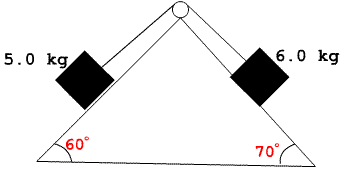
Physics Question 4 U1-C.gif


m1 = 5 kg
θ1 = 60°
m2 = 6 kg
θ2 = 70°

Equation 1 ~

FT - Fg = ma

FT - mgSinθ = ma

FT = 5a + 5(9.8)Sin60

FT = 5a + 42.44

Equation 2 ~

Fg - FT = ma

mgSinθ - FT = ma

6(9.8)Sin70 - 6a = FT

FT = 55.25 - 6a

~Set Equations Equal to Each Other ~

5a + 42.44 = 55.25 - 6a

11a = 12.81

a = 1.16 m/s2

~Sub into Eq to find Force Tension on da String Son !~

5(1.16) + 5(9.8)Sin60 = FT

FT = 48.2 N
 
Physics news on Phys.org
Inferior Mind said:
Calculate the tension in the cable connecting the two masses. Assume all surfaces are frictionless.

FBD
View attachment 55356

m1 = 5 kg
θ1 = 60°
m2 = 6 kg
θ2 = 70°

Equation 1 ~

FT - Fg = ma

FT - mgSinθ = ma

FT = 5a + 5(9.8)Sin60

FT = 5a + 42.44

Equation 2 ~

Fg - FT = ma

mgSinθ - FT = ma

6(9.8)Sin70 - 6a = FT

FT = 55.25 - 6a

~Set Equations Equal to Each Other ~

5a + 42.44 = 55.25 - 6a

11a = 12.81

a = 1.16 m/s2

~Sub into Eq to find Force Tension on da String Son !~

5(1.16) + 5(9.8)Sin60 = FT

FT = 48.2 N
The results looks correct.

Comment: If I were grading this, I would be concerned that you are using the same variable names for mass 1 quantities and mass 2 quantities, particularly Fg and m .
 
SammyS said:
The results looks correct.

Comment: If I were grading this, I would be concerned that you are using the same variable names for mass 1 quantities and mass 2 quantities, particularly Fg and m .

Thanks for the input, I will make amends in future questions.
 
Inferior Mind said:
Thanks for the input, I will make amends in future questions.
To be more specific: FT and a are the same in magnitude for both masses, so it's fine to use the same variable name for them.
 
Last edited:
The book claims the answer is that all the magnitudes are the same because "the gravitational force on the penguin is the same". I'm having trouble understanding this. I thought the buoyant force was equal to the weight of the fluid displaced. Weight depends on mass which depends on density. Therefore, due to the differing densities the buoyant force will be different in each case? Is this incorrect?

Similar threads

  • · Replies 3 ·
Replies
3
Views
2K
Replies
27
Views
4K
  • · Replies 9 ·
Replies
9
Views
2K
  • · Replies 6 ·
Replies
6
Views
3K
  • · Replies 1 ·
Replies
1
Views
4K
  • · Replies 2 ·
Replies
2
Views
7K
  • · Replies 15 ·
Replies
15
Views
4K
Replies
6
Views
4K
Replies
1
Views
2K
Replies
24
Views
3K