Another Thermo First Law Question

Join the discussion
Ask a follow-up here, or get your own question answered by working scientists, mathematicians and engineers — people, not an autocomplete.
Real named experts · corrections over time · the nuance an AI answer skips
11 replies · 3K views
DrVirz
Messages
24
Reaction score
0
Hi all,

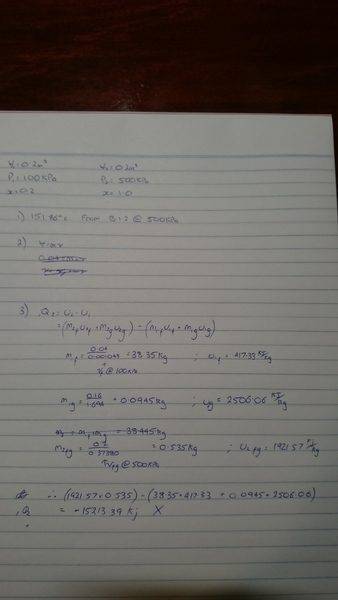
I have another thermo q I am stuck on. You can see the question and my attempted answer below. Part 1 is fine, Part 2 i don't know where to start, and part 3 I thought was correct however the answer is wrong! I think I am doing something wrong with the U2 part of internal energy, just not sure how to correct it. Am I right in taking the values of vfg and ufg @500kPa, as it is a saturated gas?

Thanks!
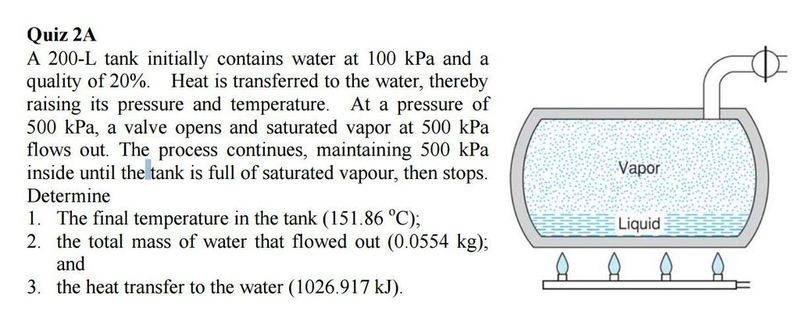
Capture_zpsjdmzgkvn.jpg


DSC_0160_zpsmnarft7d.jpg
 
Physics news on Phys.org
Yes I am using steam tables. So the mass of the water at State 1 is simply Volume/Specific Volume... 0.04/0.001043= 38.351kg

Mass of the sat. vapor at state 1 is 0.16/1.694 = 0.0945

What I would then do is find the mass of the sat. vapor when the tank is full @ 500 kPa, i.e 0.2/37380 ... Then minus this from the summation of the above answers which would give the difference in mass in the tank at the 2 states? It is not correct though.

I think I may be understanding the question wrong. I am assuming at state 2 there is ONLY sat vapor, no liquid?
 
DrVirz said:
Yes I am using steam tables. So the mass of the water at State 1 is simply Volume/Specific Volume... 0.04/0.001043= 38.351kg

Mass of the sat. vapor at state 1 is 0.16/1.694 = 0.0945

This is not quite right. Steam quality is defined in terms of mass fraction, not volume fraction. Please try again.
What I would then do is find the mass of the sat. vapor when the tank is full @ 500 kPa, i.e 0.2/37380 ... Then minus this from the summation of the above answers which would give the difference in mass in the tank at the 2 states? It is not correct though.
This is the correct approach.
I think I may be understanding the question wrong. I am assuming at state 2 there is ONLY sat vapor, no liquid?
This is correct. See the problem statement.

Chet
 
Ok, so.

I find the specific volume of the mixture (0.001044+0.2(1.67185)) = 0.335414 m3/kg

Then, the total mass of the mixture (0.2/0.335414) = 0.59627 kg

Therefore the mass of the water should be 0.2 x 0.59627 = 0.1192 kg

Which is still not correct :S
 
DrVirz said:
Ok, so.

I find the specific volume of the mixture (0.001044+0.2(1.67185)) = 0.335414 m3/kg

Then, the total mass of the mixture (0.2/0.335414) = 0.59627 kg

Therefore the mass of the water should be 0.2 x 0.59627 = 0.1192 kg

Which is still not correct :S
You multiplied the gas specific volume by 0.2 rather than the liquid specific volume, and you forgot to multiply one of the volumes by 0.8.

Chet
 
Chestermiller said:
You multiplied the gas specific volume by 0.2 rather than the liquid specific volume, and you forgot to multiply one of the volumes by 0.8.

Chet

Sorry but this has confused me. In the first part I multiplied the evap. specific vol by 0.2?

And in the last part i multiplied the total mass by 0.2?
 
DrVirz said:
Sorry but this has confused me. In the first part I multiplied the evap. specific vol by 0.2?

And in the last part i multiplied the total mass by 0.2?
specific volume of the mixture ((0.2)0.001044+(0.8)(1.67185))=1.378 m^3/kg
Total Mass of water in tank = 0.2/1.378=0.1495 kg
Mass of liquid water in tank = 0.0299 kg
Mass of water vapor in tank = 0.1196 kg

Next step is to figure out the final mass of saturated water vapor remaining in the 200 liter tank at 500 kPa and 151.86 C.

Chet
 
Something is very wrong with this problem statement. You can see that at 100 kPa, the specific volume of the mixture is 1.378 m^3/kg. For saturated vapor, that specific volume occurs at about 105 C and about 1.3 Bars. This is that point at which all the liquid water would be totally evaporated. Beyond this point, the vapor would be superheated.

Chet
 
Oops. I made a mistake. Somehow I got it in my head that the quality was 80%, not 20%. When I use 20%, everything works out:

specific volume of the mixture ((0.8)0.001043+(0.2)(1.694))=0.3390 m^3/kg
Total Mass of water in tank = 0.2/0.3352=0.5900 kg
Mass of liquid water in tank = 0.472 kg
Mass of water vapor in tank = 0.118 kg

At 151.86 C and 5 Bars, the specific volume of steam = 0.375 m^3/kg
So, the final mass of saturated water vapor in the tank is 0.2/0.375=0.5333 kg

So, total mass of water that flowed out = 0.0567 kg (The difference between this value and the answer given in the problem statement must be due to the use of slightly different steam tables).

Now for the heat transfer to the water required to bring about this change. What is the form of the 1st law that applies to this open system situation?

Chet
 
Ah! That makes much more sense to me now. Was a confusing question!

Thanks for your help!