Ansys Maxwell: Transient generator simulation torque fluctuation

Click For Summary
The discussion centers on a simulation of an axial flux generator with two rotors and one stator, where the user is experiencing confusion regarding torque fluctuations despite satisfactory output voltages. The stator material was switched to air from electrical steel laminated, which initially caused torque peaks of 2Nm. The user notes that, without a core, there should be no cogging torque, and questions why the torque curve switches signs unexpectedly. There is speculation about whether the coils are treated as ideal or if they have ohmic resistance, which could influence the torque behavior. The conversation highlights the complexities of simulating motional EMF and the potential impact of the generator's poles acting as a capacitor in the system.
piyushverma
Messages
1
Reaction score
1
TL;DR
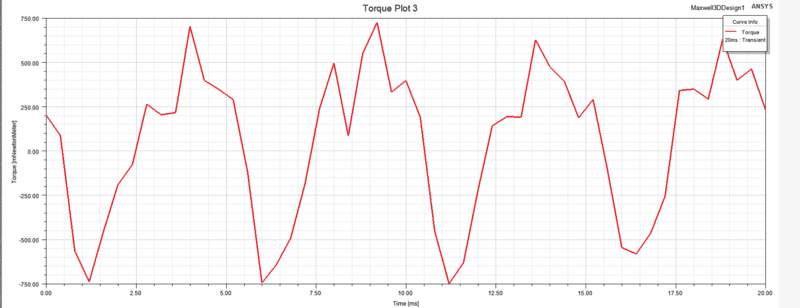
while simulation for a PM axial flux generator at no load 1000RPM, shows moving torque fluctuating between -0.7 to 0.7 Nm, which should have been 0, as there is no load attached and it is coreless design so no cogging torque as well. Need someone to help me out.
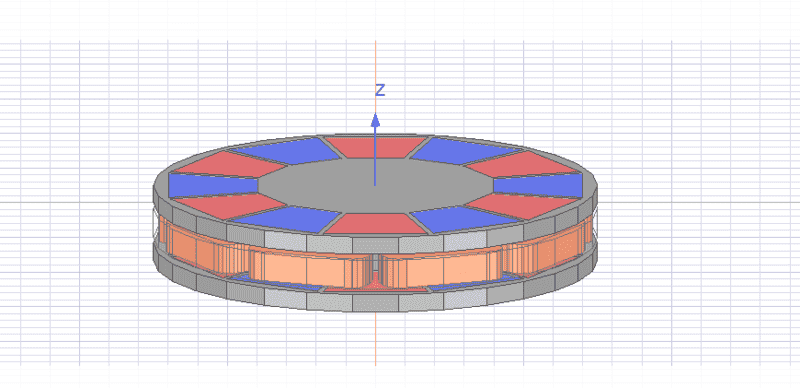
I am working on an axial flux generator design, I consisits of 2 rotors and one stator, there are 6 pole pairs and 9 coils. Here is my simulation setup
1633896416091.png

The three phase windings are connected in star configuration through Maxwell circuit.
I created two bands enclosing each rotor and then united them to assign a single band for both rotor which is set to rotational motion at 1000RPM constant. I am getting satisfactory results for output voltages, what I don't understand is this torque curve
1633896579895.png

currently the stator material is air ( I switched to air after setting it initially to electrical steel laminated, which resulted in 2Nm peaks in torque).
I don't understand the reason for this torque as there is no core so no cogging torque and also there is no load connected.
I am stuck, Kindly help :(
 
Engineering news on Phys.org
Any generator that relies on motional EMF has a very low current when rotating even in the presence of no external load.

On second thought it puzzles me that the Torque switches sign, according to my explanation it should 've been only negative (or only positive, depending how you define positive or negative here).

Something else, the coils are assumed to be ideal or have ohmic resistance? I think I might be able to explain this if the coils are not ideal.
 
Last edited:
The poles of the generator act as a capacitor that serves as some sort of external load. Depending on how you have setup your simulation software, it might be able to "see" this capacitor and include it in an implicit way in its calculations.
 
I am trying to understand how transferring electric from the powerplant to my house is more effective using high voltage. The suggested explanation that the current is equal to the power supply divided by the voltage, and hence higher voltage leads to lower current and as a result to a lower power loss on the conductives is very confusing me. I know that the current is determined by the voltage and the resistance, and not by a power capability - which defines a limit to the allowable...

Similar threads

  • · Replies 3 ·
Replies
3
Views
1K
  • · Replies 10 ·
Replies
10
Views
4K
Replies
2
Views
914
  • · Replies 18 ·
Replies
18
Views
6K
Replies
10
Views
5K
  • · Replies 8 ·
Replies
8
Views
6K
  • · Replies 2 ·
Replies
2
Views
5K
Replies
8
Views
2K
Replies
4
Views
2K
  • · Replies 4 ·
Replies
4
Views
5K