Applying Bending Stress to a Model of Ship Section

Click For Summary
SUMMARY

This discussion focuses on modeling bending stress in a ship's deck using Ansys Workbench. Dimas M. Rachman seeks guidance on applying bending stress from a left frame to a right frame within the finite element model. The conversation highlights the use of the My/I equation for stress calculation and explores various methods for applying forces, including tangential loading and localized stress application. The participants emphasize the importance of understanding the bending moment caused by buoyancy and ship weight differences when subjected to wave forces.

PREREQUISITES
  • Understanding of bending stress and moment calculations in structural engineering
  • Familiarity with Ansys Workbench for finite element analysis
  • Knowledge of the My/I equation for stress determination
  • Basic principles of fluid dynamics related to buoyancy and wave forces
NEXT STEPS
  • Research how to apply localized forces in Ansys Workbench
  • Learn about the My/I equation and its application in finite element modeling
  • Investigate methods for simulating wave-induced forces on ship structures
  • Explore advanced Ansys features for analyzing bending moments in complex geometries
USEFUL FOR

Naval architects, ocean engineers, and students in marine engineering looking to understand the application of bending stress in ship design and analysis.

dimasmr21
Good Afternoon.

My name is Dimas M. Rachman, i am an undergraduate student majoring in Ocean Engineering/Naval Architecture.

I am currently working on my final project. I need to model the effect of bending stress "inside" a plate of ship's deck with Ansys Workbench.

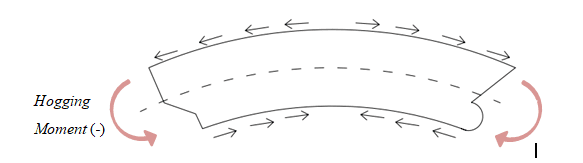
Here is a review about bending moment that cause the bending stress.
upload_2017-7-13_13-19-24.png

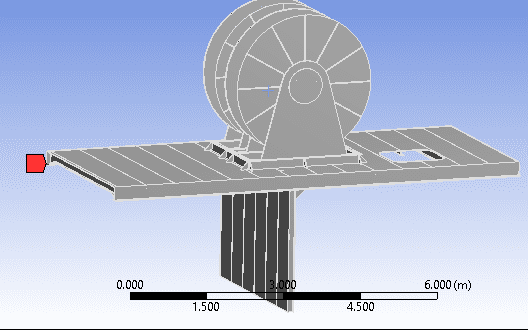
One can obtain the stress which is happened on a specific location using the -My/I equation. I want to apply the stress "inside" the place of ship's deck. Here is my finite element model.
upload_2017-7-13_13-23-33.png


As you can see the red arrow above marked the location where i calculate the stress according to the sectional profile of that "frame". I want to apply the stress from that left "frame" to the other end right "frame".

I have three options.

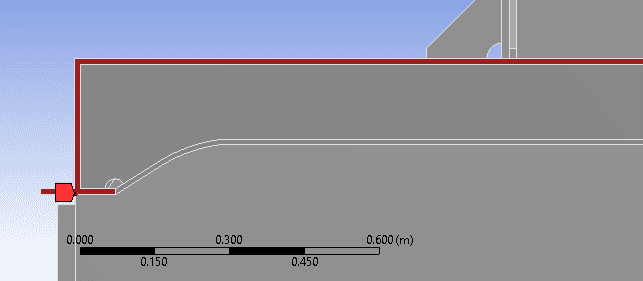
1. Applying a pressure on a surface, this surface, (where i calculate the stress). The red region is the place where i apply the pressure.
upload_2017-7-13_13-30-8.png

2. Applying a moment on the same surface with option 1.3. "This is what my supervisor wanted me to do" Applying the stress inside the plate from left frame to the other end right frame. I don't know how to thatwould you like to help me?

Thank you very much.
 
Engineering news on Phys.org
Generally he evaluation of the stresses in a structure start by applying a force or forces and restraints to the model to determine the resulting structure stresses due to the applied force(s); so, I need to know more about how you are applying an isolated stress to one region of the model.
 
JBA said:
Generally he evaluation of the stresses in a structure start by applying a force or forces and restraints to the model to determine the resulting structure stresses due to the applied force(s); so, I need to know more about how you are applying an isolated stress to one region of the model.
Thank you for your response.

Actually i am doing a research about the strength of that drum thing/winch roller drum, on the deck, by applying a tangential force on the drum.

But for the sake of detail, i want to include the effect of "difference between the ship weight and buoyancy when ship subjected to a wave train". This difference caused a bending moment. If one knows the 2nd moment of the section, the stress and force can be calculated.

What i am asking, is there any way i can apply that "force" inside the plate of the deck? In Ansys.

You can think as if there is a "stress flow" moving from one end to the other end

Calculation by hand, one can apply the force on nodes inside the plate (nodes of the mesh) and then solve it numerically.
 
Are you talking about an isolated moment applied to the deck or one combined with the tangential loading on the wench?
 
JBA said:
Are you talking about an isolated moment applied to the deck or one combined with the tangential loading on the wench?

At the first time, i included only the tangential loading.

But then, i want to combine it with a force that caused by the bending moment "flowing" inside the plate between both ends. But i don't know how to do this in Ansys.

So, yes, i want to include,

1. Tangential loading
2. "Flowing force" on the deck.
 
Ok, I am going to make some statements for your responses to help me understand the characteristics of the flowing moment. As I view it, there are two forces involved due to wave moments applied to this deck section of the ship. One is tension or compression relative to position of the moving wave due to its vertical offset from hull and the second is a bending moment due to the apparent vertical lateral bulkhead located under the winch in the model.
 
Unfortunately, I have sign off now so my next post will be delayed.
 
JBA said:
Ok, I am going to make some statements for your responses to help me understand the characteristics of the flowing moment. As I view it, there are two forces involved due to wave moments applied to this deck section of the ship. One is tension or compression relative to position of the moving wave due to its vertical offset from hull and the second is a bending moment due to the apparent vertical lateral bulkhead located under the winch in the model.

Thank you. Yes that is correct, but i want to exclude bending moment due to the bulkhead.

I don't know how to apply the effect of the bending moment caused by the wave in Ansys.
 
Let's try this, the source of the moment is the differential of buoyancy force due to the differential in submersion of a region of the hull along the longitudinal line of waves travel path. (simplest case) but without the longitudinal and lateral vertical bulkheads the imposed profile of these differential forces cannot be transmitted to the upper deck. So for further clarification and my education, what is the source of the moment that you have imposed upon the left end of your deck section under analysis?
 
  • #10
To clarify, I am not talking about the wave profile root source, but the specific moment value you have chosen for your analysis.
 
  • #11
JBA said:
Let's try this, the source of the moment is the differential of buoyancy force due to the differential in submersion of a region of the hull along the longitudinal line of waves travel path. (simplest case) but without the longitudinal and lateral vertical bulkheads the imposed profile of these differential forces cannot be transmitted to the upper deck. So for further clarification and my education, what is the source of the moment that you have imposed upon the left end of your deck section under analysis?

To simplify, let's say i have the longitudinal bending moment diagram along the ship length (the absis is the location along the ship).

This is done by calculating the net shear diagram (the difference between buoyant force along the ship and the distribution of ship's weight). From the area below the shear diagram curve one can obtain the bending moment.

Let's say i know that the bending moment at the left end of the deck is 4.5 MN-m (yes that is mega Newton).

And i know the 2nd moment of the lateral section of the left end (the frame). Its 13.5 m squared from its neutral axis.

I know the location of the plate and girder (the T beam, see the red region i mentioned in the 1st post), from the nuetral axis.

So i can calculate the stress that location, multiplied it by area of the red region, i have the force which i attempted to apply "inside the plate" not only on the "surface" of the red region.

Thank you so much for going this far. I appreciate that.
 
Last edited by a moderator:
  • #12
Ok, we have been having a small issue related to what I would specify as a resultant "force" on the end of the beam caused by the bending moment on the ship's hull at that point rather "a moment on the beam". Now that we are past that, then your red arrow pointing to the right represents the force at the left end of the beam that results on a compressive stress on that longitudinal beam. In order to create a compressive stress in that beam segment there must be an equal and opposite reaction force at the right end of that beam segment and that can be addressed by treating that end as a longitudinal restraint and compressive (or under some other wave pattern distribution along the hull a tensile) stress throughout the length of that beam segment will be constant between those to reference points.

Next, it appears that you also want to investigate whether or not the currently selected wave pattern distribution along the hull at a given point in time, as opposed to one that has progressed some increment of distance along the hull, results in the maximum compressive force on the beam and deck segment you are analyzing. To do that requires at a fundamental level means determining the moments applied to your region of interest by taking multiple snapshots of the hull's bending moments as the of the wave pattern progresses along the hull; but, this may not be practical, so you are also looking for an alternative method of determining those successive moments, and therefore compressive forces on your beam segment.

Please comment on both of the above and I will then respond later today.
 

Similar threads

  • · Replies 1 ·
Replies
1
Views
2K
  • · Replies 5 ·
Replies
5
Views
6K
  • · Replies 30 ·
2
Replies
30
Views
8K
  • · Replies 3 ·
Replies
3
Views
2K
  • · Replies 3 ·
Replies
3
Views
4K
  • · Replies 9 ·
Replies
9
Views
3K
  • · Replies 11 ·
Replies
11
Views
3K
  • · Replies 3 ·
Replies
3
Views
2K
  • · Replies 2 ·
Replies
2
Views
3K
  • · Replies 8 ·
Replies
8
Views
9K