Are electron bands symmetric in the reciprocal space?

Click For Summary
SUMMARY

The discussion centers on the symmetry of electron bands in reciprocal space, specifically addressing Kramers theorem, which states that energy bands must satisfy the condition E(-k) = E(k). Participants note discrepancies between this theoretical condition and actual band structure diagrams. It is clarified that band diagrams often represent multiple directions in k space, which can obscure the apparent symmetry. The conversation emphasizes the importance of understanding the representation of energy bands and the significance of Miller indices in interpreting these diagrams.

PREREQUISITES
  • Understanding of Kramers theorem in solid-state physics
  • Familiarity with reciprocal space and k space concepts
  • Knowledge of energy band diagrams and their interpretation
  • Basic understanding of Miller indices and their application in crystallography
NEXT STEPS
  • Research the implications of Kramers theorem on band structure calculations
  • Study the representation of energy bands in k space using software like VASP or Quantum ESPRESSO
  • Explore the significance of Miller indices in determining crystal symmetry
  • Learn about advanced techniques for visualizing band structures, such as using Python libraries like Matplotlib for custom plots
USEFUL FOR

Students and researchers in solid-state physics, materials science, and condensed matter physics who are analyzing electron band structures and their symmetries.

dRic2
Gold Member
Messages
887
Reaction score
225
Hi, in the lecture notes my professor gave us, it is stated that, due to Kramers theorem, the energy in a band must satisfy this condition:
$$E(-k) = E(k)$$
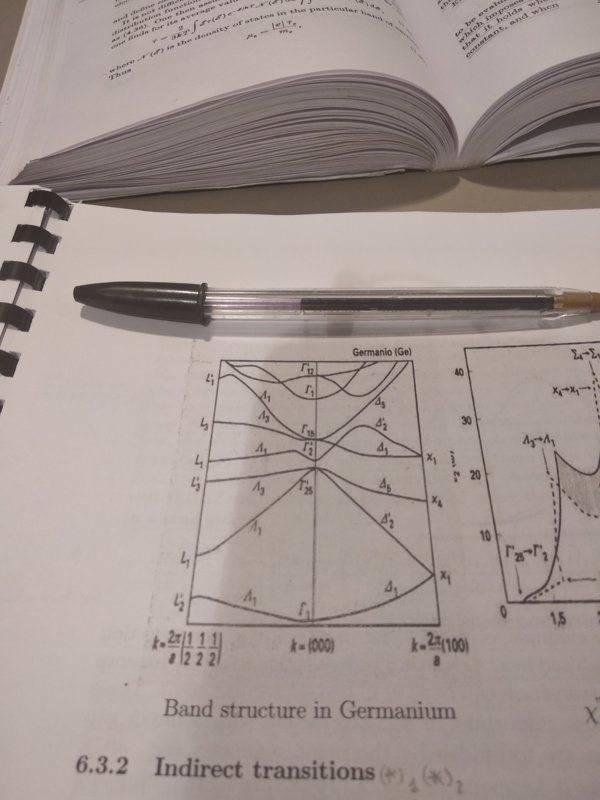
But, judging from actual pictures of band structures I don't find this condition to be true. Here's a (random) picture
15690962134621080100212305718610.jpg

I guess it looks "kind of" symmetric in the lower bands, but I wouldn't certainly call it that way.
 
Physics news on Phys.org
I am not sure you know how to read the diagram correctly. The part left of the middle is actually a different direction or slice than the right half of the diagram. That is typical situation for energy band diagrams. Instead of just plotting how the energy bands go along one direction, it takes a path through k space. Often points on the path are labeled with letters like ##\Gamma##, but in your case it seems to have indicated the direction with vectors. I borrowed this diagram for education purposes. So you would not see in the diagram what happens if you keep going from M to ##\Gamma## until the end, because once you hit ##\Gamma## the path actually turns up to Z. They do this so a 2D plot can show what happens in multiple directions, but it won't show the symmetry you're seeking.
1569102881024.png
 

Attachments

  • 1569102849758.png
    1569102849758.png
    19.7 KB · Views: 408
  • Like
Likes   Reactions: aaroman and dRic2
1000 times thank you. I didn't even notice that the Miller indexes are different.
 

Similar threads

  • · Replies 4 ·
Replies
4
Views
6K
  • · Replies 4 ·
Replies
4
Views
3K
  • · Replies 1 ·
Replies
1
Views
5K
  • · Replies 0 ·
Replies
0
Views
3K
  • · Replies 20 ·
Replies
20
Views
4K
  • · Replies 20 ·
Replies
20
Views
7K
  • · Replies 1 ·
Replies
1
Views
2K
  • · Replies 2 ·
Replies
2
Views
4K
  • · Replies 6 ·
Replies
6
Views
4K
  • · Replies 7 ·
Replies
7
Views
2K