Are these AC circuits different? And does grounding change the voltage?

Click For Summary
SUMMARY

The discussion clarifies the differences between a regular AC circuit and a live/hot & neutral AC circuit. The first circuit alternates between 240V and 0V, while the second maintains a constant reference point for safety. Grounding does not change the alternating voltage from +240/-240; it serves to define a zero voltage reference and ensure safety in case of wiring defects. The confusion arises from the dual purpose of grounding: as a reference point and as a safety measure.

PREREQUISITES
  • Understanding of AC voltage principles, specifically 220 Vac/50 Hz.
  • Knowledge of circuit diagrams and their components.
  • Familiarity with grounding concepts in electrical systems.
  • Basic electrical safety practices.
NEXT STEPS
  • Research the differences between single-phase and three-phase AC circuits.
  • Learn about grounding techniques and their importance in electrical safety.
  • Study the operation of voltmeters and how to measure voltage differences in circuits.
  • Explore the implications of grounding in various electrical fault scenarios.
USEFUL FOR

Electrical engineers, technicians, and anyone involved in designing or maintaining AC electrical systems will benefit from this discussion.

Kevin J
Messages
57
Reaction score
2
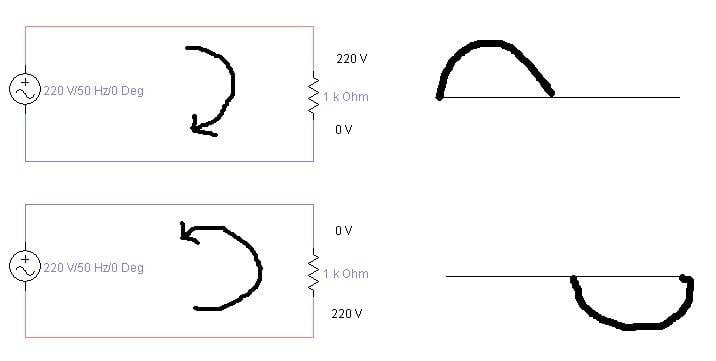
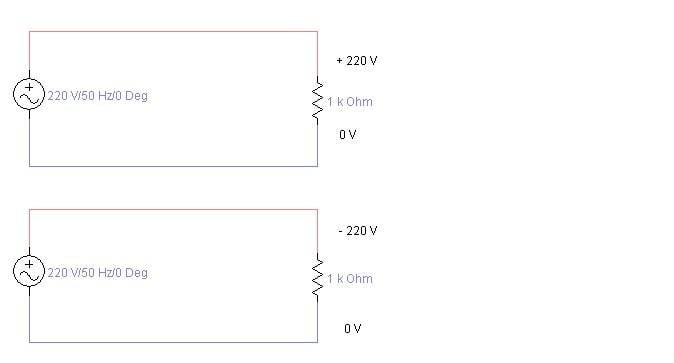
The first picture is a regular ac circuit, where the voltage alternates between 240V/0V in one of the wire. The second picture is a live/hot & neutral ac circuit. Are these 2 different type of circuits? And if I connect the top circuit to the ground which makes it neutral (just like the pic in the bottom), does the alternating voltage suddeny changes from +240/-240?
91_1336448558.jpeg
56_1336448794.jpeg
 

Attachments

  • 91_1336448558.jpeg
    91_1336448558.jpeg
    15.1 KB · Views: 774
  • 56_1336448794.jpeg
    56_1336448794.jpeg
    9.3 KB · Views: 574
Last edited:
Physics news on Phys.org
Your pictures are so faint that I can hardly read them. But it appears that they all show identical circuits but with different labels. I don't understand the point of your question.
 
anorlunda said:
Your pictures are so faint that I can hardly read them. But it appears that they all show identical circuits but with different labels. I don't understand the point of your question.
My question is what really is the difference between these 2 pictures
 
Kevin J said:
The first picture is a regular ac circuit, where the voltage alternates between 240V/0V in one of the wire. The second picture is a live/hot & neutral ac circuit. Are these 2 different type of circuits? And if I connect the top circuit to the ground which makes it neutral (just like the pic in the bottom), does the alternating voltage suddeny changes from +240/-240?

Some things that might make it easier for folks to answer your question:

1. What do you mean by a "regular" AC circuit?
2. What do you mean by a "different type of circuit"?
3. What specific ground connection are you making?
4. What do you mean by "alternating voltage changes from +240/-240"? AC voltage constantly changes polarity; in your schematic it's changing at the rate of 50 cycles per second.

As far as I can tell your diagrams just show the same circuit each time (220 Vac/50 Hz generator connected across a 1 kilo-ohm resistor); you're just showing the positive and negative cycles.
 
No, I mean for a live & neutral circuit, the diagram on the top is not suitable as one of the wire's is not kept constant.
 
Mentor's note: Original poster has tried to clarify his question. Here's the second try:
------
There may be two possibility of AC,
1)
On first half cycle one wire is at max potential while other is at 0 potential but on next half cycle the wire which was at max potential will be at 0 potential while other which was at 0 potential will be at max potential as shown in figure below,
91_1336448558.jpeg

2)
On first half cycle one wire will be at positive max potential and on next half cycle this wire will be at negative max potential while the other wire always remain at 0 potential. As shown in figure below,
56_1336448794.jpeg

*
Can anyone tell me which concept is correct?
 

Attachments

  • 91_1336448558.jpeg
    91_1336448558.jpeg
    15.1 KB · Views: 489
  • 56_1336448794.jpeg
    56_1336448794.jpeg
    9.3 KB · Views: 520
@Kevin J , I think you are being fooled by the way we use words.

Voltage is always defined as the difference in potential between two points. You need two wire leads to use a voltmeter. Depending on where you put the two leads in a circuit, you can measure many differences.

There is a dual purpose for the ground symbol in a circuit.

  1. It is placed at an arbitrary place in a circuit. The meaning is that we arbitrarily define that point as zero voltage. Then differences in voltage in the circuit can be expressed as relative to that point. We shift the language from two points to measure voltage to one point (with the second point assumed implicitly.)
  2. We physically connect power connections to an Earth ground for safety purposes. When everything works normally, the ground connection carries no current and has no influence on the circuit. Taking the ground away changes nothing. The ground becomes important in abnormal cases where there might be a broken wire, or a wiring error, or whatever. We also arbitrarily call the voltage at that ground zero, but for convenience only. If we decided that the Earth connection was one million volts instead of zero, it would change nothing.
Confusion of these two concepts causes much confusion.
1) Assigning zero volts to the ground point as a convenience.
2) Grounding for safety in case of defective or broken wiring. Does that address your question?
 
Last edited:
  • Like
Likes   Reactions: XZ923
Thanyou so much
 

Similar threads

  • · Replies 7 ·
Replies
7
Views
2K
  • · Replies 11 ·
Replies
11
Views
2K
  • · Replies 6 ·
Replies
6
Views
2K
  • · Replies 17 ·
Replies
17
Views
2K
  • · Replies 2 ·
Replies
2
Views
2K
  • · Replies 2 ·
Replies
2
Views
3K
Replies
4
Views
2K
Replies
152
Views
7K
  • · Replies 25 ·
Replies
25
Views
4K
  • · Replies 7 ·
Replies
7
Views
10K