Asymmetrical grounding of a 3 phase motor being run on a 1 phase supply

  • Thread starter Thread starter Guineafowl
  • Start date Start date
  • Tags Tags
    Earthing Grounding
Click For Summary

Discussion Overview

The discussion revolves around the implications of using a three-phase motor powered by a single-phase supply through a Variable Frequency Drive (VFD), specifically focusing on the concept of asymmetrical grounding and its effects on the system's performance and safety. Participants explore the technical aspects of grounding configurations, electromagnetic interference (EMI) filters, and the design considerations of VFDs in different electrical supply contexts.

Discussion Character

  • Technical explanation
  • Debate/contested
  • Exploratory

Main Points Raised

  • One participant describes their setup using a VFD to power a three-phase motor from a single-phase supply and seeks clarification on the term "asymmetrical grounding."
  • Another participant explains that asymmetrical grounding refers to situations where the voltage from each input to ground is not equal, contrasting it with symmetrical grounding found in certain single-phase configurations.
  • Some participants discuss the implications of using different phases for grounding, noting that using certain phases can lead to symmetrical grounding while others may not.
  • Concerns are raised about the design of EMI filters in relation to grounding configurations, with one participant mentioning that the filter design may vary based on whether the grounding is symmetrical or asymmetrical.
  • There is a mention of the historical context of grounding practices, including the use of center-tapped transformers for safety on construction sites.
  • Participants express curiosity about the manufacturer's reasoning for including a filter in certain configurations and the potential cost implications of different grounding designs.

Areas of Agreement / Disagreement

Participants generally agree on the definitions and implications of symmetrical versus asymmetrical grounding, but there are differing views on the practical effects of these configurations on the VFD and motor operation. The discussion remains unresolved regarding the necessity of disconnecting the EMC filter in the participant's specific setup.

Contextual Notes

Limitations include the lack of consensus on the best practices for grounding in this context and the potential variability in VFD designs based on regional electrical standards.

Guineafowl
Messages
891
Reaction score
414
TL;DR
3 phase motor being run on a 1 phase supply, via a VFD/inverter drive. The VFD manufacturer mentions ‘asymmetrical grounding’ in the manual. What is it?
A single phase, 240V AC supply is used to power the 3 phase motor on my milling machine. A VFD is used to generate the 3 phases required, along with the other benefits such as overload/overvoltage protection, soft start, braking, speed control, reverse, etc.

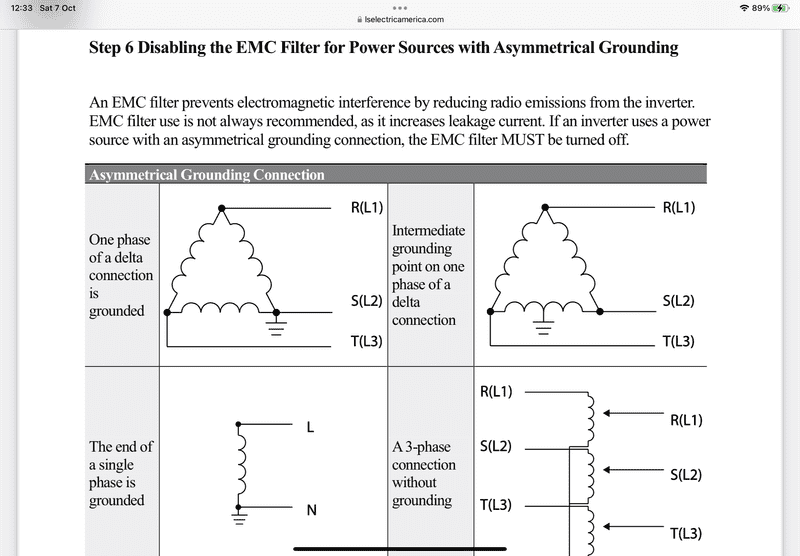
The VFD has an inbuilt EMC filter. The manufacturer recommends disconnecting this if used on supplies with ‘asymmetrical grounding’. Now, although I’m familiar with installing VFDs/motors, I’m not familiar with this term. Given the use of the term ’grounding’ rather than ‘earthing‘ as we in the UK call it, I wondered if anyone on this mainly USA-based forum could shed any light.

Here is my supply:
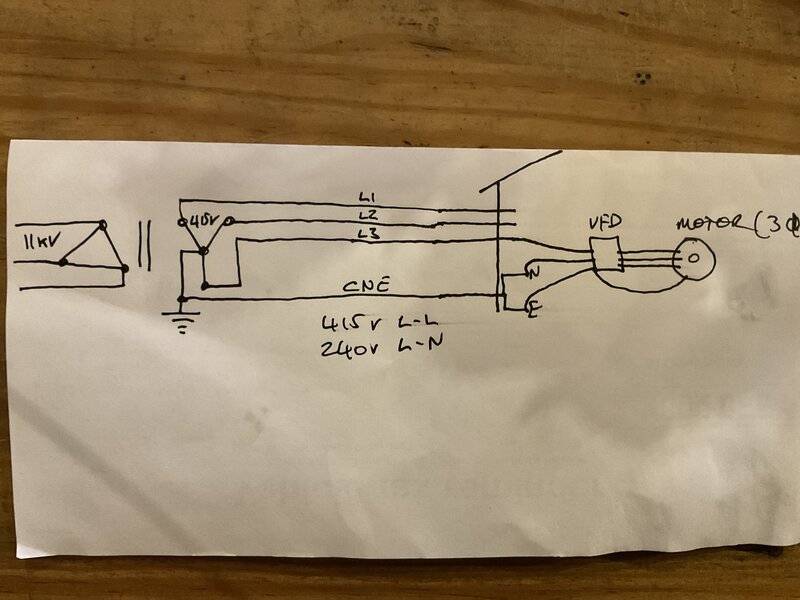
image.jpg

And here is the relevant page from the VFD manual:
IMG_1151.png


The bottom left image appears to show what I have, which is a standard setup over here. I’ve never heard it called asymmetrical grounding, however. To me, it looks like I should disconnect the EMC filter.

The manufacturer has not, so far, been especially contactable. I’d welcome your thoughts.

Edit: To anticipate the question, ‘why not run the motor on the 3ph supply you have?’, there is an existing 1ph supply in the machine room, and even if I bothered to extend the 3ph circuit from the next room, I would still run it through a VFD to obtain the benefits listed above. The motor in question is very easy to convert from 415V 3ph operation to 240V 3ph operation.
 
Last edited:
Engineering news on Phys.org
They are referring to any setup where the voltage magnitude from each input to ground isn't equal. So, the "symmetrical" grounding of single phase would be like a 240V winding with the center tap grounded. This 240/120V 1Φ is the common LV distribution in the USA for residential areas. In Europe the distribution is more often 380/220V 3Φ (wye) with the neutral grounded. This creates symmetric grounding for the 3Φ source, but asymmetric if you only use one leg to make 220V 1Φ.
 
  • Informative
Likes   Reactions: Guineafowl
DaveE said:
They are referring to any setup where the voltage magnitude from each input to ground isn't equal. So, the "symmetrical" grounding of single phase would be like a 240V winding with the center tap grounded. This 240/120V 1Φ is the common LV distribution in the USA for residential areas. In Europe the distribution is more often 380/220V 3Φ (wye) with the neutral grounded. This creates symmetric grounding for the 3Φ source, but asymmetric if you only use one leg to make 220V 1Φ.
Thanks, that makes sense.

What confuses me slightly, if you look at the top right picture, is that by using phases S and T, you would have symmetrical grounding.
 
Guineafowl said:
Thanks, that makes sense.

What confuses me slightly, if you look at the top right picture, is that by using phases S and T, you would have symmetrical grounding.
Yes. You get 1 leg of higher quality 1Φ that way, at the expense of weird grounding for the other two 1Φ legs, and a pretty insignificant improvement in the 3Φ grounding. It's more expensive to do, transformer winding-wise. Of course nothing is better for grounding than wye with a grounded neutral, but that is also more expensive for the power company. The cheapest version is Δ with one node grounded.

PS: If y'all want to comment on how I use leg, phase, winding, etc. interchangeably, know in advance that you're probably right, but I don't care. Context is everything.
 
  • Like
  • Informative
Likes   Reactions: hutchphd and Guineafowl
DaveE said:
Yes. You get 1 leg of higher quality 1Φ that way, at the expense of weird grounding for the other two 1Φ legs, and a pretty insignificant improvement in the 3Φ grounding. It's more expensive to do, transformer winding-wise. Of course nothing is better for grounding than wye with a grounded neutral, but that is also more expensive for the power company. The cheapest version is Δ with one node grounded.

PS: If y'all want to comment on how I use leg, phase, winding, etc. interchangeably, know in advance that you're probably right, but I don't care. Context is everything.
The only symmetric ground I can think of here would be in the old-fashioned ‘building site‘ transformers. 240V ac goes in, 110V out with a centre-tapped earth. This reduces touch potential to 55V, much safer on a rainy site. Of course, you had to buy the special 110V tools.

These have largely been superseded by cordless tools.
 
  • Informative
Likes   Reactions: hutchphd
Guineafowl said:
Thanks, that makes sense.

What confuses me slightly, if you look at the top right picture, is that by using phases S and T, you would have symmetrical grounding.
In your case of feeding a single phase to your VFD, then yes, that is the case. But if you used all three legs then you would not have a symmetrical ground.
-
The reason they warn about an asymmetrical ground is because the lowest voltage from all hot conductors to ground will be in the case of symmetrical grounding. Move in any direction and one of the legs voltage to ground will increase while other legs decrease. Depending on supply voltage, this could trigger MOV type over voltage devices depending on the devices they chose to use.
 
Of course this is all about EMI filter design. If you search for filters you will often see this distinction between symmetrical and asymmetrical grounds. It's really all about the capacitors to ground inside. In addition to @Averagesupernova's comments. Some issues are size and voltage rating of those capacitors, and the introduction of ground currents. In a balanced system you can have more capacitor current because they mostly cancel each other. So you will often see significantly different designs for these two cases.

They are saving size and cost for the same performance by requiring balance. It does make me wonder about their EMC approvals, why have a filter in one case and none in the other? Either you need it or you don't. The EMC requirements have been mostly globally harmonized for a long time now.

edit: Usually a switch like that wouldn't completely eliminate the filter, but just switch the ground capacitor configuration.
 
Last edited:
  • Like
Likes   Reactions: Guineafowl
Well, yes, I was reading the bit about disabling the filter, expecting this to be needed only in ‘weird’ earthing setups like the IT system of Norway, but was surprised to find my, very common, system tucked away in the diagrams. I wondered why the unit would be designed this way, and as you say, cost might be the answer.

I’ve just noticed in my screenshot above, that the manufacturer is listed as ‘LSAmerica’ (I thought it was Korean), so perhaps my model was designed with the dual phase system in mind.
 

Similar threads

  • · Replies 19 ·
Replies
19
Views
4K
  • · Replies 9 ·
Replies
9
Views
3K
  • · Replies 27 ·
Replies
27
Views
1K
Replies
23
Views
7K
  • · Replies 14 ·
Replies
14
Views
7K
  • · Replies 1 ·
Replies
1
Views
2K
  • · Replies 20 ·
Replies
20
Views
5K
  • · Replies 1 ·
Replies
1
Views
3K
Replies
1
Views
3K
  • · Replies 13 ·
Replies
13
Views
3K