Discussion Overview
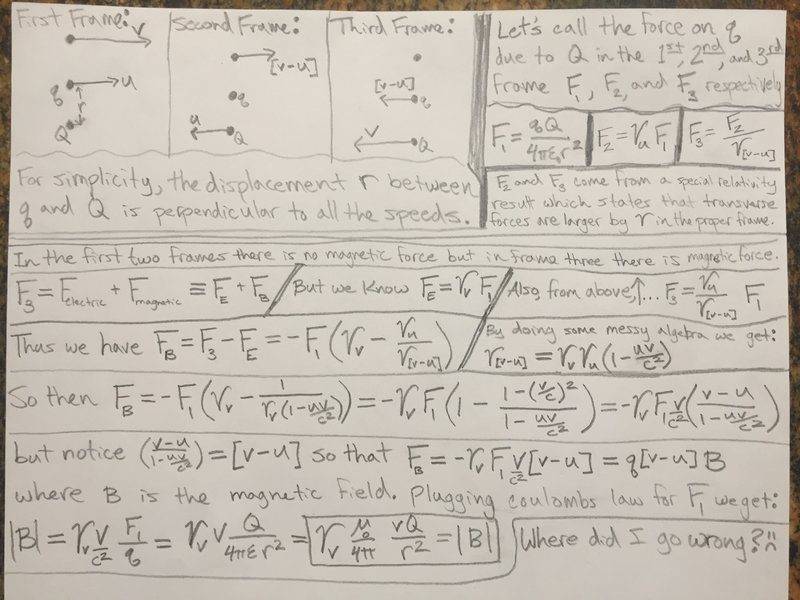
The discussion centers around the calculation of the magnetic field generated by a moving charge, exploring the implications of relativistic effects on electric and magnetic forces. Participants examine various approaches, including the use of Liénard-Wiechert potentials, and discuss the complexities of electric field transformations in different reference frames.
Discussion Character
- Exploratory
- Technical explanation
- Debate/contested
- Mathematical reasoning
Main Points Raised
- Some participants suggest using Liénard-Wiechert fields for a more straightforward calculation of the magnetic field.
- One participant argues that the electric field of a moving charge is "length contracted," which introduces additional forces that must be accounted for in calculations.
- Another participant acknowledges the need to simplify the problem by considering the charges moving together in one frame, rather than breaking it into multiple frames.
- There is a discussion about how the electric force in one frame is larger due to relativistic effects, leading to confusion about the relationship between electric and magnetic forces.
- Participants express uncertainty about whether the transverse component of the electric field increases when transitioning between frames, and how this relates to the magnetic field generated.
- One participant references external sources to support their position, but acknowledges conflicting interpretations from those sources, leading to further confusion.
Areas of Agreement / Disagreement
Participants do not reach a consensus on the correct approach to calculating the magnetic field or the implications of relativistic effects on electric fields. Multiple competing views remain, with ongoing debate about the nature of the forces involved.
Contextual Notes
There are unresolved assumptions regarding the treatment of electric and magnetic forces in different reference frames, and participants express uncertainty about the application of relativistic transformations to their calculations.