Availability of funding within different areas of physics

Click For Summary

Discussion Overview

The discussion revolves around the availability of funding across different areas of physics, with participants sharing qualitative insights based on personal experiences. The scope includes academic funding trends, departmental resources, and implications for career decisions in physics.

Discussion Character

  • Exploratory
  • Debate/contested
  • Technical explanation

Main Points Raised

  • One participant notes that Condensed Matter/Solid State physics is currently well-funded at their institution, while Particle physics is experiencing a decline in funding.
  • Another participant mentions that Astronomy receives even less funding than Particle physics, highlighting difficulties for undergraduates in securing research stipends.
  • There is a suggestion that funding trends may not directly correlate with job availability, as fields with high funding can still have saturated job markets.
  • Concerns are raised about the implications of new facility constructions for Particle physics funding, with a participant questioning why increased facilities do not lead to more funding for data analysis and job creation.
  • A later reply clarifies that funding for facilities and operational costs are distinct, emphasizing that capital expenditures do not equate to long-term hiring commitments.

Areas of Agreement / Disagreement

Participants express differing views on the implications of funding trends, particularly regarding the relationship between facility construction and job availability in Particle physics. There is no consensus on the overall state of funding across different fields.

Contextual Notes

Participants acknowledge that the question of funding is broad and context-dependent, with various factors influencing the availability and implications of funding in different physics areas.

Who May Find This Useful

This discussion may be of interest to students considering careers in physics, researchers evaluating funding opportunities, and academic advisors assessing departmental resources.

Hypercube
Messages
62
Reaction score
36
Hello!

I was wondering if any of you researchers on PF are willing to provide some insight in regards to how much funding is available to different areas of physics? I'm happy with just qualitative, personal experience-type answers, like which areas you think have the most, which areas have the least, etc. It does not have to be solely within US either.

I will add this below, if it helps:
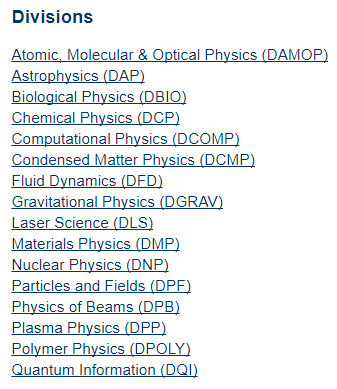
upload_2017-8-5_7-51-45.png


(I am posting this in Academic Guidance because it may influence my future career decisions, but feel free to move this topic wherever you think is appropriate.)
 
Physics news on Phys.org
Condensed Matter/Solid State is god right now at my school. Most funding goes there iirc.

Particle is in decline at my school (we barely have enough to pay our undergraduates, and even then only some).

Astro gets even less than particle (our department is half the size of particle or condensed matter).

I'm in Astro and it's really hard for undergrads to get stipends for research here.

I'm at a top 50 school for perspective.
 
I see. I suspected it would be more or less like that.
Thank you!
 
PhotonSSBM is talking about undergraduate stipends in his examples. So it's but one facet of what is an impossibly broad question. Just as an example, particle funding at universities is trending down because new facilities construction is trending up. Does that mean funding is bad? Or good?
 
If it's related to electronics or biology, it's probably well funded by industry or the government (United States point of view).

However the context of the question will determine whether or not any of that matters. Whether or not a field has a lot of funding is not actionable information in a vacuum. For instance, many fields of cellular biology are extremely well funded, but there are also so many people pursuing it that the job market is atrocious.
 
Vanadium 50 said:
Just as an example, particle funding at universities is trending down because new facilities construction is trending up.
Oh that's interesting, although I don't quite understand why. I mean, if they're building more facilities for (say) particle physicists, wouldn't you expect there would be more data for particle physics people to work on? And more jobs?
 
Can't use the same dollar to build a facility and to analyze the data from it.
 
  • Like
Likes   Reactions: PhotonSSBM
Hypercube said:
Oh that's interesting, although I don't quite understand why. I mean, if they're building more facilities for (say) particle physicists, wouldn't you expect there would be more data for particle physics people to work on? And more jobs?

Vanadium 50 said:
Can't use the same dollar to build a facility and to analyze the data from it.

Also, capital and/or spending on facilities is a one-off cost whereas if you hire someone you will have to pay him/her for several years (plus pensions etc) so it is a long term commitment.
Hence, it is not at all unusual for there to be plenty of money for equipment but no money to hire people.
 
  • Like
Likes   Reactions: PhotonSSBM

Similar threads

  • · Replies 15 ·
Replies
15
Views
2K
  • · Replies 12 ·
Replies
12
Views
2K
  • · Replies 4 ·
Replies
4
Views
2K
  • · Replies 9 ·
Replies
9
Views
3K
  • · Replies 14 ·
Replies
14
Views
3K
  • · Replies 11 ·
Replies
11
Views
3K
  • · Replies 1 ·
Replies
1
Views
2K
  • · Replies 1 ·
Replies
1
Views
1K
  • · Replies 9 ·
Replies
9
Views
3K
  • · Replies 7 ·
Replies
7
Views
3K