Average value of the impulse as the parameters vary

Join the discussion
Registration is free. Ask a follow-up in this thread, or start your own.
14 replies · 4K views
keyzan
Messages
32
Reaction score
14
TL;DR Summary: A particle of mass m, placed in an infinite rectangular one-dimensional potential well that confines it in the segment between x=-a/2 and x=a/2

Hi guys, I need help with this exercise which reads: a particle of mass m, placed in an infinite rectangular one-dimensional potential well that confines it in the segment between x=-a/2 and x=a/2, is in the state :

1705935717912.png

being |1> and |2> normalized kets representative of the ground state and the first excited one.
1. Determine the possible outcomes of an energy measurement and the related probabilities as a function of the real alpha and beta parameters.
Solution:

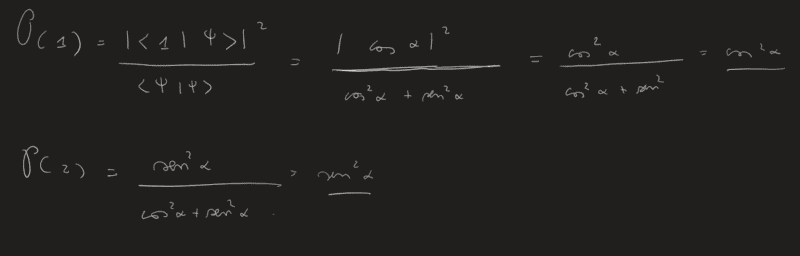
I applied the fourth postulate in the specific case with discrete eigenvalues and without degeneracy. I got:
1705936030810.png

it's right?
2. Determine the average value of the impulse as the parameters vary.
Solution:
In this case I don't really know how to proceed and in general in these cases I don't know how to proceed (when it comes to average values in general). I found:

1705936451056.png

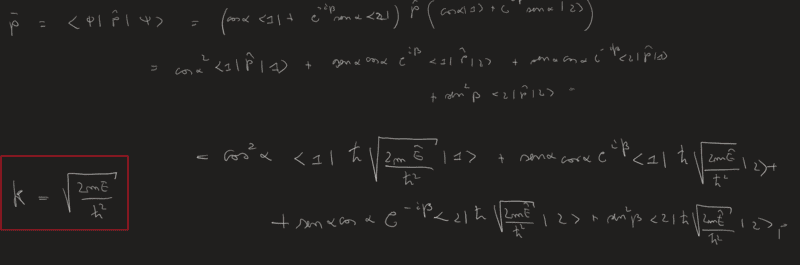
At this point I should consider that the impulse p=(h/2*pi)*k. And since I know k of the different eigenstates I can find:
1705936839758.png

And continue in this way? But my reasoning seems very forced, I don't know. I'm doing it wrong?
 
Physics news on Phys.org
@keyzan please use the PF LaTeX feature to post equations directly. Equations in images are not acceptable as it's harder to read them and they can't be quoted. There is a LaTeX Guide link at the bottom left of the post window.
 
ok. The general state is: $$|\psi \rangle = cos\alpha |1\rangle + e^{i \beta} sin\alpha |2\rangle$$

For solution 1:
$$P(1) = \frac {|\langle1|\psi\rangle|^2} {\langle\psi|\psi\rangle} = \frac {|\cos\alpha|^2} {cos^2\alpha + sin^2\alpha} = cos^2\alpha$$

and

$$P(2) = \frac {|\langle2|\psi\rangle|^2} {\langle\psi|\psi\rangle} = \frac {|\sin\alpha|^2} {cos^2\alpha + sin^2\alpha} = sin^2\alpha$$

For solution 2:

$$\bar p = \langle\psi|\hat P | \psi\rangle = (cos\alpha\langle1| + e^{-i\beta}sin\alpha\langle2|)\hat P(cos\alpha|1\rangle + e^{-i\beta}sin\alpha|2\rangle) =$$ $$= cos^2\alpha \langle 1|\hat P|1\rangle + sin\alpha cos\alpha e^{i\beta} \langle 1|\hat P|2\rangle + sin\alpha cos\alpha e^{-i\beta} \langle 2| \hat P |1\rangle + sin^2\alpha \langle 2|\hat P |2 \rangle $$

Finally I replace:

$$\hat P = \hbar k = \hbar \sqrt{\frac {2m\hat E} {\hbar^2}} $$
 
So, if what I wrote is right, I continue the exercise. So, with ##n## and ##m## representing stationary states ##1## and ##2## in each combination, i need:
$$\sqrt{2m} \space \langle n| \sqrt{\hat H} |m \rangle$$

At this point I consider the fact that the Hamiltonian in the basis of its eigenkets is represented by a diagonal matrix with its eigenvalues on the diagonal. So, the non-null values are:

$$\langle 1| \sqrt{\hat H} |1 \rangle = \sqrt{E_{1}} \langle 1|1 \rangle = \sqrt{E_{1}}$$ e
$$\langle 2| \sqrt{\hat H} |2 \rangle = \sqrt{E_{2}} \langle 2|2 \rangle = \sqrt{E_{2}}$$

keyzan said:
p¯=⟨ψ|P^|ψ⟩=(cosα⟨1|+e−iβsinα⟨2|)P^(cosα|1⟩+e−iβsinα|2⟩)=

So this becomes:
$$\bar p = \langle \psi| \hat P |\psi \rangle = cos^2 \alpha \sqrt{2m E_{1}} + sin^2 \alpha \sqrt{2m E_{2}}$$

In this relationship ##E_{1}## and ##E_{2}## have values that vary as the width ##a## of the hole varies. We represent graphically how the average value of the impulse varies as the ##\alpha## parameter varies:
1706096855010.png


Obviously considering that ##E_{2}>E_{1}##. If its's ok let me now :)
 
I do not understand the original question. What is the "average impulse"? You have equated it loosely to the momentum and done some questionable manipulation (the expectation of p=ħk for either bound eigenstate is zero) and so I am adrift here as to your answer as well. Is the question quoted exactly?
 
I have a particle of mass ##m## in a infinite rectangular potential between ##x=-\frac{a} {2}## and ## x=\frac{a} {2}##. This particle is in the state:

keyzan said:
$$|\psi \rangle = cos\alpha |1\rangle + e^{i \beta} sin\alpha |2\rangle$$

I have to calculate:
keyzan said:
$$\bar p = \langle\psi|\hat P | \psi\rangle$$

My solution:
Since i don't know (or i don't remember) how to calculate this, i thought to use this formula:
$$p = \hbar k = \hbar \sqrt{\frac {2mE} {\hbar ^2}}$$
If i consider these to be operators i have:

keyzan said:
$$\hat P = \hbar k = \hbar \sqrt{\frac {2m\hat H} {\hbar^2}} $$

The if i replace in ##\bar p## I have:

$$\bar p = \sqrt{2m} \langle \psi | \sqrt{\hat H} |\psi \rangle $$

Question:

Can i do this?
Sorry for the mess but is my first post :)
 
It depends upon what you are trying to do.
What is "average impulse"?
You can write $$E= (p^2)/2m$$ but not $$p=\sqrt {2mE}$$ because p is a vector (a signed number in 1D)
 
Is the expectation value of the observable P as you can see from the formula.

Ok I said heresy. I obviously can't do this cause we're talking about operators.. I think I just need to solve the integral:
$$ \int_{-\frac {a} {2}}^{\frac {a} {2}} \psi^*(x) \space \hat P \space \psi(x) dx \, = \int_{-\frac {a} {2}}^{\frac {a} {2}} \psi^*(x) \space -i\hbar \frac {d} {dx} \space \psi(x) dx$$

So I need the projection of ##|\psi \rangle## on ##|x \rangle##. So I need:
$$ \psi (x) = \langle x | \psi \rangle $$

It all comes down to calculation of:

##\langle x | 1 \rangle ## and ##\langle x | 2 \rangle ##

that are the stationary states in the state 1 e 2:

$$\psi_1 (x) = \sqrt {\frac {2} {a}} cos(\frac {\pi x} {a})$$
and
$$\psi_2 (x) = \sqrt {\frac {2} {a}} cos(\frac {\pi x} {a} 2)$$

So we have:

$$\psi (x) = \langle x | \psi \rangle = cos\alpha \sqrt {\frac {2} {a}} cos(\frac {\pi x} {a}) + e^{i\beta} sin\alpha \sqrt {\frac {2} {a}} cos(\frac {\pi x} {a} 2)$$

Now I can calculate the integral. Do you agree?
 
But what does the operator you defined represent? The(long) time average of impulse on a bound particle is identically zero. I can make up lots of operators...... Are you intersted in the average magnitude of the impulse delivered to (or by) the walls of the box??? Impulse is not a very quantum Mechanical idea and I have no real idea why this is at all interesting (except as an arbitrary exercise).
 
Last edited:
It seems that the term “average value of the impulse”, used in the original question, is a mistake.

Also the OP uses "##~\bar p~##". I would expect that to represent the time-average of momentum which is inappropriate.

What is probably required is the expectation value of the momentum, ##\langle p \rangle##.

The OP needs to confirm (or otherwise clarify) this.

Further thoughts…

Although ##\langle p \rangle = 0## for the energy-eigenstates, I believe this is not necessarily true for superpositions. If so, the OP’s approach in Post#11 looks OK to me (as an amateur!). [Whoops - there's a mistake in Post #11; see Edit 2 below.]

Edit 1: typo'
Edit 2. In post #11, ##\psi_2 (x) = \sqrt {\frac {2} {a}} cos(\frac {\pi x} {a} 2)## is wrong. That's not the wavefunction for the 1st excited level.
 
Last edited:
The formalism attempted by the OP is fine. The states he chooses are not correct and I do not understand the purpose .
Steve4Physics said:
Although ⟨p⟩=0 for the energy-eigenstates, I believe this is not necessarily true for superpositions.
What is p?. If it is p then perhaps. If it is |p| =√(2mE) then manifestly this is not zero for energy eigenstates. But I remain befuddled by the question. (not an unusual state for me...........)
 
Last edited:
hutchphd said:
The formalism attempted by the OP is fine. The states he chooses are not correct
Well spotted. I assume you mean that the OP used the wrong wavefunction for ##|2 \rangle##.

hutchphd said:
What is p?. If it is p then perhaps.
I was sloppy - I should have written ##\langle \bf p \rangle## rather than ##\langle p \rangle##.

I still think the intended question is to find ##\langle \bf p \rangle## in terms of ##\alpha## and ##\beta##.. But the OP seems to have stopped replying so we'll probably never know.