Band structure after compensation doping

Click For Summary
SUMMARY

The discussion centers on the complexities of band structure in semiconductors, particularly regarding compensation doping, where P-type materials are doped with N-type impurities. Participants express confusion over how this process can yield usable N-type materials from initially P-type substrates, especially given the energy gap of 1.1 eV in silicon. The conversation highlights the role of acceptor and donor atoms in neutralizing each other and the implications for energy band diagrams, emphasizing the need for clarity in understanding these transitions.

PREREQUISITES
  • Understanding of energy band diagrams in semiconductors
  • Knowledge of P-type and N-type doping processes
  • Familiarity with semiconductor physics concepts
  • Basic principles of charge carrier dynamics in silicon
NEXT STEPS
  • Research the effects of compensation doping on semiconductor properties
  • Study the role of acceptor and donor levels in energy band diagrams
  • Learn about the temperature dependence of charge carrier mobility in silicon
  • Explore advanced semiconductor fabrication techniques and their impact on doping
USEFUL FOR

Electronic engineers, semiconductor physicists, and students studying semiconductor technology who seek to deepen their understanding of doping mechanisms and energy band structures in silicon.

majormajor
Messages
2
Reaction score
0
As an electronic engineer I am not an expert on semiconductor physics but I think I understand the basics of energy band diagrams reasonably well. It all fits together fairly neatly with the normal textbook assumption that we are looking at pure N-type or P-type doping. The problem I have is when they then mention that actually the semiconductor manufacturing process uses predominantly compensation doping, so they might start with a P-type material and then add N-type doping until the material ends up N-type. How exactly this looks on the energy band diagrams is glossed over. There are some fleeting mentions that "oh by the way, the acceptor and donor atoms will neutralize each other".

For example, here's a link from

http://www.doe.carleton.ca/~smcgarry/ELEC3908/Slides/ELEC3908_Lect_3.pdf

Showing the band diagram below for compensation doping:
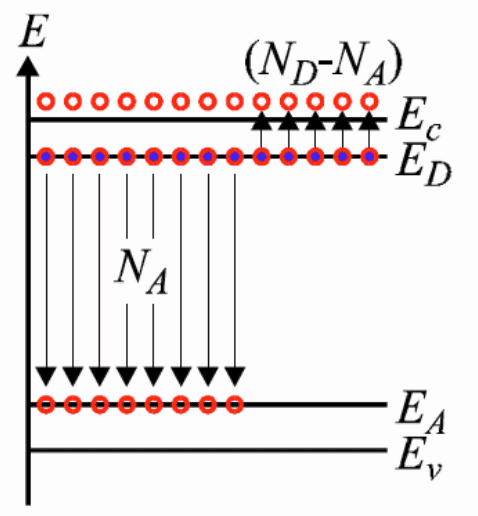
upload_2016-10-20_10-31-2.png


Perhaps I am missing something here but I am baffled as to how the electrons sitting at energy levels very close to the conduction band will now all of a sudden happily fall into the band just above the valence band - especially as the whole story starts with the statement that at room temperature very few electrons have the energy to bridge the 1.1 eV gap for silicon.

To me the logical thing for me to end up with just a mish-mash of "neither p nor n type" silicon, rather then being able to make a usable N-type when we start from P-type.

I would appreciate it if somebody could explain this to me at a qualitative level. If that's at all possible.
 
majormajor said:
As an electronic engineer I am not an expert on semiconductor physics but I think I understand the basics of energy band diagrams reasonably well. It all fits together fairly neatly with the normal textbook assumption that we are looking at pure N-type or P-type doping. The problem I have is when they then mention that actually the semiconductor manufacturing process uses predominantly compensation doping, so they might start with a P-type material and then add N-type doping until the material ends up N-type. How exactly this looks on the energy band diagrams is glossed over. There are some fleeting mentions that "oh by the way, the acceptor and donor atoms will neutralize each other".

For example, here's a link from

http://www.doe.carleton.ca/~smcgarry/ELEC3908/Slides/ELEC3908_Lect_3.pdf

Showing the band diagram below for compensation doping:

View attachment 107752

Perhaps I am missing something here but I am baffled as to how the electrons sitting at energy levels very close to the conduction band will now all of a sudden happily fall into the band just above the valence band - especially as the whole story starts with the statement that at room temperature very few electrons have the energy to bridge the 1.1 eV gap for silicon.

To me the logical thing for me to end up with just a mish-mash of "neither p nor n type" silicon, rather then being able to make a usable N-type when we start from P-type.

I would appreciate it if somebody could explain this to me at a qualitative level. If that's at all possible.

I don't quite understand the significance of the "arrows" in the diagram. But for the example you cited in the lecture, it is simply the addition of MORE acceptor levels to the original n-type semiconductor to the extent that the density of states of the the acceptor level is larger than the density of states of the donor level. Since there are more acceptor states, more electrons from the valence band will be promoted to the acceptor level, leaving more holes behind. Thus, nA>nD, turning the material from a n-type semiconductor to a p-type semiconductor.

Zz.
 

Similar threads

  • · Replies 11 ·
Replies
11
Views
3K
  • · Replies 2 ·
Replies
2
Views
3K
  • · Replies 1 ·
Replies
1
Views
1K
  • · Replies 2 ·
Replies
2
Views
3K
  • · Replies 4 ·
Replies
4
Views
3K
  • · Replies 4 ·
Replies
4
Views
3K
  • · Replies 6 ·
Replies
6
Views
2K
  • · Replies 2 ·
Replies
2
Views
2K
  • · Replies 5 ·
Replies
5
Views
6K
  • · Replies 4 ·
Replies
4
Views
3K