Bandpass filter design - wideband

Click For Summary

Discussion Overview

The discussion revolves around the design of a bandpass filter with a bandwidth of 50MHz and a center frequency of 2GHz, focusing on simulation challenges in LTSpice and the desired characteristics of the filter response. Participants explore various design approaches, including frequency transformation methods and the implications of filter order on performance.

Discussion Character

  • Technical explanation
  • Debate/contested
  • Exploratory

Main Points Raised

  • One participant is using frequency transformation to design a bandpass filter but is dissatisfied with the simulation results, particularly the response curve.
  • Another participant questions the circuit design and suggests the need for a 50 ohm source.
  • There is uncertainty about whether the design is for practical implementation or theoretical exploration.
  • A participant mentions removing a resonator to simplify the filter design, which has improved the response but still lacks a flat passband.
  • Concerns are raised about the limited data points in the response curve and the need for a clearer representation of the passband.
  • One participant suggests exploring distributed element filters as an alternative to the current topology.
  • Another participant notes the impracticality of using discrete components at 2GHz and suggests considering a stripline filter design.
  • There is a discussion about the necessity of driving the filter from a 50 ohm source, with some participants confirming this requirement.
  • Trade-offs in filter design are highlighted, particularly between achieving a flat passband and maintaining steep roll-off characteristics.
  • A suggestion is made to use a series connection of highpass and lowpass filters to achieve the desired passband characteristics, with the addition of a buffer amplifier to prevent loading errors.

Areas of Agreement / Disagreement

Participants express differing views on the effectiveness of the current filter design and the methods used. There is no consensus on the best approach to achieve the desired filter characteristics, and multiple competing views remain regarding design strategies and practical implementation.

Contextual Notes

Participants note limitations in the simulation results and the potential need for adjustments in the design approach, including the choice of filter topology and component types. The discussion reflects various assumptions about the design goals and practical constraints.

deki
Messages
15
Reaction score
1
I'm trying to design a bandpass filter with a BW of 50MHz in LTSpice, however my simulations aren't coming out as I'd like. I'm using the frequency transformation method, with a centre frequency of 2GHz., fractional BW 2.5%. I'd like a wider passband, however I can't seem to get away from the following type of response (images attached):
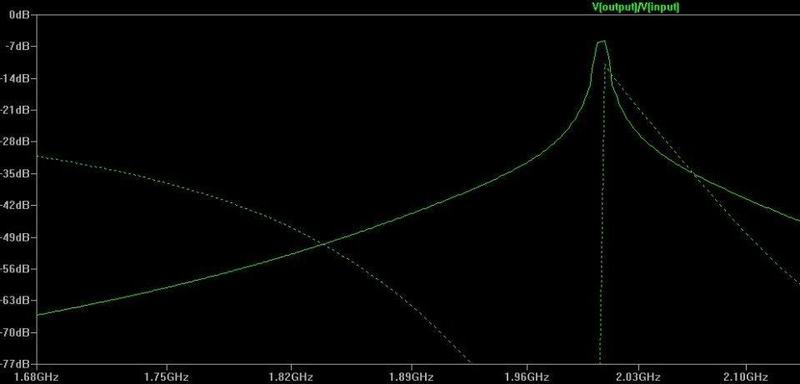
2.jpg


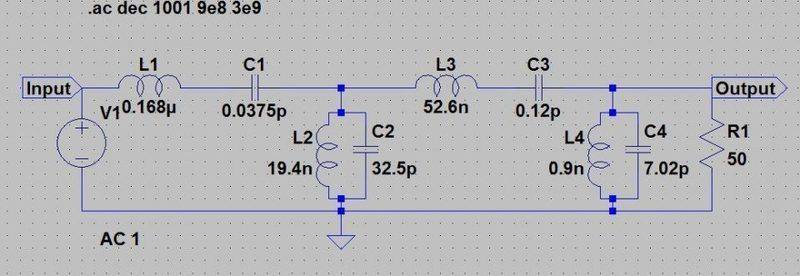
And the circuit:
1.jpg


Any ideas on how to approach this?
 
Engineering news on Phys.org
How did you come up with that circuit?

You probably need a 50 ohm source also.

http://www.electronicproducts.com/Bandpass_Filter_Design_Calculator.aspx
 
You are intending to build this, or is this a paper exercise?
 
There is the possibility of building it, though it's not confirmed. As of now I removed the second resonator, so it's a 3rd order filter instead of the 4th order I begun with. It has helped, but my passband isn't as flat as I'd like.
 
I'm having trouble with the posted response curve. The region of interest seems to be the pass band, but there looks to be only two data points near there. Is it possible to get a closer picture of the pass band?

Also, what don't you like about it? Is it just gain fluctuations in the pass band you object to, or do other concerns come into play like the group delay?

Are you wedded to the Caur topology? There are some nice distributed element filters that start to work around that frequency.

BTW, I'm no filter guru, so don't expect answers from me. Just questions.
 
I've managed to alter it closer towards what I want. I want a more flat passband, though I'm still getting these ripples even though my frequency transformations didn't account for them (I'm using the freq transformation technique to get the BPF). And if possible to get it to resemble more of an ideal BPF with steeper roll off. Or would I have to go into the microstrip realm?
Untitled.jpg
 
Using discrete Ls and Cs at 2GHz is impractical, are you planning to transform your schematic into a stripline filter?
 
Am I wrong about the need to drive it from a 50 ohm source?
 
meBigGuy said:
Am I wrong about the need to drive it from a 50 ohm source?

No, you were right.

Looks like OP included source term in post #6 with Rser card.
 
  • #10
As I understand it, filter design is about trade offs. It's possible to build a flatter pass band, but at the cost of less roll off -- for an equal number of poles.

Also, there's something wrong with your simulation. You have actual gain in that bump at the top of your pass band. That should never happen in a passive network. Something about perpetual motion I think.
 
  • #11
For a flat passband and - at the same time - a relatively large bandwidth it is best to use a series connection of a highpass (lower corner) and a lowpass (higher corner) . The roll-off characteristic is determined by the filter order of both sections. To avoid loading errors both sections should be isolated with a buffer amplifier in between.
 
  • Like
Likes   Reactions: Jeff Rosenbury

Similar threads

  • · Replies 1 ·
Replies
1
Views
4K
  • · Replies 6 ·
Replies
6
Views
3K
Replies
3
Views
4K
Replies
8
Views
2K
Replies
16
Views
4K
Replies
2
Views
3K
  • · Replies 3 ·
Replies
3
Views
2K
  • · Replies 5 ·
Replies
5
Views
17K
  • · Replies 19 ·
Replies
19
Views
4K
Replies
2
Views
3K