Batteries connected in parallel - Amps won´t add up?

Click For Summary

Discussion Overview

The discussion revolves around the behavior of batteries connected in parallel, specifically addressing the current (amps) observed when multiple batteries are used to power a light bulb. Participants explore the implications of voltage remaining constant while questioning why the current does not increase with additional batteries.

Discussion Character

  • Exploratory
  • Conceptual clarification
  • Debate/contested
  • Technical explanation

Main Points Raised

  • One participant notes that the multimeter shows a constant voltage of 1.5V and a current of 0.12A regardless of the number of batteries connected in parallel.
  • Another participant questions the understanding of Ohm's law and suggests that the original poster (OP) should clarify their conceptual framework regarding current in parallel circuits.
  • A participant proposes that the light bulb requires a specific number of amps to operate, and once enough batteries are connected in parallel to meet that requirement, adding more batteries does not change the current.
  • It is suggested that the OP measure the voltage across the light bulb while powered to gain further insight into the behavior of the circuit.
  • Some participants emphasize that batteries are rated in ampere-hours, indicating that the capacity of the batteries does not directly affect the current unless the load changes.
  • Another point raised is that the current flowing through the circuit is determined by the resistance of the bulb and the supply voltage, which remains consistent regardless of the number of parallel batteries.

Areas of Agreement / Disagreement

Participants express differing views on the relationship between the number of batteries in parallel and the current observed. While some assert that the current should increase with more batteries, others argue that the current remains constant due to the characteristics of the load and the voltage supply. The discussion remains unresolved with multiple competing views.

Contextual Notes

Participants highlight the importance of understanding the load's resistance and the implications of battery ratings in ampere-hours versus amperes. There is also mention of the potential variation in bulb resistance when heated, though this is noted to be minimal.

trickybilly
Messages
16
Reaction score
4
Batteries are connected in parallel. Multimeter shows: 1,5V AND... "0.12A" regardless of battery number. Volts stay the same but should not Amps add up in parallel? "0.12A" with 4, 5 or 6 batteries...
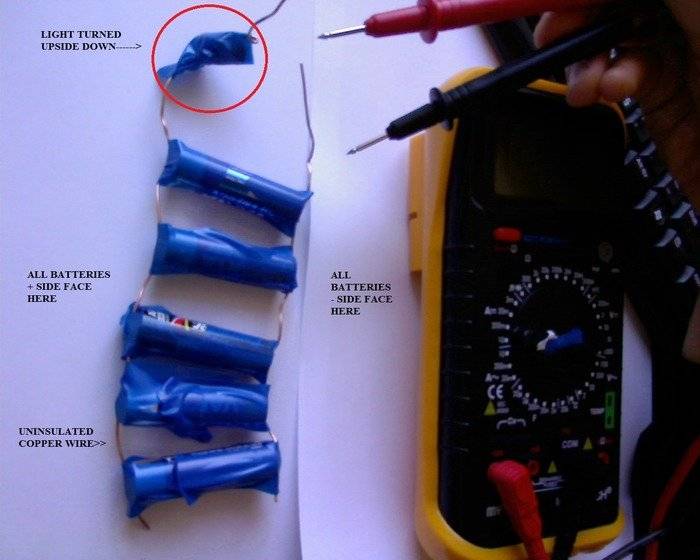
3308ns5.jpg


Details: Amps measured correctly by closing the circuit with multimeter probes (bulb lights up)
Posted this under "physics education" because my question is trivial. I am very new to electronics.
 
Engineering news on Phys.org
trickybilly said:
Volts stay the same but should not Amps add up in parallel?
How?
Have you studied Ohm's law?

Also, post such conceptual questions in general physics or classical physics (or EE) forums. For posting in HH forums, you should fill up the three-part template with an attempt at a solution.
 
  • Like
Likes   Reactions: trickybilly
Mod note: Thread moved to Electrical Engineering Forum.
 
trickybilly said:
Batteries are connected in parallel. Multimeter shows: 1,5V AND... "0.12A" regardless of battery number. Volts stay the same but should not Amps add up in parallel? "0.12A" with 4, 5 or 6 batteries...
It seems that you are powering a light globe from some 1.5V cells, and you are finding that the current to the bulb stays unchanged regardless of how many cells you connect in parallel?

Were you expecting that with more cells connected there would be more amps through your light globe?

Contrast what you are doing here with what happens in a different experiment where you connect the extra cells in series.
 
NascentOxygen said:
Were you expecting that with more cells connected there would be more amps through your light bulb?
Yes. One 1,5V battery cannot light the bulb up. When I connect batteries in parallel voltage remains the same "1,5V" (regardless of how many batteries I connect), so something else must change since the light NOW shines with 4, 5 or 6 batteries connected in parallel.
When you connect batteries in series voltage rises, amps stay the same - so I thought when you connect batteries in parallel voltage stays the same, but amps rise. Otherwise why is the bulb shining with 5 batteries and not with 1, when voltage is 1,5V in both cases?
 
trickybilly said:
Yes. One 1,5V battery cannot light the bulb up. When I connect batteries in parallel voltage remains the same "1,5V" (regardless of how many batteries I connect), so something else must change since the light NOW shines with 4, 5 or 6 batteries connected in parallel.
Something else is going on, something that you haven't considered. When you measure the voltage and report it as being 1.5V, you should be measuring the voltage across the light globe when it's powered. So connect your meter across the light globe and tell us that voltage with 1 cell, then with 2 cells, and so on.

When you connect batteries in series voltage rises, amps stay the same
Amps stay the same? Can you use Ohm's Law to show that you are right?

- so I thought when you connect batteries in parallel voltage stays the same, but amps rise. Otherwise why is the bulb shining with 5 batteries and not with 1, when voltage is 1,5V in both cases?
Something else is happening to confuse you.
 
  • Like
Likes   Reactions: NTL2009
Batteries in parallel increase the available amps. You have a light bulb in circuit which at a given voltage requires a specific number of amps. Once you have enough batteries in parallel to able to source the number of amps required, you can add as many batteries as you wish and it will make no difference other than it will take longer to run the batteries down.
 
  • Like
Likes   Reactions: russ_watters, davenn, jim hardy and 1 other person
Batteries are rated in amp/hours, not amps (automotive batteries are also rated in CCA but that's a different ball of wax and still a measure of current over time).

If you connect batteries in parallel, the voltage remains the same, thus the current remains the same across the same load. If you connect a 12 Vdc battery across a 24 ohm resistor, you will induce a current flow of 0.5 amps. It doesn't matter whether the battery has a storage capacity of 3 amp/hours or 300 amp/hours. If you want to increase the current through the load you need to increase the voltage of your power supply or decrease the resistance of the load.
 
XZ923 said:
Batteries are rated in amp/hours, not amps
That should not be read as "Batteries are rated in amperes per hours, not amperes." because that would be incorrect.

What it should be is "Batteries are rated in ampere hours, not amperes". Though in the exercise in question, even with the correction it seems unhelpful because it is difficult to construe that to account for OP's observation.
 
  • #10
The amount of current which flows is determined by the resistance of the bulb and the supply voltage.
These will be more or less the same regardless of how many parallel batteries you have.
(The bulb resistance might vary a small amount when hot at opposed to cold, but not enough to make much difference)
 

Similar threads

  • · Replies 15 ·
Replies
15
Views
2K
  • · Replies 17 ·
Replies
17
Views
3K
Replies
7
Views
3K
Replies
6
Views
2K
  • · Replies 10 ·
Replies
10
Views
2K
Replies
24
Views
5K
Replies
14
Views
3K
Replies
12
Views
3K
Replies
4
Views
2K
  • · Replies 14 ·
Replies
14
Views
5K