Solving a Belt and Pulley Question Using Simple Equations

  • Thread starter Thread starter Idrees27
  • Start date Start date
  • Tags Tags
    Belt Pulley
Click For Summary
SUMMARY

The discussion focuses on solving a belt and pulley problem using the equation (g(M-m))/(M+m) to determine the force magnitude. The user calculated a force of 6 kN based on masses M = 2500 kg and m = 600 kg. The equation is confirmed to be correct for this scenario, although alternative methods, such as calculating net force from belt tension, are suggested for clarity. The conversation highlights the importance of understanding the underlying physics principles in pulley systems.

PREREQUISITES
  • Understanding of Newton's laws of motion
  • Familiarity with basic mechanics concepts, specifically pulleys
  • Knowledge of force calculations and vector addition
  • Ability to interpret and manipulate equations involving mass and gravity
NEXT STEPS
  • Study the principles of pulley systems in classical mechanics
  • Learn about vector addition in force calculations
  • Explore alternative methods for calculating tension in belt systems
  • Review examples of single and multiple pulley systems for comparative analysis
USEFUL FOR

Students in physics, mechanical engineers, and anyone interested in understanding the dynamics of belt and pulley systems.

Idrees27
Messages
2
Reaction score
0
Hi guys,

I am working on a simple belt and pulley question, as pictured below.
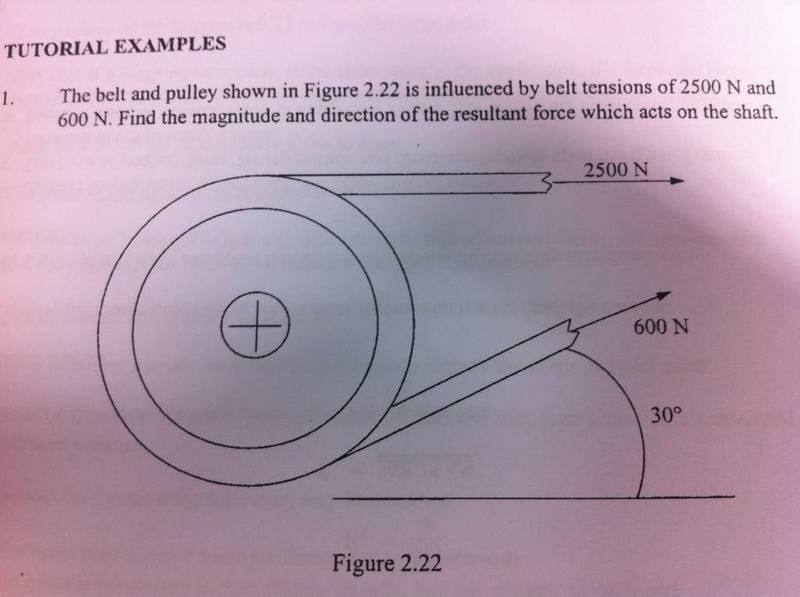
4a7b0128.jpg


To find the magnitude, I used the following equation:

(g(M-m))/(M+m)

So,

9.81(2500-600)/(2500+600) = 6.01 - Answer = 6kN

Is this correct, or am I doing it totally wrong? I have searched for the same question but didn't find any like this with a single pulley, all other examples seem to show 2 pulleys.

Any help would be greatly appreciated.
 
Physics news on Phys.org
Idrees27 said:
To find the magnitude, I used the following equation:

(g(M-m))/(M+m)
I don't understand that expression. Where did you get it? (Are m and M masses?)

In any case, why not just find the net force on the pulley due to the belt tension? Add up those tension forces vectorially.
 
Doc Al said:
I don't understand that expression. Where did you get it? (Are m and M masses?)

In any case, why not just find the net force on the pulley due to the belt tension? Add up those tension forces vectorially.
Yes, they are masses. That's a formula I found via Google.

How would you attempt the whole question?
 
Idrees27 said:
Yes, they are masses. That's a formula I found via Google.
Masses of what? How is that relevant?
How would you attempt the whole question?
Do as I suggested in my last post.
 

Similar threads

  • · Replies 2 ·
Replies
2
Views
2K
  • · Replies 22 ·
Replies
22
Views
7K
Replies
25
Views
4K
  • · Replies 10 ·
Replies
10
Views
1K
  • · Replies 22 ·
Replies
22
Views
1K
Replies
4
Views
2K
  • · Replies 30 ·
2
Replies
30
Views
4K
  • · Replies 9 ·
Replies
9
Views
2K
  • · Replies 13 ·
Replies
13
Views
7K
  • · Replies 15 ·
Replies
15
Views
2K