Block on a Plane (Classical Mechanics)

Click For Summary
SUMMARY

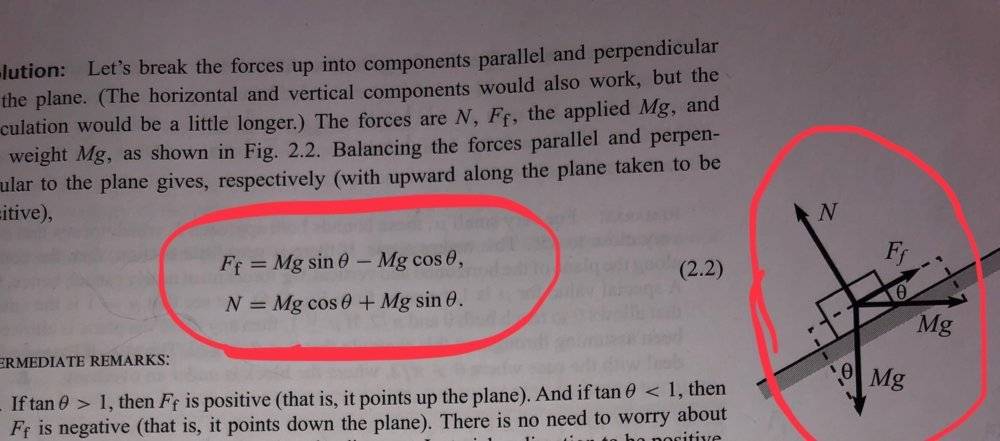
The discussion focuses on calculating the friction force and normal force for a block resting on an inclined plane under the influence of a horizontal force, denoted as Mg. Participants clarify that the solution involves balancing forces in both tangential and normal directions, emphasizing the importance of understanding the problem statement. The key takeaway is that drawing separate arrows for parallel and perpendicular components simplifies the analysis, allowing for a clearer understanding of the force balance equations.

PREREQUISITES
  • Understanding of classical mechanics principles, particularly forces on inclined planes.
  • Familiarity with force balance equations in both tangential and normal directions.
  • Ability to decompose forces into components, specifically in inclined scenarios.
  • Knowledge of friction forces and their role in maintaining equilibrium.
NEXT STEPS
  • Study the derivation of force balance equations for inclined planes in classical mechanics.
  • Learn about the role of friction in static equilibrium scenarios.
  • Explore vector decomposition techniques for forces acting on inclined surfaces.
  • Review examples of similar problems involving inclined planes and horizontal forces.
USEFUL FOR

Students of classical mechanics, physics educators, and anyone seeking to deepen their understanding of force analysis on inclined planes.
vcm1992
Messages
5
Reaction score
1
I've taken intro to classical mechanics, but am really not sure about how this example calculates the friction force and the normal force...I usually break down the force vector into components, and I understand that this is probably a much more simple way to calculate the perpendicular and parallel forces, I just can't really grasp how the author is coming to these conclusions. Sorry if this is a really simple problem! Any help or other textbooks that might explain this would be appreciated! Thanks.
IMG-3562.JPG
 
Physics news on Phys.org
You have shown us the solution from your textbook, but not the problem that it's a solution for. From the third sentence of the solution and the drawing, it appears that there is a horizontal force ##Mg## applied to the block in addition to the vertical force of gravity. Given that, the equations for ##F_f## and ##N## are just the force balance equations in the tangential and normal directions.
 
We might very well ask why Mg acts in both the horizontal and vertical directions. This looks like a mistake to me.
 
Dr.D said:
We might very well ask why Mg acts in both the horizontal and vertical directions. This looks like a mistake to me.
We won't know until we see the problem statement.
 
vcm1992 said:
I just can't really grasp how the author is coming to these conclusions.
By balancing all forces parallel and perpendicular to the plane, as the text says. It might help you to draw the parallel and perpendicular components as separate arrows.
 
tnich said:
You have shown us the solution from your textbook, but not the problem that it's a solution for. From the third sentence of the solution and the drawing, it appears that there is a horizontal force ##Mg## applied to the block in addition to the vertical force of gravity. Given that, the equations for ##F_f## and ##N## are just the force balance equations in the tangential and normal directions.

The problem states that "A block of mass M rests on a fixed plane inclined at an angle theta. You apply a horizontal force Mg on the block. Assume friction force is enough to keep the block at rest. What are the normal and friction forces that the plane exerts on the block? For what range of angles will the block remain at rest?"

I understand that these are the force balance equations and I have no doubt that they are correct, I think that my question is more why are they correct? As I said, my professor taught breaking down force vectors into x and y components, so I do not understand HOW this balance equation is true. What is the assumption here? Thanks!
 
A.T. said:
By balancing all forces parallel and perpendicular to the plane, as the text says. It might help you to draw the parallel and perpendicular components as separate arrows.

Hi, thank you so much for this advice! Although I did break it up into components before, I finally grasp the logic. I really feel like this way should have been taught as it does make it easier to orient the components with respect to the plane and not the x and y axis. Thank goodness this finally makes sense.

IMG-3563.JPG
 
  • Like
Likes   Reactions: A.T.

Similar threads

  • · Replies 13 ·
Replies
13
Views
3K
  • · Replies 5 ·
Replies
5
Views
3K
  • · Replies 20 ·
Replies
20
Views
4K
  • · Replies 3 ·
Replies
3
Views
2K
  • · Replies 1 ·
Replies
1
Views
1K
  • · Replies 9 ·
Replies
9
Views
3K
  • · Replies 4 ·
Replies
4
Views
3K
  • · Replies 11 ·
Replies
11
Views
2K
  • · Replies 1 ·
Replies
1
Views
1K
  • · Replies 2 ·
Replies
2
Views
2K