Block released on frictionless ramp hits spring

Click For Summary
SUMMARY

The discussion centers on calculating the speed of a block at point C after it travels down a frictionless ramp and compresses a spring. The participant initially derived the speed using energy conservation principles, resulting in the equation Vc = √(2g(h-μ)(C-B)). However, the professor's simpler solution, Vc = d√(k/m), indicates a misunderstanding of the problem's requirements. The key takeaway is that the participant's approach, while mathematically sound, did not align with the problem's focus on spring compression rather than speed.

PREREQUISITES
  • Understanding of kinetic and potential energy in physics
  • Familiarity with the concepts of friction and energy loss
  • Knowledge of spring mechanics and Hooke's Law
  • Ability to manipulate algebraic equations for problem-solving
NEXT STEPS
  • Study the conservation of mechanical energy in systems with friction
  • Learn about Hooke's Law and spring constant calculations
  • Explore energy loss due to friction in practical scenarios
  • Practice solving physics problems involving multiple energy forms
USEFUL FOR

Students preparing for physics exams, educators teaching energy conservation, and anyone interested in understanding the dynamics of blocks on ramps and spring mechanics.

AmagicalFishy
Messages
50
Reaction score
1
Hi, folks. Studying for an upcoming Physics exam. I've got a few example problems which the professor has solved—and am getting a different answer, but I don't know where the fault is in my reasoning. Could someone tell me whether or not my answer is, too, correct?
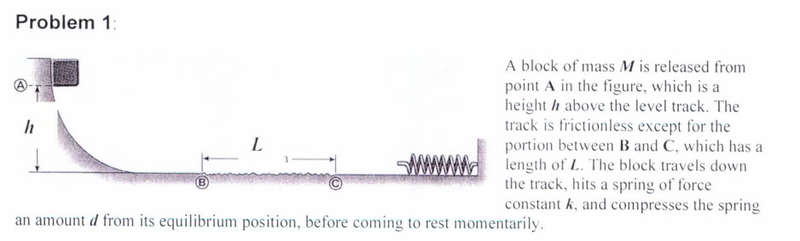
Homework Statement


PhysicsProblem.jpg


Find the speed of the block at point C.

Homework Equations


Kinetic Energy at Point A = 0

Potential Energy at Point A = Mgh

Kinetic Energy at Point B = \frac{1}{2}MVB2

Potential Energy at Point B = 0

Velocity at Point B = \sqrt{2gh}

Work of Friction = μN(C-B) [μ is the frictional coefficient. N is the normal force. C-B is the distance the block travels on the surface with friction]

The Attempt at a Solution


I came up with this equation, essentially saying the energy of friction from point B to C taken away from the kinetic energy of the block at point B equals the kinetic energy of the block at point C.

M(\sqrt{2gh})2/2 - μN(C-B) = MVc2/2 Which simplifies to:

Mgh - μN(C-B) = MVc2/2

Mgh - μMg(C-B) = MVc2/2

Mg(h-μ)(C-B) = MVc2/2

Solve for Vc to get:

Vc = \sqrt{2g(h-μ)(C-B)}

----------

The answer my professor gave was: d\sqrt{k/m}

Where d is the point at which the Block compressed the spring by amount d, and k is the spring-coefficient. This answer is much simpler, without a doubt, but I'd like to know if my answer is wrong.

Any help?
 
Last edited:
Physics news on Phys.org
AmagicalFishy said:
M(\sqrt{2gh})2/2 - μN(C-B) = MVc2/2 Which simplifies to:

Mgh - μN(C-B) = MVc2/2

Mgh - μMg(C-B) = MVc2/2
OK. Replace "C-B" with L.

Mg(h-μ)(C-B) = MVc2/2

Solve for Vc to get:

Vc = \sqrt{2g(h-μ)(C-B)}
You messed up the simplification.

But more importantly, you are solving for the speed at C for some reason. Instead, you want the maximum compression of the spring. Rather that worry about speed, just think in terms of energy. How much energy is left to compress the spring?
 
May I addd that by inspecting dimensions you can very easily spot that there is something wrong with your final equation, because in the term h-μ you are subtracting a dimensionless number from a number with dimension length which is a no-no.
 
Doc Al said:
But more importantly, you are solving for the speed at C for some reason. Instead, you want the maximum compression of the spring. Rather that worry about speed, just think in terms of energy. How much energy is left to compress the spring?
The problem asks for the speed of the block at C. Isn't that what I'm supposed to be solving for?

Filip Larsen said:
May I addd that by inspecting dimensions you can very easily spot that there is something wrong with your final equation, because in the term h-μ you are subtracting a dimensionless number from a number with dimension length which is a no-no.
When you distribute the 2g, it's technically 2hg - 2μg — or does that not matter?

So, then, the answer that I got wasn't different, it was just wrong?
 
AmagicalFishy said:
The problem asks for the speed of the block at C. Isn't that what I'm supposed to be solving for?
You actually never posted what the problem was asking for. But since your professor gave an answer for 'd', I assume that's what you were expected to find.


When you distribute the 2g, it's technically 2hg - 2μg — or does that not matter?

So, then, the answer that I got wasn't different, it was just wrong?
Yes, you solved for the speed at C and got the wrong answer. Here's where you went wrong:
AmagicalFishy said:
Mgh - μMg(C-B) = MVc2/2
OK.

Mg(h-μ)(C-B) = MVc2/2
Not OK.

Mgh - μMg(C-B) = Mg[h - μ(C-B)] ≠ Mg(h-μ)(C-B)

(But use L for the length C-B, since that's what's given.)
 
I underlined and bolded what the problem asked for under the picture. I was hoping the underline would emphasize it a bit, but it is a bit hard to catch. Sorry about that.

Though, I very much appreciate the mathematical correction. Now, if I'm not (again) mistaken, the correct answer is:

\sqrt{2g(h-μL)} = Vc

Now, even though my professor and I expressed this answer differently (indicative of us solving it differently), is my answer wrong? I imagine I'm going to solve problems differently on the test, so I just want to make sure that I can at least get the right answer.
 
Last edited:
AmagicalFishy said:
Though, I very much appreciate the mathematical correction. Now, if I'm not (again) mistaken, the correct answer is:

\sqrt{2g(h-μL)} = Vc
Good. That's the correct answer for Vc.
Now, even though my professor and I expressed this answer differently (indicative of us solving it differently), is my answer wrong?
Your professor and you answered different questions. You solved for the velocity at C; your professor solved for the distance the spring was compressed. One of you answered the wrong question.

Unless this was a multiple part question, I would have assumed that the question asked for the compression of the spring and not Vc. Otherwise why add the spring? (Unless he messed up and asked the wrong question!)
 
He may have solved the wrong question. Here was his approach, just to make sure:

Vx = Velocity at Point x
Ex = Total Mechanical Energy at Point x
Kx = Kinetic Energy at Point x
Ux = Potential Energy at Point x
M = Mass of Block
d = Point at which the spring is fully compressed
c = Point C (in diagram)
k = Spring Constant

—————

Kc = \frac{1}{2}MVc2

Uc = 0

Kd = 0

Ud = \frac{1}{2}kd2

—————

Ed = Ec

\frac{1}{2}MVc2 = \frac{1}{2}kd2

Solve for Vc and get. . .

Vc = d\sqrt{k/m}

—————

It seems like he solved for Vc, just very differently. Sorry to pester (believe it or not, very slowly typing out the processes involved in solving these problems is helping me. :smile:). Thanks for your help, by the way.
 
Wait! I've figured out why my answer doesn't work.

Mechanical energy isn't conserved on a surface with friction—some of that energy inevitably turns into heat energy, right?
 
  • #10
AmagicalFishy said:
It seems like he solved for Vc, just very differently. Sorry to pester (believe it or not, very slowly typing out the processes involved in solving these problems is helping me. :smile:). Thanks for your help, by the way.
Ah, my bad. I misread your professor's answer. He wasn't solving for d, he was using d to solve for Vc. (Just like you said!)

Either method is valid. You found Vc in terms of the original height and friction; he found Vc in terms of d.
AmagicalFishy said:
Wait! I've figured out why my answer doesn't work.

Mechanical energy isn't conserved on a surface with friction—some of that energy inevitably turns into heat energy, right?
Your answer is perfectly OK--you already included the loss of energy due to friction in your answer.

Unless your professor stated that he wanted Vc in terms of d, then your answer is fine.
 
  • #11
One small issue is that the problem statement did not specify the coefficient of friction, or even mention it. So it's not one of the variables or constants "on the menu", so to speak.
 
  • #12
gneill said:
One small issue is that the problem statement did not specify the coefficient of friction, or even mention it. So it's not one of the variables or constants "on the menu", so to speak.
Excellent point! I'm embarrassed to say that I missed that entirely. :redface:

Since you don't have--even symbolically--any information about the coefficient of friction, your only choice is to do what your professor did: Solve for Vc in terms of d, which is given. (So in that sense your answer is wrong.)

(Of course the next logical step might be to solve for μ in terms of the given data. That can be done.)
 

Similar threads

  • · Replies 12 ·
Replies
12
Views
3K
Replies
8
Views
6K
Replies
1
Views
1K
  • · Replies 29 ·
Replies
29
Views
1K
  • · Replies 58 ·
2
Replies
58
Views
3K
  • · Replies 4 ·
Replies
4
Views
2K
  • · Replies 3 ·
Replies
3
Views
2K
Replies
24
Views
4K
Replies
29
Views
3K
Replies
30
Views
2K