Science Advisor
Homework Helper
Dearly Missed
- 9,864
- 4,896
interesting discussion of the approach here:
http://flyingprofessors.net/what-happened-to-asiana-airlines-flight-214-2/
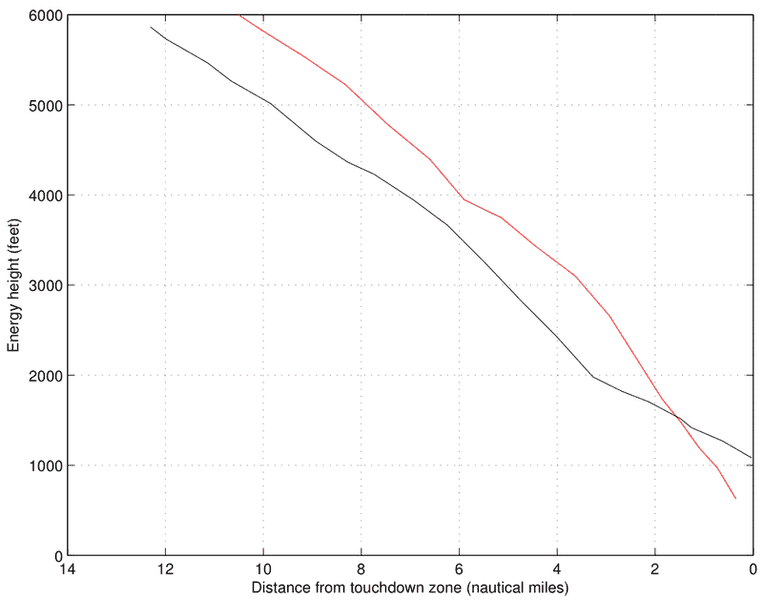
He compares this landing to one by another 777 ten minutes earlier from an energy perspective..
disclaimer - it's not an official report. But it looked apropos for a physics forum...
old jim
http://flyingprofessors.net/what-happened-to-asiana-airlines-flight-214-2/
He compares this landing to one by another 777 ten minutes earlier from an energy perspective..
On the other hand, AAR214 was never on a stabilized approach. Until about 30 sec before touchdown, it was high and fast. Only 3 miles out, it's 20 or 25 knots too fast, and 500 feet high. As a result, the pilot no doubt reduced power to intercept the glideslope from above. 1.5 nm out (nominally less than 40 sec from touchdown), he's finally on glideslope and at V ref , but with a high sink rate on low engine power. If he applied power at that point, the engines would take some time (a few seconds) to spool up, and he would further sink below glide slope, slow down, or both.
The situation can be appreciated more precisely (but more technically) by looking at the total energy of the aircraft, that is, the sum of the potential energy due to altitude plus the kinetic energy due to velocity. The total energy is given by
E=mgh+1 2 mv 2
where m is the mass of the aircraft, g is the acceleration due to gravity, h is the height of the aircraft, and v is the velocity. Because we don't know the weight of the aircraft, it's convenient to normalize the energy by mg , yielding the energy height
h E =h+v 2 2g
The plot below compares the energy height for the two aircraft:
Note that the energy of UAL852 decreases at a steady rate until about 6 nm out, where the rate of energy dissipation increases, because the aircraft is slowing. At about 3.5 nm out, the rate decreases, because the aircraft has hit its target approach speed and stops slowing down.
AAR214 has a much different trajectory. At about 3 nm out, the rate of energy dissipation increases a lot, because the aircraft is both too high and too fast. As a result, the power is reduced significantly, perhaps even to near idle, in order to simultaneously slow the aircraft and get it down to the glideslope. At about 1.5 nm out, it has about the right airspeed and altitude (and therefore energy), but the energy continues to decrease precipitously. If the pilot added enough power at this point, a safe landing might have been possible. But it takes several seconds for the engines to spool up, and the pilot may not have added enough power or done so early enough, so both the altitude and airspeed continue to decrease below their desired values. Indeed, at the last radar return, AAR214 would have been near its stall speed, and unable to pull up.
disclaimer - it's not an official report. But it looked apropos for a physics forum...
old jim
 . That might explain a lot. The fact that you can do something doesn't mean you know how to teach, or supervise others!
