Bridge Collapse Genoa - Informed Engineering Perspectives
- Thread starter epenguin
- Start date
-
- Tags
- Bridge Collapse Engineering
Join the discussion
Registration is free. Start your own thread to ask a follow-up.
43 replies · 13K views
Engineering news on Phys.org
Science Advisor
2025 Award
- 17,270
- 10,730
I have never gone to the NYT for engineering information or advice. Your experience may be different.cjl said:Why do you not think the NYT is a trusted source? I have usually found them to be fairly reliable.
When it comes to the rational engineering analysis of bridge structures, there can be nothing more corrosive and damaging than reports that include the emotional response of the unfortunate victims.
All engineering evidence reported in the NYT article will now need to be re-examined and decontaminated before it can be used to support any hypothesis. Indeed, the inclusion of that article in this thread has done more to undermine rational engineering analysis than it has to understand the reasons behind the structural failure.
Printing something in a newspaper does not make it true. The author of that NYT article is clearly interested in selling entertainment. We do not yet know what political barrow they are pushing, or who they will point their uneducated finger of blame at next.
Science Advisor
Homework Helper
Dearly Missed
- 9,864
- 4,896
Somebody seems to have been worried over the years about the stay attachments.
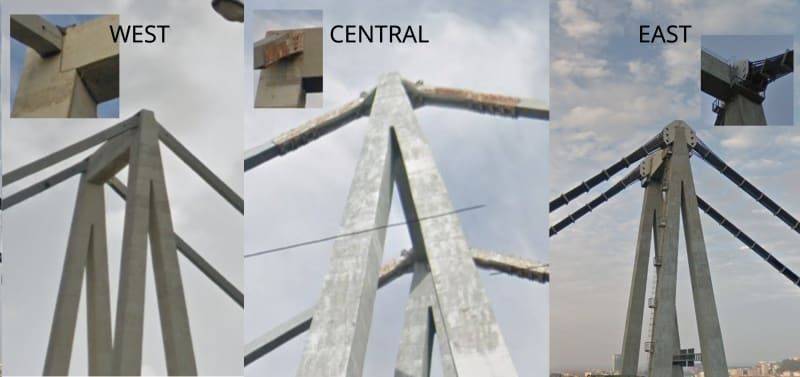
https://www.eng-tips.com/viewthread.cfm?qid=443075
https://www.eng-tips.com/viewthread.cfm?qid=443075
Attachments

Science Advisor
- 1,567
- 5,226
This link was in Jim's post above.
https://files.engineering.com/getfi...sc=212727627.1.1536693115435&__hsfp=494127832
the full project explained in details by the designer himself, Mr Morandi
https://files.engineering.com/getfi...sc=212727627.1.1536693115435&__hsfp=494127832
the full project explained in details by the designer himself, Mr Morandi
Science Advisor
Homework Helper
Gold Member
- 10,546
- 2,324
Indeed. Soon after the accident there was an article in the UK press that said that some of the stays had been reinforced but not those on the tower that collapsed.jim hardy said:Somebody seems to have been worried over the years about the stay attachments.
View attachment 230548
https://www.eng-tips.com/viewthread.cfm?qid=443075
Science Advisor
Homework Helper
Dearly Missed
- 9,864
- 4,896
It's a few meg pdf file, and in Italian, but has interesting pictures during construction.
Those stay attachments were added sometime after 1968.
Which doesn't really mean a thing .
The stays themselves are encased in concrete that's why they're square. . I don't know what provisions there were for inspection.
There are in that document @nsaspook linked some pictures of them before the concrete cover was put on.
Hey - @ worked first time ! Something has changed !
Those stay attachments were added sometime after 1968.
Which doesn't really mean a thing .
The stays themselves are encased in concrete that's why they're square. . I don't know what provisions there were for inspection.
There are in that document @nsaspook linked some pictures of them before the concrete cover was put on.
Hey - @ worked first time ! Something has changed !
Mentor
- 8,478
- 5,700
A recent newspaper article points to poor maintenance as the probable cause for the collapse:
https://www.theguardian.com/cities/...lapse-and-the-end-of-an-italian-national-myth
https://www.theguardian.com/cities/...lapse-and-the-end-of-an-italian-national-myth
alantheastronomer
- 256
- 77
This might not have anything to do with the bridge collapse, but I noticed that in cases where old rebar is newly exposed that the rebar is severely rusted out. How would this affect the material's ability to handle stress? How does rebar rust while it's encased in concrete? Does it occur while the concrete is curing? Now that there are coatings to prevent corrosion shouldn't rebar be treated before being used?
Science Advisor
Gold Member
- 5,661
- 4,509
If the old concrete is near salt water there is a chemical reaction between the chloride and the concrete. I don't recall the exact details, someone else here may be able to correct any errors, but here goes.
The chloride reaction weakens the concrete and makes it more hygroscopic. When the absorbed moisture reaches the rebar, it rusts. Since rust has approximately 13 times the volume of the steel, the expansion cracks the concrete, letting in more moisture.
Several years ago I lived in a building where this was happening. The individual concrete stair steps on a steel framework were cracking. The building was built on a concrete deck over underground parking which had the same problem, chunks of concrete were falling off the deck into the parking garage. I moved, the building is still there, so far.
Another example is the Gerald Desmond Bridge in Long Beach, Calif. It is being replaced for the same reason. The temporary "fix" for the bridge was to put steel nets under it to catch the concrete before it fell on the ships entering the port.
There is now an additive for concrete that supposedly avoids that chemical reaction, but it isn't always used; especially for imported products like concrete steps.
Cheers,
Tom
The chloride reaction weakens the concrete and makes it more hygroscopic. When the absorbed moisture reaches the rebar, it rusts. Since rust has approximately 13 times the volume of the steel, the expansion cracks the concrete, letting in more moisture.
Several years ago I lived in a building where this was happening. The individual concrete stair steps on a steel framework were cracking. The building was built on a concrete deck over underground parking which had the same problem, chunks of concrete were falling off the deck into the parking garage. I moved, the building is still there, so far.
Another example is the Gerald Desmond Bridge in Long Beach, Calif. It is being replaced for the same reason. The temporary "fix" for the bridge was to put steel nets under it to catch the concrete before it fell on the ships entering the port.
There is now an additive for concrete that supposedly avoids that chemical reaction, but it isn't always used; especially for imported products like concrete steps.
Cheers,
Tom
Science Advisor
2025 Award
- 17,270
- 10,730
Get with the times. Basalt rebar is stronger than steel, weighs less, and does not rust.Tom.G said:Since rust has approximately 13 times the volume of the steel, the expansion cracks the concrete, letting in more moisture.
https://basalt-rebar.com/
Science Advisor
Homework Helper
Dearly Missed
- 9,864
- 4,896

Science Advisor
Gold Member
- 5,661
- 4,509
Baluncore said https://www.physicsforums.com/threa...ering-perspectives.953337/page-2#post-6141799
Get with the times. Basalt rebar is stronger than steel, weighs less, and does not rust.
https://basalt-rebar.com/
. . . . . . . . . .
An alternate product. Thanks, I learned something new.
The website says the stuff is a natural-fiberglass reinforced polymer but stronger than the fiberglass version.
Get with the times. Basalt rebar is stronger than steel, weighs less, and does not rust.
https://basalt-rebar.com/
. . . . . . . . . .
An alternate product. Thanks, I learned something new.
The website says the stuff is a natural-fiberglass reinforced polymer but stronger than the fiberglass version.
