Calculate the distribution of energies from momenta

  • Level: Graduate 
  • Thread starter Thread starter SchroedingersLion
  • Start date Start date
  • Tags Tags
    Distribution Energies
Join the discussion
Registration is free. Start your own thread to ask a follow-up.
17 replies · 3K views
SchroedingersLion
Messages
211
Reaction score
56
TL;DR
Question to a derivation in the book "An Introduction to Statistical Mechanics and Thermodynamics" by R. H. Swendsen (second edition).
Greetings!

I started working through a book of statistical mechanics, and I struggle with properly deriving a formula that makes intuitive sense. I will describe the situation and then my own solution attempts.

Suppose we have two systems ##j## and ##k## of volumes ##V_j## and ##V_k## and particle numbers ##N_j## and ##N_k##. The particles do not interact. The systems are isolated from each other. Suppose we are given the total energy ##E## and we are interested in the probability distribution ##P(E_j, E_k)## where ##E_j + E_k = E = const##. We make the assumption that all particle momenta are equally likely, but they satisfy the constraint ## E=\sum_i^N \frac{p_i^2}{2m} ##, where ##p_i## is the momentum of the ##i-th## particle, ##m## the particle mass, and ##N=N_j + N_k##. The same energy-momentum relation holds in each subsystem.

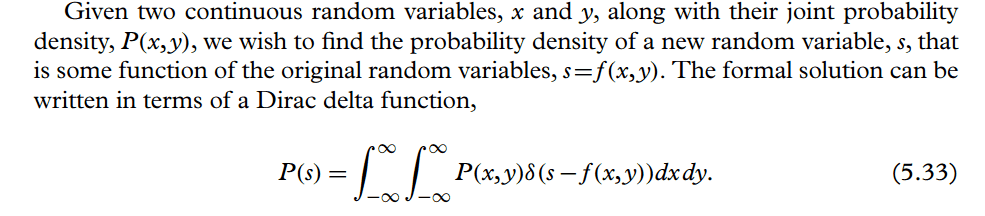
Now consider this section that the author allegedly makes use of:
book1.png

I already found a heuristic proof for this, so let's accept this as a given fact.

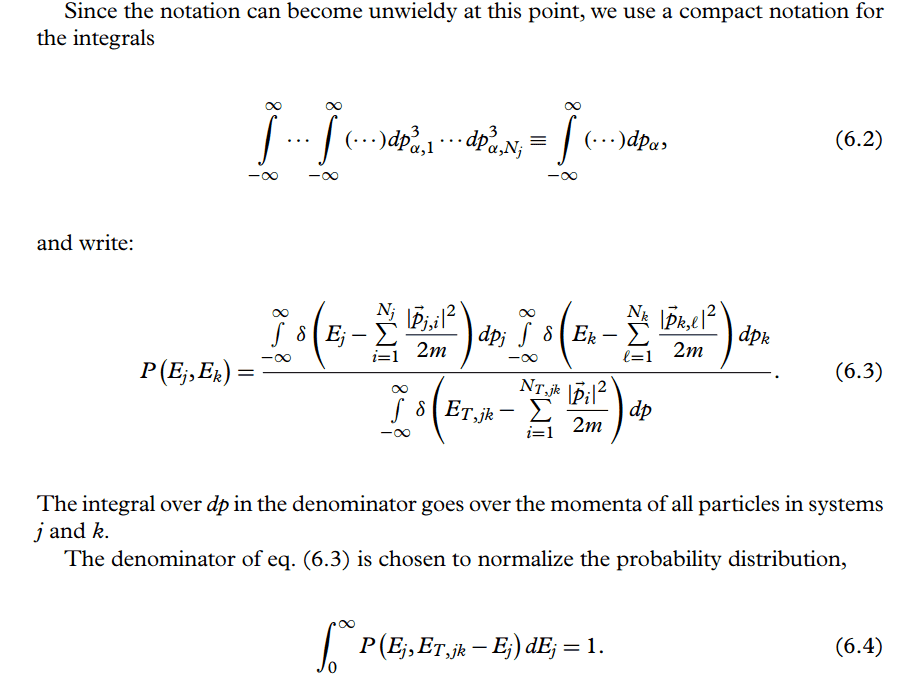
Now he wants to derive the distribution of the two energies from the momenta making use of (5.33). He writes:
book2.png


---
I don't understand how he actually ended up at (6.3). Given (5.33), what we can write is
$$\begin{align}
p_{E_j}(E_j) & = \int_{-\infty}^{\infty} p_{p_j}(p_{j,1},p_{j,2},...) \delta \left( E_j - \sum_{i}^{N_j} \frac{p_{j,i}^2}{2m} \right) \, dp_j , \\
p_{E_k}(E_k) &= \int_{-\infty}^{\infty} p_{p_k}(p_{k,1},p_{k,2},...) \delta \left( E_k - \sum_{i}^{N_k} \frac{p_{k,i}^2}{2m} \right) \, dp_k,
\end{align}$$
where ##p_{p_x}## and ##p_{E_x}## are the distributions of momenta and energies in system ##x##.

The joint distribution of all momenta should be writable as
$$
p(p_{1}, p_{2},...) = \frac{ \delta \left( E- \sum_i^N \frac{p_i^2}{2m}\right) } {\int_{-\infty}^{\infty} \delta \left( E- \sum_i^N \frac{p_i^2}{2m}\right) \, dp}.
$$

Now, all the delta functions are there, one just has to combine them properly...
It is clear that ##P(E_j, E_k) \neq p_{E_j}(E_j) p_{E_k}(E_k)## (since the energies in the subsystems are linearly dependent, i.e. fully correlated). In the same way, the joint momentum distribution cannot be written as a product of the joint distributions in the subsystems...
It is also clear that ##p_{E_k}(E_k) = p_{E_j}(E-E_k) ##.
If one interprets the delta-"functions" as living under energy integrals, one can also write
$$
\delta \left( E- \sum_i^N \frac{p_i^2}{2m}\right) = \delta \left( E_j - \sum_{i}^{N_j} \frac{p_{j,i}^2}{2m} \right)\delta \left( E_k - \sum_{i}^{N_k} \frac{p_{k,i}^2}{2m} \right). $$

Any idea from here?
I am always frustrated by the lack of derivations and / or mathematical rigor in physics books. I spent more time thinking about derivations such as these than actually learning the physics...
 
Physics news on Phys.org
Your last formula with the relation
[tex]E=E_j+E_k[/tex]
says
LHS: spherical shell in 3N dimension p-space
RHS: spherical shell in 3N_j dimension * spherical shell in N_k dimension, p-spaces
RHS is cut of sherical shell in two sub spaces.
so RHS should be integrated to be right one wrt LHS as
[tex]\delta(E-...)=\int \int \delta(E_j-...) \delta(E_k-...) \delta(E-E_j-E_k)dE_jdE_k[/tex]
 
  • Like
Likes   Reactions: SchroedingersLion
I agree to that, but how does this relation help me in deriving (6.3) from above?
 
As for (6.3)
Numerator : (volume of spherical shell in ##3N_i## dimension p-space for radius^2##=E_i## )*(volume of spherical shell in ##3N_j## dimension p-space for radius^2=##E_j##)
Denominator: volume of spherical shell in ##3N=3(N_i+N_j)## dimension p-space for radius^2##=E##

Numerator consists of cut two parts of Denominator by plane ##E_j=E-E_i## for specific ##E_i## and ##E_j##. So by integrating cut parts
[tex]\frac{\int \int \delta(E-E_i-E_j) Numerator \ dE_idE_j}{Denominator}=1[/tex]

It means
[tex]\frac{Numerator}{Denominator}=p(E_i,E_j)[/tex]
 
Last edited:
anuttarasammyak said:
As for (6.3)
Numerator : (volume of spherical shell in ##3N_i## dimension p-space for radius^2##=E_i## )*(volume of spherical shell in ##3N_j## dimension p-space for radius^2=##E_j##)
Denominator: volume of spherical shell in ##3N=3(N_i+N_j)## dimension p-space for radius^2##=E##
I understand this part.
anuttarasammyak said:
Numerator consists of cut two parts of Denominator by plane ##E_j=E-E_i## for specific ##E_i## and ##E_j##. So by integrating cut parts
[tex]\frac{\int \int \delta(E-E_i-E_j) Numerator \ dE_idE_j}{Denominator}=1[/tex]
I don't quite get the "cut two parts" stuff. I see that the equation is correct, but just because the integral is 1 does not mean that the following is the correct density:

anuttarasammyak said:
It means
[tex]\frac{Numerator}{Denominator}=p(E_i,E_j)[/tex]

Does he even make use of eq. (5.33)?
 
SchroedingersLion said:
I don't quite get the "cut two parts" stuff.
For an example 3D sphere shell
[tex]x^2+y^2+z^2=c^2[/tex]
is cut with cross section of 2D sphere shell (circle) and 1D sphere shell (##\pm b##) ,i.e.
[tex]x^2+y^2=a^2[/tex]
[tex]z^2=b^2[/tex]
where ##a^2+b^2=c^2##.

example #2
4D sphere shell
[tex]x^2+y^2+z^2+s^2=c^2[/tex]
is cut with cross section of two 2D sphere shells (circles) ,i.e.
[tex]x^2+y^2=a^2[/tex]
[tex]z^2+s^2=b^2[/tex]
where ##a^2+b^2=c^2##.

Integration of the cross sections with all the possible b and c restores the original sphere shell.
Area of cross sections (=Numerator) depends on the way of cutting and since we postulate that number density of states is homogeneous on the sphere shell of the defined volume ( =Denominator) , it seems reasonable that Numerator / Denominator equals probability that such a cut, i.e. division of energy to ##E_i## and ##E_j## to each group, takes place, i.e. ##p(E_i,E_j)##.

In case of example #2 the largest cross section, i.e. most probable case is
[tex]x^2+y^2=c^2/2[/tex]
[tex]z^2+s^2=c^2/2[/tex]
equal distribution of energy to the two groups.
 
Last edited:
  • Like
Likes   Reactions: SchroedingersLion
Thanks for the examples, @anuttarasammyak , I am beginning to understand this geometric approach.

But shouldn't the density then be given by
$$
p(E_j, E_k) = \frac{\delta\left(E-E_j - E_k\right) numerator }{denominator}?
$$
Since integrating this over ##E_j## and ##E_k## gives 1. And integrating this numerator over small energy intervals would give fractions of the area of the 3N-sphere. Dividing this fraction by the total area given in the denominator gives the probability to find the energies in the intervals.

That would imply that (6.3) is incomplete.
 
Last edited:
By author's definition
[tex]\int \int p(E_j,E_k)\delta(E-E_j-E_k)dE_jdE_k = \int p(E_j,E-E_j)dE_j=1[/tex]
By your defnition
[tex]\int \int p(E_j,E_k)dE_jdE_k = \int \frac{Numerator(E_j,E-E_j)}{Denominator}dE_j=1[/tex]
So it depends on how the normalization is defined.
 
  • Like
Likes   Reactions: SchroedingersLion
Sorry guys, coming back to this, I still don't see a rigorous way to understand this.
Is there no way to derive this only with properties of the dirac delta and with (5.33)?

My new approach:
I only know the total energy E and how many particles are in each subsystem. If all momenta are equally likely given E, then the joint probability density for the momenta are given by
$$
P(p_{1}, p_{2},...) = \frac{ \delta \left( E- \sum_i^N \frac{p_i^2}{2m}\right) } {\int_{-\infty}^{\infty} \delta \left( E- \sum_i^N \frac{p_i^2}{2m}\right) \, dp} =: \frac {1}{Z} \delta \left( E- \sum_i^N \frac{p_i^2}{2m}\right).
$$

Now, according to (5.33), the density of ##E_j## is given by
$$\begin{align}
P(E_j) &=\int_{-\infty}^{\infty}P(p_{1}, p_{2},...) \delta \left( E_j - \sum_{i}^{N_j} \frac{p_{j,i}^2}{2m} \right) \, dp \\
&= \frac {1}{Z}\int_{-\infty}^{\infty} \delta \left( E- \sum_i^N \frac{p_i^2}{2m}\right) \delta \left( E_j - \sum_{i}^{N_j} \frac{p_{j,i}^2}{2m} \right)\, dp
\end{align}$$
But I am actually interested in ##P(E_j, E_k) = P(E_j) P(E_k | E_j)## with conditional density ##P(E_k | E_j)##. Since ##E_k = E - E_j##, the latter can be written as ##P(E_k | E_j) = \delta \left( E_k - (E-E_j)\right)##.
We thus arrive at
$$
P(E_j, E_k) = \frac {1}{Z}\int_{-\infty}^{\infty}\delta \left( E_k - (E-E_j)\right) \delta \left( E- \sum_i^N \frac{p_i^2}{2m}\right) \delta \left( E_j - \sum_{i}^{N_j} \frac{p_{j,i}^2}{2m} \right)\, dp
$$

Now, the integral somehow must be reasoned to be equal to the author's numerator in (6.3)...
 
Hello.

RHS of (4) has two energy parameters ##E## and ##E_j## so LHS should be written as
[tex]P(E_j\cap E)[/tex]
where I would say E_j has vale E_j and E has value E. Your ##P(E_j,E_k)=P(E_j \cap E_k) ## is same with it ?
 
Last edited:
  • Skeptical
Likes   Reactions: SchroedingersLion
The trick is that you just have to calculate the microcanonical integral
$$P(E)=\int \mathrm{d}^{3N} p \delta[E-\sum_{j=1}^N \vec{p}_j^2/(2m)].$$
Then you get the probability for a energy partition into ##E_A## and ##E_B## as
$$P_{\text{part}}(E_A)=\frac{P(E_A) P(E_B)}{P(E)}=\frac{P(E_A) P(E-E_A)}{P(E)}.$$
 
Last edited:
  • Like
Likes   Reactions: SchroedingersLion, etotheipi and Delta2
vanhees71 said:
The trick is that you just have to calculate the microcanonical integral
$$P(E)=\int \mathrm{d}^{3N} p \delta[E-\sum_{j=1}^N \vec{p}_j^2/(2m)].$$
Then you get the probability for a energy partition into ##E_A## and ##E_B## as
$$P_{\text{part}}(E_A)=\frac{P(E_A) P(E_B)}{P(E)}=\frac{P(E_A) P(E-E_A)}{P(E)}.$$
Thank you Vanhees, I think that's what I need. Even though I still don't understand why your second formula is obvious. Rewritten:
$$
P_{part}(E_A)P(E) = P(E_A)P(E_B)
$$

##E_A## is the event of having ##N_A## particles at energy ##E_A##. ##E_B## is the event of having ##N-N_A## particles at ##E_B##.
Are the events ##E_A## and ##E_B## independent, i.e. do we have at this point that ##P(E_A\cap E_B)=P(E_A)P(E_B)##?

Now ##E## is the event of having ##N## particles at energy ##E##. ##part(E_A)## then is the event of having energy ##E## distributed over the subsystems as ##E=E_A + E_B## ? Are those independent, i.e. do I have ##P(E \cap part(E_A)) = P(E)P(part(E_A))## ?

Now in case that both the independencies hold, how can I be sure that I have ##P(E_A\cap E_B)=P(E \cap part(E_A)) ## ?

Sorry if I am a bit slow...
 
I believe it is just a statement of Bayes theorem actually. Part of stuff worth knowing.
 
  • Like
Likes   Reactions: vanhees71
hutchphd said:
I believe it is just a statement of Bayes theorem actually. Part of stuff worth knowing.
Bayes rule for two events ##A,B##:
$$
P(A|B) = \frac{P(B|A)P(A)}{P(B)}
$$

So written for my events in my previous post:
$$
P(E_A | E) = \frac{P(E | E_A)P(E_A)}{P(E)}
$$

In order to obtain the desired shape given by @vanhees71 we need to have that ##P(E | E_A)=P(E_B)##. Does this make sense?
 
It does to me. If it doesn't to you, tell us why.
 
  • Like
Likes   Reactions: vanhees71
So if I know a priori that there are formally three systems ##(E,N), (E_A, N_A), (E_B,N_B)## with ##E=E_A+E_B## and ##N=N_A+N_B##, and now I am given ##E_A##... I would say that ##P(E|E_A)=P(E_B|E_A)##.
If I now assume that ##E_B## and ##E_A## are independent, then yes, we have ##P(E|E_A)=P(E_B)##.

But couldn't I also assume that ##E## and ##E_A## are independent? Then I had ##P(E)=P(E_B|E_A)##...
How do I know which independency to assume?
 
You choose them to suit your needs. But the constraint holds regardless.
 
  • Like
Likes   Reactions: SchroedingersLion
Right... I understand that both the quations ##P(E|E_A)=P(E_B)## and ##P(E)=P(E_B|E_A)## make sense under the assumption that the constraint ##E=E_A+E_B## holds. I am just not used to being able to "choose" between two independencies. But it makes sense that if I have three systems and only a single constraint, I can always choose two of them to be independent of each other.