Engineering Calculate voltage and position of the slider

Click For Summary
SUMMARY

The discussion centers on calculating voltage and position of a slider in a potential divider circuit. It confirms that an unloaded potential divider divides voltage, with the same current flowing through both series resistors. The participant calculated the current using the formula i = (5V - 3V) / 5k and subsequently determined resistance using R = 3V / i, arriving at the correct solution. The methodology employed is validated by the consensus of the forum participants.

PREREQUISITES
  • Understanding of potential dividers in electrical circuits
  • Knowledge of Ohm's Law and its application
  • Familiarity with series resistor configurations
  • Basic proficiency in calculating voltage and current
NEXT STEPS
  • Study the principles of potential dividers in greater detail
  • Learn about series and parallel resistor combinations
  • Explore advanced applications of Ohm's Law in circuit analysis
  • Investigate the effects of load on potential divider circuits
USEFUL FOR

Electronics students, electrical engineers, and hobbyists working on circuit design and analysis will benefit from this discussion.

Edy56
Messages
38
Reaction score
5
Homework Statement
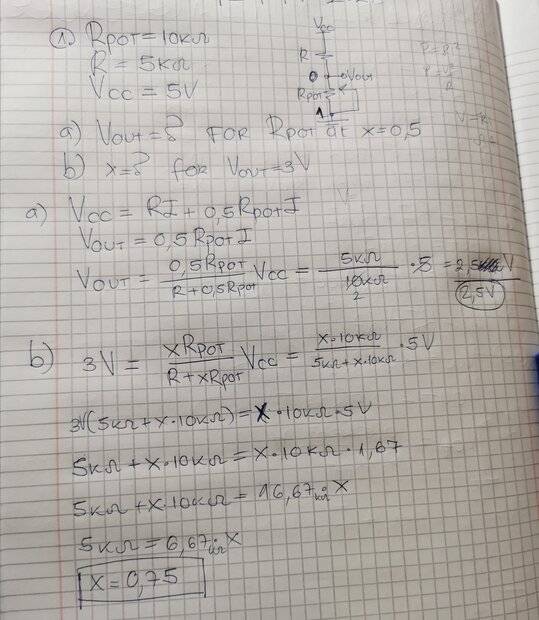
A total resistance potentiometer is used in the circuit in Figure 1
R POT = 10 kΩ which changes linearly from position 0 to position 1. If R= 5 kΩ, VCC= 5 V, determine:
(a) voltage value V OUT when the slider of the potentiometer is in position 0.5;
(b) position the potentiometer slider so that V OUT= 3 V.
Relevant Equations
None
Is my work correct?
I got confused whether the current Splits or not, but i decided against it.
IMG_20230604_224627.jpg
 
Physics news on Phys.org
Edy56 said:
Is my work correct?
Yes.

Edy56 said:
I got confused whether the current Splits or not, but i decided against it.
An unloaded potential divider, divides the voltage.
The same current flows through both series resistors.

For part b, I solved it differently, to get the same answer.
Computed current; i = (5V - 3V ) / 5k ;
Then R = 3V / i ;
 
Baluncore said:
Yes.An unloaded potential divider, divides the voltage.
The same current flows through both series resistors.

For part b, I solved it differently, to get the same answer.
Computed current; i = (5V - 3V ) / 5k ;
Then R = 3V / i ;
Thank you
 

Similar threads

Replies
6
Views
5K
  • · Replies 50 ·
2
Replies
50
Views
9K
  • · Replies 10 ·
Replies
10
Views
6K
Replies
1
Views
4K
Replies
7
Views
3K
  • · Replies 7 ·
Replies
7
Views
2K
  • · Replies 25 ·
Replies
25
Views
7K
  • · Replies 5 ·
Replies
5
Views
2K
  • · Replies 7 ·
Replies
7
Views
10K
  • · Replies 7 ·
Replies
7
Views
517