How Do You Calculate Slider Position on a Potentiometer?
- Thread starter james123
- Start date
Join the discussion
Registration is free. Start your own thread to ask a follow-up.
50 replies · 10K views
Physics news on Phys.org
james123
So for R it's 6/0.6=10Ω
& for 10k-R it's 3/0.6=5Ω
??
& for 10k-R it's 3/0.6=5Ω
??
james123
but how can I find the current for 10k-R resistor?
james123
you don't mean 3/10=0.3A ??
Admin
- 69,779
- 25,626
I could have missed it, but I didn't see you writing the KCL equation for the node at the wiper of the pot. Did you ever take that approach, or are you saying that KCL has not been covered in your class yet?james123 said:I have KCL as this:
'at any electrical junction the sum of the currents flowing towards the junction equals the sum of the currents flowing away from the junction.'
I still don't get how to apply this with the info I'm given? Maybe I'm punching above my weight with this course
If not, this problem is simple enough that you can just use a voltage divider equation. I've seen that posted in the thread so far, but you seem mired in the details. What is the overall equation you are working with at this point?
james123
Hi there, I believe this is a voltage divider equation question. However this thread has confused me I must admit.
My problem is I know the answer will end in a quadratic equation with x=0.5 as the final answer, but I can't figure out how to get there! People have used different methods(none of which are shown in my course materials) and arrived at the same answer.
I just need a clear outlined method on how to arrive at the answer..
My problem is I know the answer will end in a quadratic equation with x=0.5 as the final answer, but I can't figure out how to get there! People have used different methods(none of which are shown in my course materials) and arrived at the same answer.
I just need a clear outlined method on how to arrive at the answer..
Numbskull
- 54
- 1
I did this some time ago, and I feel your pain with the learning materials, they are woefully inadequate!
I called the parallel resistors ##R_o## and followed with ##R_o = \frac{10 \left(1 - x\right) \text{ x } 5}{10 \left(1 - x\right) + 5}##
Does that help?
I called the parallel resistors ##R_o## and followed with ##R_o = \frac{10 \left(1 - x\right) \text{ x } 5}{10 \left(1 - x\right) + 5}##
Does that help?
james123
Hi there, yeh they're a struggle to follow, given you're expected to essentially teach yourself!
I have seen that method before but never understood it.
Does this make sense to you? Using this diagram:
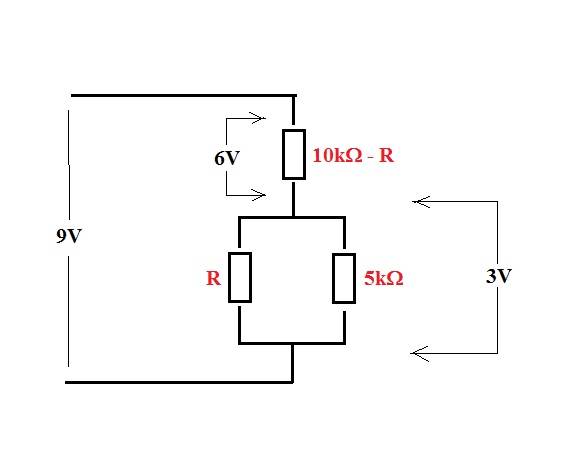
As the question says, 'the voltage across points ‘XX' is 3 V.' Meaning 'R' must be 5kohm as it has the same voltage across it as its parallel 5kohm resistor does, right?
And as you said, 'total resistance in the parallel section is 1/2 the resistance of the section in series ...'
So because the voltage drops from 6V to 3V (50%) between '10kohm-R' and the 'R' & '5kohm' parallel resistors.
Can we conclude that the slider position on the 'pot' will be 50% of the way down (0.5) ?
I have seen that method before but never understood it.
Does this make sense to you? Using this diagram:
As the question says, 'the voltage across points ‘XX' is 3 V.' Meaning 'R' must be 5kohm as it has the same voltage across it as its parallel 5kohm resistor does, right?
And as you said, 'total resistance in the parallel section is 1/2 the resistance of the section in series ...'
So because the voltage drops from 6V to 3V (50%) between '10kohm-R' and the 'R' & '5kohm' parallel resistors.
Can we conclude that the slider position on the 'pot' will be 50% of the way down (0.5) ?
Numbskull
- 54
- 1
Yes, the correct final position of the slider is 0.5. I then fiddled with the equation I posted to get ##-50x^2 + 125x - 50 = 0## and popped that into the quadratic formula for which there is only one credible answer.james123 said:Hi there, yeh they're a struggle to follow, given you're expected to essentially teach yourself!
Can we conclude that the slider position on the 'pot' will be 50% of the way down (0.5) ?
Homework Helper
Gold Member
- 3,489
- 1,173
Although the final answer is correct, your analysis is not.james123 said:Can we conclude that the slider position on the 'pot' will be 50% of the way down (0.5) ?
No. The reason R=5k is different. Parallel components always have the same voltage across them, whether or not they are equal.james123 said:Meaning 'R' must be 5kohm as it has the same voltage across it as its parallel 5kohm resistor does, right?
What does this mean?james123 said:And as you said, 'total resistance in the parallel section is 1/2 the resistance of the section in series ...'
james123
Okay I have this, using your equation but ended with slightly different numbers:
Ro=10(1-x) x 5/10(1-x) + 5
=50(1-x)/10+5(1-x)
So, we know that the parallels resistors are half the value of the series resistor:
50x=2x50(1-x)/10+5(1-x)
x=2(1-x)/10+5(1-x)
x(10+5(1-x)) = 2(1-x)
10x+5x-5x^2 = 2-2x
0 = 5x^2-13x+2
By the way, I know this doesn't pull up 0.5 as the answer but could some direction as to where I've gone wrong please??
Ro=10(1-x) x 5/10(1-x) + 5
=50(1-x)/10+5(1-x)
So, we know that the parallels resistors are half the value of the series resistor:
50x=2x50(1-x)/10+5(1-x)
x=2(1-x)/10+5(1-x)
x(10+5(1-x)) = 2(1-x)
10x+5x-5x^2 = 2-2x
0 = 5x^2-13x+2
By the way, I know this doesn't pull up 0.5 as the answer but could some direction as to where I've gone wrong please??
Last edited by a moderator:
Diegor
- 44
- 20
Hi james123. Maybe you should go back to really basic cicuit examples like two different resistors in series or two resistors in parallel and try to understand how KVL, KCl and Ohms law work there to get a better understanding before you jump to a more complex situation.james123 said:I have KCL as this:
'at any electrical junction the sum of the currents flowing towards the junction equals the sum of the currents flowing away from the junction.'
I still don't get how to apply this with the info I'm given? Maybe I'm punching above my weight with this course
MaRkR78
- 3
- 1
I have the exact same question to answer and have been using KCL/KVL/Ohms law to attempt it. I'd love to pick this up for myself from post #23 with cnh1995 if at all possible as he was providing insight into the use of those laws to determine the solution.
As I see it the KCL equation would be I1=I2+I3 where I1 is the current entering the junction after resistor R, I2 is the current leaving the junction towards resistor 10k-R and I3 is the current leaving the junction towards resistor 5k (load).
I already have current I3 as 3/5000 = 0.0006A or 6x10^-4 or 0.6m/A
Therefore to determine I1 we also need I2. In a slightly earlier post #35 cnh1995 suggested that I2 would be calculated with ohms law I=V/R which would give I2=3/10000-R this is where it becomes a little unclear to me. The reason is that although I can calculate I2=3/10000-R it still leaves me with 0.0003-R or 3x10^-4-R or 0.3m/A-R. We still don't have a value for R...
Even if I state I1=I2+I3 and use I1=0.0003-R+0.0006 that gives me 0.0009-R for I1.
You state to solve for R and this is where I'm hitting a wall. Do I just need to apply some more algebra to make R the subject?
I have seen others use product over sum for the parallel resistors but I'm keen to carry on with Kirchhoff/Ohms if it is doable.
Regards Mark.
As I see it the KCL equation would be I1=I2+I3 where I1 is the current entering the junction after resistor R, I2 is the current leaving the junction towards resistor 10k-R and I3 is the current leaving the junction towards resistor 5k (load).
I already have current I3 as 3/5000 = 0.0006A or 6x10^-4 or 0.6m/A
Therefore to determine I1 we also need I2. In a slightly earlier post #35 cnh1995 suggested that I2 would be calculated with ohms law I=V/R which would give I2=3/10000-R this is where it becomes a little unclear to me. The reason is that although I can calculate I2=3/10000-R it still leaves me with 0.0003-R or 3x10^-4-R or 0.3m/A-R. We still don't have a value for R...
Even if I state I1=I2+I3 and use I1=0.0003-R+0.0006 that gives me 0.0009-R for I1.
You state to solve for R and this is where I'm hitting a wall. Do I just need to apply some more algebra to make R the subject?
I have seen others use product over sum for the parallel resistors but I'm keen to carry on with Kirchhoff/Ohms if it is doable.
Regards Mark.
Homework Helper
Gold Member
- 3,489
- 1,173
Hi Mark,
Welcome to PF!
Refer the diagram in #40 (Ignore the reasoning).
You know the current through the 5k resistance.
How would you write KCL equation for the junction of the three resistors?
It would be an equation with R as the only unknown and you'll be able to solve it with some algebraic manipulations.
Welcome to PF!
It certainly is.MaRkR78 said:I'm keen to carry on with Kirchhoff/Ohms if it is doable.
Refer the diagram in #40 (Ignore the reasoning).
You know the current through the 5k resistance.
How would you write KCL equation for the junction of the three resistors?
It would be an equation with R as the only unknown and you'll be able to solve it with some algebraic manipulations.
MaRkR78
- 3
- 1
Many thanks for your reply and help.
I think I get where you're coming from. I'm going away for the Easter break so won't get to look at this for three days which is probably a good thing as my head is frazzled. I've had little rest from study for a while now.
Before I go perhaps you can just confirm something for me?
The diagram you refer to in #40. I had already redrawn the circuit expanding the 'Pot' out to give three resistors and of course the necessary junction from which to work out KCL. However I have resistor 10k-R in parallel with the 5k resistor where as diagram #40 has it the other way round. Will this matter?
Again appreciate the input and hoping a fresh mind will get me through this in a couple of days time :)
Mark.
I think I get where you're coming from. I'm going away for the Easter break so won't get to look at this for three days which is probably a good thing as my head is frazzled. I've had little rest from study for a while now.
Before I go perhaps you can just confirm something for me?
The diagram you refer to in #40. I had already redrawn the circuit expanding the 'Pot' out to give three resistors and of course the necessary junction from which to work out KCL. However I have resistor 10k-R in parallel with the 5k resistor where as diagram #40 has it the other way round. Will this matter?
Again appreciate the input and hoping a fresh mind will get me through this in a couple of days time :)
Mark.
Homework Helper
Gold Member
- 3,489
- 1,173
No. Both the diagrams will give the same answer, but in different forms.MaRkR78 said:Will this matter?
If using one diagram you get the slider position as "4k from top", the other diagram will give "6k from the bottom"(both of them give the same position).
MaRkR78
- 3
- 1
Ah.
I'll go back through my scribbles later as I'm convinced I had an answer very similar to those results but made the decision they were wrong. Reason being was that a friend has used a different method and had the slider at halfway. I've seen other stuff online giving the same result so assumed I must have been wrong with so many examples showing the slider at 5k or halfway. Worrying to think so many people have this incorrect??
Thanks again and I'll post back after Easter once I have it nailed down. :)
I'll go back through my scribbles later as I'm convinced I had an answer very similar to those results but made the decision they were wrong. Reason being was that a friend has used a different method and had the slider at halfway. I've seen other stuff online giving the same result so assumed I must have been wrong with so many examples showing the slider at 5k or halfway. Worrying to think so many people have this incorrect??
Thanks again and I'll post back after Easter once I have it nailed down. :)
Jason-Li
- 119
- 14
Hi,
Sorry to have to ask, you replied to James saying that 5k was correct however to Mark you have said that the 4&6 options are correct. I have completed the question as per how Mark completed it (paralleled resistor = 10000 - R1). I have attached my workings, would you be able to explain why it is correct / incorrect? Reading this post seems to have re-confused me!
Thanks and much appreciated,
Jason
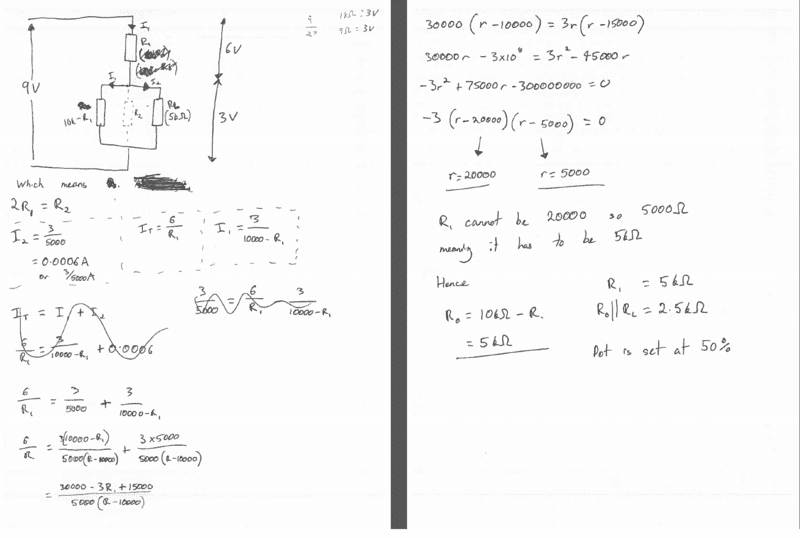
Sorry to have to ask, you replied to James saying that 5k was correct however to Mark you have said that the 4&6 options are correct. I have completed the question as per how Mark completed it (paralleled resistor = 10000 - R1). I have attached my workings, would you be able to explain why it is correct / incorrect? Reading this post seems to have re-confused me!
Thanks and much appreciated,
Jason
Attachments

Homework Helper
Gold Member
- 3,489
- 1,173
Because Mark's question was a bit different.Jason-Li said:Sorry to have to ask, you replied to James saying that 5k was correct however to Mark you have said that the 4&6 options are correct.
Your solution looks correct to me.MaRkR78 said:However I have resistor 10k-R in parallel with the 5k resistor where as diagram #40 has it the other way round. Will this matter?
Similar threads
Finding potentiometer slider position with 5kΩ load
- brenfox
- · Replies 7 ·
- Engineering and Comp Sci Homework Help
- Replies
- 7
How to determine the position of the slider on a potentiometer
- lew123189
- · Replies 1 ·
- Engineering and Comp Sci Homework Help
- Replies
- 1
Position of slider on potentiometer
- rikiki
- · Replies 7 ·
- Engineering and Comp Sci Homework Help
- Replies
- 7
Voltage across a potentiometer?
- bensm0
- · Replies 43 ·
- Engineering and Comp Sci Homework Help
- Replies
- 43
Position Potentiometer for 3V Across XX
- charger9198
- · Replies 4 ·
- Engineering and Comp Sci Homework Help
- Replies
- 4
Where Should the Slider Be Positioned on a Loaded Potentiometer?
- StokeBoy
- · Replies 6 ·
- Introductory Physics Homework Help
- Replies
- 6
How do I calculate Vo/Vs for a potentiometer circuit with varying resistance?
- tanky322
- · Replies 2 ·
- Engineering and Comp Sci Homework Help
- Replies
- 2
How Do You Calculate the Linear Acceleration and Impact Velocity of a Load?
- brooker2009uk
- · Replies 3 ·
- Engineering and Comp Sci Homework Help
- Replies
- 3
Engineering How Do You Calculate Power Consumption in AC Circuits?
- math_04
- · Replies 5 ·
- Engineering and Comp Sci Homework Help
- Replies
- 5
How Do You Calculate Thevenin Equivalent Circuit Without a Load Resistor?
- Alexander Max
- · Replies 3 ·
- Introductory Physics Homework Help
- Replies
- 3