Calculating Charge of an Electron w/ the Millikan Oil Drop Experiment

Click For Summary

Homework Help Overview

The discussion revolves around the Millikan Oil Drop experiment, which aims to determine the charge of a single electron. Participants are analyzing the velocities of oil droplets under the influence of gravity and an electric field, using parameters such as effective viscosity and voltage from a DC power supply.

Discussion Character

  • Exploratory, Assumption checking, Problem interpretation

Approaches and Questions Raised

  • Participants discuss the calculation of charge based on the velocities of falling and rising oil droplets, questioning the validity of their results and the constants used. There are inquiries about the effective viscosity and its implications on the calculations, as well as the application of Stokes' Law under specific conditions.

Discussion Status

The discussion has evolved with participants providing guidance on checking calculations and clarifying the units of viscosity. There is acknowledgment of a potential oversight regarding a conversion factor, which has led to a reevaluation of the results. While some participants have expressed confidence in their findings, others are still exploring the implications of the viscosity values and their effects on the charge calculation.

Contextual Notes

Participants note that the velocities of the droplets are critical for accurate charge determination, and there is a mention of the limitations of Stokes' Law when dealing with small velocities. The discussion also highlights the importance of careful reading of the lab manual to avoid misinterpretations of the viscosity values.

guyvsdcsniper
Messages
264
Reaction score
37
Homework Statement
Find the charge of an electron
Relevant Equations
q=ne
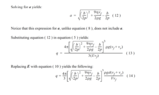
I am doing the Millikan Oil Drop experiment to determine the charge of a single electron. I have been following the lab manual provided by the manufacturer, https://hepweb.ucsd.edu/2dl/pasco/Millikans Oil Drop Manual (AP-8210).pdf.

The manual defines a simple method to calculate for the charge of the electron, which accounts for the effective viscosity of air. Page 12 and 13 of the linked lab manual defines all constants and list the method as described above.

I am using 500V from a DC power supply and have an effective viscosity of 1.809

Determining the charge essentially comes down to the velocity of the oil particle during free fall and its rising velocity under the influence of the electric field when the top capacitor plate is positive.

After analyzing over 15 particles, both respective velocities come out to be on the order of ##10^-5 to 10^-6## m/s.

Velocities on this order give a charge on the order of ##10^-10 to 10^-12## C. This is obviously too large.

I have checked the dimensional analysis of the formula provided by the manual and when done with S.I. Units, everything checks out.

After playing with numbers, I would need a velocity on the order of nm/s to get a charge on the order of ##10^-19##.

That velocity seems very excessive, given the other lab reports I have seen. Am I doing something wrong here or missing out a conversion factor?
 

Attachments

  • Screenshot 2023-07-14 at 3.16.33 PM.png
    Screenshot 2023-07-14 at 3.16.33 PM.png
    18.2 KB · Views: 194
  • Screenshot 2023-07-16 at 6.00.32 PM.png
    Screenshot 2023-07-16 at 6.00.32 PM.png
    22.2 KB · Views: 142
Physics news on Phys.org
guyvsdcsniper said:
Homework Statement: Find the charge of an electron
Relevant Equations: q=ne

have an effective viscosity of 1.809
What does this mean?
 
  • Like
Likes   Reactions: TSny
hutchphd said:
What does this mean?

Sorry I should have been more clear. Its Viscosity of Dry Air as a Function of Temperature. To calculate the radius of the oil drop, stokes law is used. But according to the lab manual

"Stokes’ Law, however, becomes incorrect when the velocity of fall of the droplets is less than 0.1 cm/s. (Droplets having this and smaller velocities have radii, on the order of 2 microns, comparable to the mean free path of air molecules, a condition which violates one of the assumptions made in deriving Stokes’ Law.)"

So the viscosity is multiplied by a corrective factor to give the effective velocity, ##n_{eff}##.
 
Sorry, please refer to page 9 of the lab manual in the link for the formula used to calculate q.
 
guyvsdcsniper said:
This is obviously too large.
Why is it so obvious that it is too large?
 
kuruman said:
Why is it so obvious that it is too large?
Because in S.I. units, 1 electron corresponds to ##1.6 x 10^{-19}## Couloumbs, and what I am calculating is on the order of ##10^{-10-12}## Couloumbs, making my value larger.
 
What were the typical times (rise and fall) for your drops? Were they like 10s?
 
So recheck your calculations. If you want us to check them, you have to post them here, preferably using LaTeX.
 
  • Like
Likes   Reactions: MatinSAR and hutchphd
hutchphd said:
What were the typical times (rise and fall) for your drops? Were they like 10s?
Falling was about a minute and rise was around 5 seconds. In hindsight, id use a lower voltage to reduce the rise speed to get a more accurate velocity.
 
  • Like
Likes   Reactions: hutchphd
  • #10
guyvsdcsniper said:
an effective viscosity of 1.80
What are the units for this number? Are you missing a factor of 10-5?
See viscosity of air.
 
  • Like
Likes   Reactions: MatinSAR, hutchphd and guyvsdcsniper
  • #11
TSny said:
What are the units for this number? Are you missing a factor of 10-5?
See viscosity of air.
Or even ##10^{-10}## if the adjustment was made the wrong way.
The notation on the Y axis at the Pasco link says "##Nsm^{-2}\times 10^{-5}##". Taken literally, that would mean that if the value marked on the axis is 1.8 then 1.8 is the ##Nsm^{-2}## value after multiplying by ##10^{-5}##, i.e. the value is ##1.8\times 10^5##. But what it intends is the reverse.
 
  • Like
Likes   Reactions: MatinSAR and guyvsdcsniper
  • #12
TSny said:
What are the units for this number? Are you missing a factor of 10-5?
See viscosity of air.
haruspex said:
Or even ##10^{-10}## if the adjustment was made the wrong way.
The notation on the Y axis at the Pasco link says "##Nsm^{-2}\times 10^{-5}##". Taken literally, that would mean that if the value marked on the axis is 1.8 then 1.8 is the ##Nsm^{-2}## value after multiplying by ##10^{-5}##, i.e. the value is ##1.8\times 10^5##. But what it intends is the reverse.

TSny was correct, I completely missed the factor of ##10^{-5}##. I am on the right order of magnitude now. I completely missed the units and the ##10^{-5}## on the lab manual, thank you for pointing that out haruspex.

Just a bonehead mistake and reading way too fast. You can close this thread now.
 
  • #13
guyvsdcsniper said:
Just a bonehead mistake and reading way too fast. You can close this thread now.
But it will forever remain a warning beacon marking the shoals of carelessness :warning:
 
  • Like
  • Haha
Likes   Reactions: TSny, Steve4Physics and guyvsdcsniper

Similar threads

  • · Replies 52 ·
2
Replies
52
Views
5K
  • · Replies 3 ·
Replies
3
Views
2K
Replies
1
Views
3K
  • · Replies 26 ·
Replies
26
Views
3K
  • · Replies 5 ·
Replies
5
Views
2K
  • · Replies 2 ·
Replies
2
Views
4K
  • · Replies 10 ·
Replies
10
Views
6K
  • · Replies 6 ·
Replies
6
Views
2K
  • · Replies 1 ·
Replies
1
Views
3K
  • · Replies 1 ·
Replies
1
Views
2K