Calculating Copper Wire Gauge for Resistance Thermometer Bridge Circuit

Click For Summary

Discussion Overview

The discussion revolves around calculating the appropriate gauge of copper wire for a resistance thermometer bridge circuit, focusing on the effects of wire resistance on temperature readings. Participants explore the implications of wire resistance on the maximum indicated temperature and the calculations involved in determining wire gauge, including the application of relevant equations and properties of copper wire.

Discussion Character

  • Technical explanation
  • Mathematical reasoning
  • Debate/contested

Main Points Raised

  • One participant calculates the resistivity of copper at 20°C and attempts to determine the smallest gauge of wire needed to keep the indicated maximum temperature below 202°C.
  • Another participant questions the clarity of the equations used and the role of certain resistances in the circuit, suggesting that the participant clarify the relationship between resistors in the bridge circuit.
  • Some participants express uncertainty about whether to focus on finding the wire diameter or the resistivity of copper to reference the standard wire gauge (SWG) table.
  • There is a discussion about the maximum resistance allowed for the connecting wire based on the temperature coefficient and the desired temperature limits, with calculations presented for the resistance of the wire.
  • One participant suggests that the calculations lead to a conclusion about the appropriate SWG, but there is uncertainty about whether SWG 12 or SWG 14 should be used.
  • Another participant raises concerns about the interpretation of the problem statement and the assumptions made regarding the resistance of the wire at different temperatures.
  • Participants discuss the implications of the resistance of the wire on the overall circuit and how it affects the readings from the thermometer.

Areas of Agreement / Disagreement

Participants generally express uncertainty and confusion regarding the calculations and interpretations of the problem, with no clear consensus on the correct approach or final answer. Multiple competing views on how to proceed with the calculations and interpretations of the circuit remain evident.

Contextual Notes

Participants note potential ambiguities in the problem statement and the assumptions made regarding the resistance of the wire and its temperature dependence. There is also mention of the need for clarity in the relationships between different resistances in the circuit.

calcphonup
Messages
4
Reaction score
0
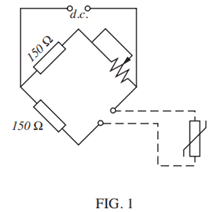
a. The resistance thermometer bridge circuit shown in FIGURE 1 has a designed maximum temperature of 200°C, ignoring the effects of connecting wire resistance. If the connecting loop is 250 m determine the smallest gauge (swg) of copper wire which must be used if the indicated maximum temperature is to be less than 202°C.

The temperature coefficient of resistance of the thermometer is 0.0042 °C–1 and the resistance of the thermometer is 112 Ω at 20°C. Assume the connecting leads are at 20°C.

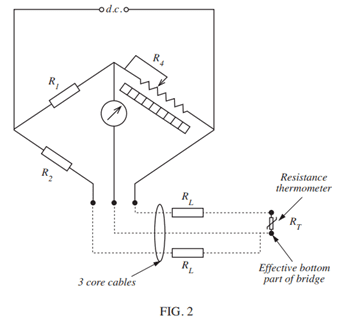
b. Using the gauge of copper wire calculated in part (a), calculate the maximum indicated temperature using a 3-wire system (as shown in FIGURE 2) over a distance of 125 m.Relevant EquationsRt = R0(1 + at)

R1RT = R2RS

R = pL/A = Resistance = (Resistivity) x Length of wire / cross-sectional area

A = (pi x d2) / 4

d = squareroot(4A /pi)
1557675546003-png.png

1557675556199-png.png

1557675564142-png.png


R_t=R_20×(1+α×∆t)
α=0.0042
R20 = 112Ω
∆t=202-20=182
R_t=R_20×(1+α×∆t)
R_t=112×(1+0.0042×182)
R_t= 197.6128

As both resistors on figure 1 are 150Ω, they cancel each other out.
Find the resistivity of copper at 20°C

ρ=RA÷L
Where:
R = Resistance of copper at 20°C
A = area
L = length
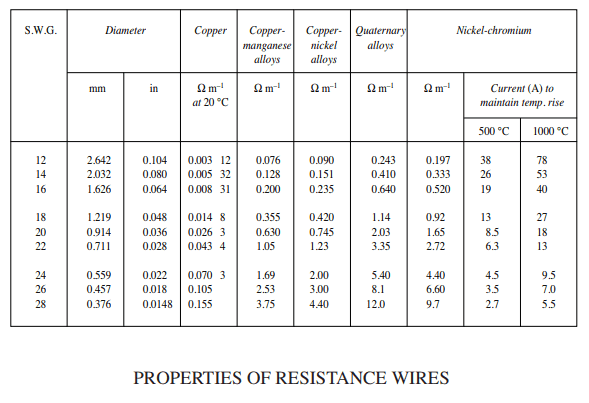
From the properties of resistance wires table:
When diameter = 0.376mm, resistance = 0.155m-1
0.376mm diameter = 0.11103645mm2 for the area.
Converting resistance to per mm = 0.000155m-1
For length 1m = 1000mm.

Therefore, ρ=0.000155×0.111036450÷1000=1.72×10^(-8)
Resistivity of copper wire at 20°C = 1.72×10^(-8)Ωm-1
To find the area the equation would be A=(ρ×L)/R
A=(1.72×10^(-5) Ωmm×250000mm)/197.6128Ω
A = 0.02176mm2

Find diameter = 0.16645mm

Too small of a diameter.

Any help would be greatly appreciated. Ive been stuck for a week

Moderator note: Moved from a technical forum.
 
Last edited by a moderator:

Physics news on Phys.org
Hello @calcphonup ,
:welcome: ##\qquad ## !​

For the bridge circuit you have a relationship , I suppose that's what you mean with R1RT = R2RS ?

Where in your essay is ##R_4## ? Is the value given ?

Your calculation gives me the impression that you start out with a diameter and then calculate another diameter. What is the intention ?

[edit]It's really worthwhile to learn some ##\LaTeX## (link at lower left of the edit box). ##R_1 R_t = R_2 R_S## looks a lot better than R1RT = R2RS But you want to at least use subscripts (toolbar) R1 Rt = R2RS. No clue what ##R_S## is ... :rolleyes:
You sure this is the right equation for the circuit shown ? Shouldn't it have ##R_4## somewhere ?

##\ ##
 
In other words R_s is the position of the slidewire tapper – is a measure of the resistance (and therefore the temperature) of the resistance thermometer. So for figure 2, R_S = R_4. However, I have not made it passed part (a) of the question yet where I am only using figure 1. I am not sure which route I should be going down. Should I be trying to find a diameter and reference the table to find my SWG or should I be trying to find the Ωm-1 of copper at 20degrees and then using the table?
 
calcphonup said:
I have not made it passed part (a) of the question
Does this mean that you finished part (a) or that you are still stuck in part (a) :rolleyes:
I am under the impression that you are still stuck, right ?

OK, so for figure 1 you have an equilibrium condition ##R_1\,R_t = R_2\,R_s## and with ##R_1=R_2## this becomes ##R_s = R_t##.

The information
calcphonup said:
has a designed maximum temperature of 200°C, ignoring the effects of connecting wire resistance
can then be used to find ##R_s = 200 \ \Omega## as you did. The maximum value of ##R_S##, when the slider is at the top end, that is.
(or ##198 \ \Omega## if you think 2.5 digit accuracy is justified -- I would certainly agree). Never ever omit units ! and do the calculations with ##197.6128 \ \Omega##).

I must admit that I find it hard to interpret the exact problem statement in part (a) (is this the exact formulation ?) because with such a value of ##R_S## the indicated temperature is never more than 200 °C.

The way I would compose this exercise would be something like 'determine the smallest gauge ... if the indicated temperature is less than 202 °C when the actual temperature of the thermistor is 200 °C'

Then the 250 m of connecting wire should have a resistance of less than ##\alpha \,\Delta T\, R_t = 0.9408 \ \Omega ## and that lets you find a gauge.

---

Moving on to figure 2 (and to complicate things ##R_s=R_4## :wink:) is now in order. What is the equilibrium condition ?

##\ ##
 
BvU said:
Does this mean that you finished part (a) or that you are still stuck in part (a)
I am stuck on part (a) as you correctly assumed.

BvU said:
Then the 250 m of connecting wire should have a resistance of less than αΔTRt=0.9408 Ω and that lets you find a gauge.
So is it correct to say α=0.0042. Δt=(202-200)=2. R_t = 112Ω at 20°C. Punching in the figures = 0.9408Ω. 0.9408Ω/250 = 0.0037632Ω/m^-1. From properties of resistance table, SWG12 is too low, so SWG 14 must be used? Is that correct?
 
BvU said:
Moving on to figure 2 (and to complicate things Rs=R4 :wink:) is now in order. What is the equilibrium condition ?
As far as part (b) goes, I am not sure where to start? Other than the total resistance of the wire is 0.00532Ω/m(from the table)*125 = 0.665Ω. However, that is at 20 degrees and the resistance will increase with the temperature.
 
BvU said:
hard to interpret the exact problem statement in part (a) (is this the exact formulation ?)
...
Moving on to figure 2 ... What is the equilibrium condition ?

Wrt #5: I'm not clearvoyant and not the exercise composer. It's your exercise, so your judgment prevails. I do agree with your calculations.

Wrt #6:
calcphonup said:
Assume the connecting leads are at 20°C.
##\ ##
 

Similar threads

  • · Replies 5 ·
Replies
5
Views
3K
Replies
14
Views
4K
Replies
5
Views
3K
  • · Replies 2 ·
Replies
2
Views
2K
  • · Replies 1 ·
Replies
1
Views
1K
Replies
1
Views
8K
  • · Replies 4 ·
Replies
4
Views
4K
Replies
2
Views
2K
  • · Replies 1 ·
Replies
1
Views
2K
Replies
6
Views
3K