DavidAp
- 44
- 0
I am asked to find all local maximum and minimum points for the function,
f(x,y) = (1+xy)(x+y) so, naturally, I had to find the critical points. However, in the back of my book (Calculus Early Transcendentals 6E, James Stewart) the only critical points are (1,-1) (-1,1) (both of which are saddle points but that's not what's important).
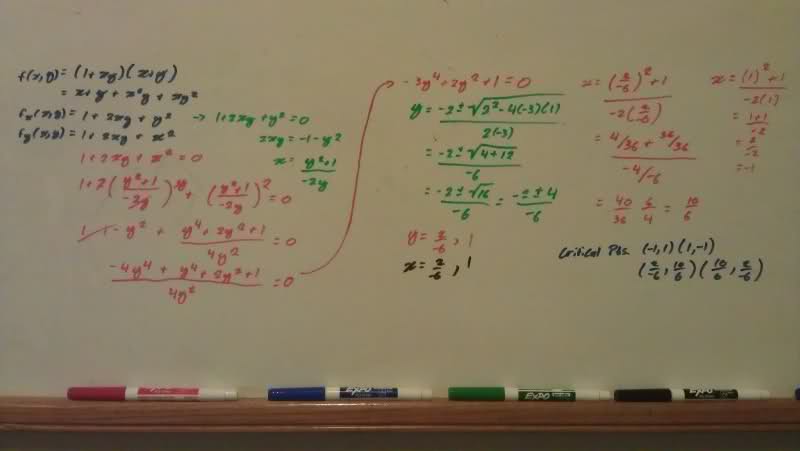
My question is, what did I do wrong in my mathematics? I am getting two extra sets of critical points and I'm wondering: did the book forget to mention them as possible points or did I mess up during the calculations? Probably the latter but I checked my math twice, the second time on the board.
I took a picture of my math because it seemed so much easier. Hopefully my hand writing is legible and the picture is big enough.
My critical points are (1,-1) (-1,1) (-2/6, 10/6) (10/6, -2/6)
If the image is illegible please tell me and I will type it all out on text.
Thank you for reviewing my question, I greatly appreciate it.
f(x,y) = (1+xy)(x+y) so, naturally, I had to find the critical points. However, in the back of my book (Calculus Early Transcendentals 6E, James Stewart) the only critical points are (1,-1) (-1,1) (both of which are saddle points but that's not what's important).
My question is, what did I do wrong in my mathematics? I am getting two extra sets of critical points and I'm wondering: did the book forget to mention them as possible points or did I mess up during the calculations? Probably the latter but I checked my math twice, the second time on the board.
I took a picture of my math because it seemed so much easier. Hopefully my hand writing is legible and the picture is big enough.
My critical points are (1,-1) (-1,1) (-2/6, 10/6) (10/6, -2/6)
If the image is illegible please tell me and I will type it all out on text.
Thank you for reviewing my question, I greatly appreciate it.