Discussion Overview
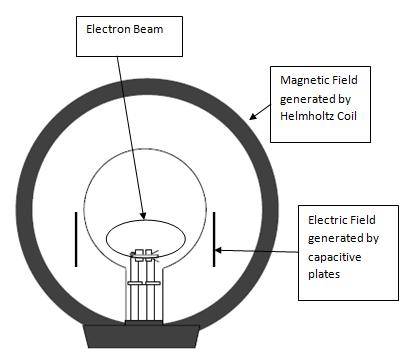
The discussion revolves around calculating the displacement of an electron in the presence of electric and magnetic fields, with a focus on understanding the shape of the electron's trajectory, which some participants speculate may be elliptical. The conversation includes theoretical considerations, mathematical modeling, and practical implications of the forces acting on the electron.
Discussion Character
- Exploratory
- Technical explanation
- Mathematical reasoning
- Debate/contested
Main Points Raised
- One participant anticipates that the electron will form an elliptical path and seeks to calculate the major and minor axes of this ellipse.
- Another participant suggests looking up the drift of charged particles in electric and magnetic fields, mentioning the guiding center concept.
- A participant notes the presence of an accelerating voltage on the anode, which adds complexity to the calculations.
- One participant emphasizes starting with the Lorentz force law and describes how the electric field is perpendicular to the magnetic field, leading to a drift of the electron's path.
- Another participant argues that the electron does not return to its starting point and instead travels in a spiral, questioning how the application of an electric field would alter this path.
- One participant provides detailed equations relating the Lorentz force to centripetal force, discussing the conditions under which these forces can be equated.
- There is a discussion about the complexity of including the electric field in calculations, with one participant outlining steps to derive the motion equations for the electron.
- A later reply questions the reasoning behind equating centripetal force and Lorentz force, suggesting they should be considered separately.
- Another participant expresses a desire to create a stationary elliptical path rather than a moving spiral, proposing a specific configuration involving opposite polarity DC voltages on electrode plates.
Areas of Agreement / Disagreement
Participants express differing views on the nature of the electron's path, with some asserting it will be elliptical while others argue it will spiral or drift. The discussion remains unresolved regarding the exact trajectory and the conditions necessary to achieve a stationary ellipse.
Contextual Notes
Participants mention various assumptions and conditions, such as the configuration of electric and magnetic fields, the role of accelerating voltages, and the mathematical complexity involved in solving the equations of motion. There are also references to specific equations and theoretical models that may not be universally agreed upon.