Calculating Electric Fields and Acceleration

Click For Summary

Homework Help Overview

The discussion revolves around calculating electric fields and acceleration in the context of physics problems involving charged particles and electric fields. The original poster presents two specific problems: one related to finding the electric field at the center of a rectangle formed by charges, and the other concerning the acceleration and final speed of a proton in a uniform electric field.

Discussion Character

  • Mixed

Approaches and Questions Raised

  • Participants discuss the calculation of electric fields from multiple charges and the need to consider vector addition. Questions arise regarding the application of formulas involving force, mass, and charge, particularly in the context of the proton's motion in an electric field.

Discussion Status

Some participants have provided guidance on calculating electric fields and have suggested methods for vector addition. Others are exploring different approaches to determine the acceleration of the proton and its final speed, with varying degrees of success and understanding.

Contextual Notes

There is mention of specific values for charge and dimensions, as well as the need to clarify the relationship between force, mass, and charge in the context of the problems. Participants express confusion over certain aspects of the calculations and the application of relevant physics concepts.

StudentofPhysics
Messages
65
Reaction score
0
The magnitude of each of the charges in Figure 18.21 is 9.40 10-12 C. The lengths of the sides of the rectangle are 3.00 cm and 5.00 cm. Find the magnitude of the electric field at the center of the rectangle in Figures 18.21a and 18.21b.
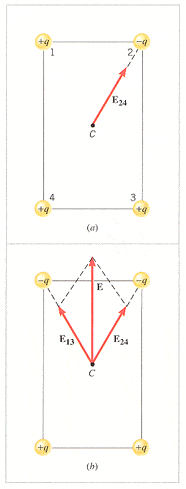

18-21fig.gif


I know figure a is 198.22, but I can't seem to figure out b.


Also I'm struggling with how to tell acceleration:

A uniform electric field has a magnitude of 2.6 103 N/C. In a vacuum, a proton begins with a speed of 2.1 104 m/s and moves in the direction of this field. Find the speed of the proton after it has moved a distance of 2.0 mm.


I can't seem how to find the acceleration. The closest I can figure is that F=ma for the formula E= f/q, but there is no mass, and that formula does not include a distance so I believe it is not the one I should be using.

Any thoughts on how to do these?
 
Physics news on Phys.org
StudentofPhysics said:
The magnitude of each of the charges in Figure 18.21 is 9.40 10-12 C.

Before I get started, did you mean that the magnitude of the charges is [itex]9.40\times10^{-12}C[/itex]?
 
Tom Mattson said:
Before I get started, did you mean that the magnitude of the charges is [itex]9.40\times10^{-12}C[/itex]?


Sorry about that. Yes, that is what I meant.
 
StudentofPhysics said:
but I can't seem to figure out b.

You need to calculate the fields separately, then add them like vectors. Then you can find the magnitude of the resultant. An easy way to do this is to get the magnitude of each electric field, then find a unit vector that points from the center to the charge in question. Then you can multiply the magnitude by the unit vector and voila, you have the electric field vector.

Also I'm struggling with how to tell acceleration:

A uniform electric field has a magnitude of 2.6 103 N/C. In a vacuum, a proton begins with a speed of 2.1 104 m/s and moves in the direction of this field. Find the speed of the proton after it has moved a distance of 2.0 mm.

I can't seem how to find the acceleration. The closest I can figure is that F=ma for the formula E= f/q,

So far, so good.

but there is no mass,

Ah, but there is. They tell you that the particle is a proton.

and that formula does not include a distance so I believe it is not the one I should be using.

You have to go back to kinematics here. You definitely do have a formula that relates initial position and velocity, final position and velocity, and acceleration.
 
OK, proton mass I inserted but I am still struggeling.

As for adding the vectors in the first problem, I knew that and tried but it still isn't working.
 
Let's see what you've tried. Then I can tell you what's going wrong.
 
Ok, for the second problem I used E=F/q. I then used F = ma to change it to E = ma/q and inserted the mass of the proton, which I looked up as equalling 1.67 x 10^-27 Kg.

but what is q? If it is the charge of a proton, which I would believe it is, then it is said to be worth 1n. I don't know how to convert that into N/C.


As for the first problem I assumed that the Fy would equal the total magnitude, (198.22 cos 45) x 2.
 
StudentofPhysics said:
Ok, for the second problem I used E=F/q. I then used F = ma to change it to E = ma/q and inserted the mass of the proton, which I looked up as equalling 1.67 x 10^-27 Kg.

So far, so good.

but what is q? If it is the charge of a proton, which I would believe it is, then it is said to be worth 1n. I don't know how to convert that into N/C.

It is indeed the charge of the proton, which is [itex]1.602\times10^{-19}C[/itex]. I don't understand your remark about what the charge is worth.

As for the first problem I assumed that the Fy would equal the total magnitude, (198.22 cos 45) x 2.

What's Fy?
 
Fy = F in the Y direction. The Force along the x axis, Fx, will cancel out as the two forces are equal in opposite directions.
 
  • #10
ok, with the proton charge factored in, I've come up with a = 2.49 x 10^11what formula would I use to find the speed again?

I know its kinematics but I can't find which one.
 
  • #11
I would think its V =V0X (initial velocity) + a t, but what is t?
 
  • #12
The problem doesn't ask for any forces. It asks for the electric field. But you are correct in saying that the horizontal components cancel.

So try to follow these steps:

1.) Calculate the magnitude of each of the 4 electric fields using:

[tex]E=\frac{kQ}{r^2}[/tex]

2.) Compute the unit vectors pointing from the center to each of the 4 corners of the rectangle. Since you have correctly observed that the net electric field has no x component, it should be clear that you really only care about the y-components of these unit vectors.

3.) Multiply each E-field magnitude by its corresponding unit vector.

4.) Add them up.

5.) Find the magnitude.
 
  • #13
StudentofPhysics said:
I would think its V =V0X (initial velocity) + a t, but what is t?

No, you need the formula that doesn't refer to time. The formula you need is in the same chapter as the one you just quoted. Try to find it.
 
  • #14
Success! I got the second answer. Thank you very much for the help with that.


Still working on the first...
 
  • #15
Super! If you get stuck again just post what you've done and we'll try to fix what's broke.
 
  • #16
Hi, I'm working on a problem identical to the first question posted, and I'm on part B. I am having a whole lot of trouble figuring out what the resultant vector E is.

Here's what I've attempted thus far, oy:

a) First, I did as Mattson suggested and found the vertical components of the charges. I multiplied them by four (since the resultant is a combination of the four, right?) and my answer was incorrect.

b) Then, I did the good old 30-60-90 calculation, just because I was getting frustrated. It gave me the same answer as A, and it was incorrect.

I've done a million things and seem to end up at the same, incorrect number. I'm very frustrated, please help? Thanks.
 

Similar threads

Replies
9
Views
2K
Replies
4
Views
4K
Replies
6
Views
2K
  • · Replies 6 ·
Replies
6
Views
2K
Replies
1
Views
2K
Replies
17
Views
3K
  • · Replies 10 ·
Replies
10
Views
1K
  • · Replies 8 ·
Replies
8
Views
5K
  • · Replies 16 ·
Replies
16
Views
2K
  • · Replies 12 ·
Replies
12
Views
3K