Calculating Electrostatic Force with Coulomb's Law

Click For Summary
SUMMARY

The forum discussion focuses on calculating the net electrostatic force acting on a 100 microC charge using Coulomb's Law in a rectangular configuration of point charges. The charges are positioned at the corners of a 3.0m x 4.0m rectangle, with specific values for each charge. The key takeaway is that the angle used in calculations must accurately reflect the geometry of the rectangle, specifically using the correct tangent ratio to determine the angle for force components. The correct angle for the force calculation is 36.87 degrees, derived from the 3-4-5 triangle relationship.

PREREQUISITES
  • Coulomb's Law for electrostatic force calculation
  • Understanding of vector components in physics
  • Basic trigonometry, specifically tangent and arctangent functions
  • Knowledge of charge units, specifically microCoulombs
NEXT STEPS
  • Review the derivation of Coulomb's Law and its applications
  • Learn about vector addition in electrostatics
  • Study the properties of triangles, particularly the 3-4-5 triangle
  • Explore examples of electrostatic force calculations with varying charge configurations
USEFUL FOR

Students in physics, educators teaching electrostatics, and anyone interested in mastering the application of Coulomb's Law in real-world scenarios.

antiderivativ
Messages
17
Reaction score
0
Four point-charges are fixed at the corners of a 3.0m X 4.0m rectangle. The coordinates of the corners and the values of the charges are listed below.
q1 = 100 microC (0, 4m), q2 = 36 microC (4m, 3m), q3 = 125 microC (0, 3m) and q4 = 32 microC (0,0). Compute the net electrostatic force acting on the 100 microC charge.
ke = 8.99 x 10⁹

I'm using Coulomb's Law.
F = \frac{ke*q1*q2}{r^2}

Here is my attempt at a solution. Is it correct?
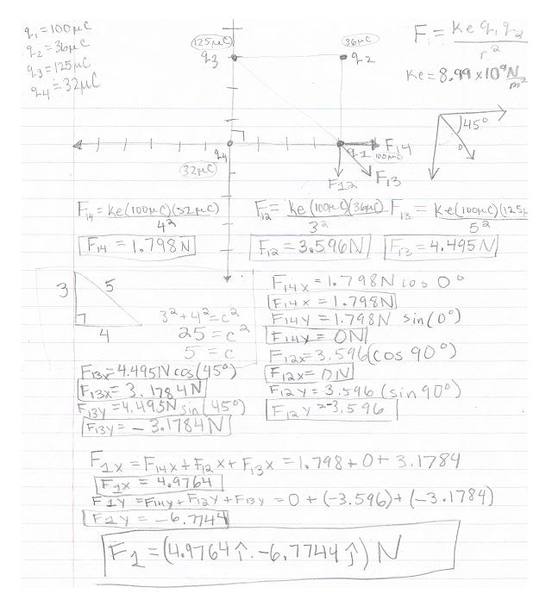
6-1.jpg
 
Last edited:
Physics news on Phys.org


Hi antiderivativ,

antiderivativ said:
Four point-charges are fixed at the corners of a 3.0m X 4.0m rectangle. The coordinates of the corners and the values of the charges are listed below.
q1 = 100 microC (0, 4m), q2 = 36 microC (4m, 3m), q3 = 125 microC (0, 3m) and q4 = 32 microC (0,0). Compute the net electrostatic force acting on the 100 microC charge.
ke = 8.99 x 10⁹

I'm using Coulomb's Law.
F = \frac{ke*q1*q2}{r^2}

Here is my attempt at a solution. Is it correct?

6-1.jpg

No, I don't believe that is correct. When you find the components of F13, you are using an angle of 45 degrees. It would have been a 45 degree angle if the charges were at the corners of a square, but since this is a rectangle it will be different.

You can use your 3-4-5 triangle you have on the page to find the correct angle. What do you get?


Thanks for the reply! My new angle is 53.13. Is this better? :)
6-2.jpg


antiderivativ said:
Thanks for the reply! My new angle is 53.13. Is this better? :)
6-2.jpg

Really close! But you changed your triangle when you calculated the angle, and that gave you the wrong angle.

If you look at the 3-4-5 triangle about halfway down the page on the left side, the 3 side is vertical and the 4-side is horizontal, and that matches your problem and calculation.

At the bottom of the page, you switched the 3 and 4 sides. You did the correct procedure; it's just that if you use your original triangle, you'll do:

<br /> \tan^{-1}\left(\frac{3}{4}\right)<br />

instead of the arctangent of 4/3.
 

Similar threads

Replies
3
Views
1K
  • · Replies 5 ·
Replies
5
Views
1K
  • · Replies 4 ·
Replies
4
Views
2K
  • · Replies 3 ·
Replies
3
Views
4K
Replies
17
Views
2K
  • · Replies 8 ·
Replies
8
Views
4K
Replies
4
Views
2K
Replies
2
Views
2K
  • · Replies 2 ·
Replies
2
Views
3K
  • · Replies 5 ·
Replies
5
Views
2K