Calculating Line Integral on Curve C (IR3)

Click For Summary
The discussion revolves around calculating the line integral on the curve C defined by the intersection of x² + 2z² = 2 and y = 1, traversed counter-clockwise. Participants explore simplifications, noting that since y is constant, dy equals zero, allowing for the omission of certain terms in the integral. A parameterization of the curve is suggested, leading to a revised integral expression. The conversation highlights a mistake regarding the evaluation of the integral, with corrections made to ensure accuracy. Ultimately, the integral is determined to relate to the area inside the loop, emphasizing the importance of direction in the calculations.
portuguese
Messages
15
Reaction score
0
Consider that the curve C (IR3) is the intersection between x2+2z2=2 and y=1.

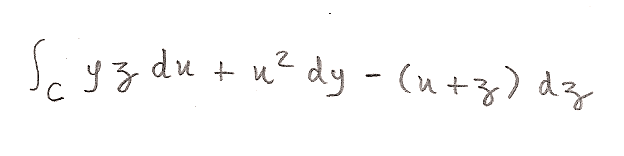
Calculate the line integral:
MmJ6C.png
Note: The curve C is traversed one time in the counter-clockwise direction (seen from the origin of IR3).

My attempt:

http://i.imgur.com/5EsJO.png

Can someone check? Thanks! :)
 
Last edited by a moderator:
Physics news on Phys.org
If I have the question right, a lot of simplification is possible.
Given y = 1, the integral wrt y is zero, and y can be set to 1 elsewhere.
I also notice there's integral x.dz - integral z.dx. Hmmm... what do you think that might simplify to? Think of the geometric meaning, or of integration by parts.
 
But it is still correct?
 
The answer looks right. I haven't verified all the working (because it can all be done in couple of lines).
 
Thanks! Btw, I understand your simplifications, but I have to do this way... ;)
 
You have curve C defined in an xyz- coordinate system but you have u, y, and z in your integral. Did you intend
\int_C yzdx+ x^2dy- (x+ z)dz?

Assuming that, since y= 1, a constant, dy= 0 so we can ignore the middle term.

I would be inclined to parameterize the curve by x= \sqrt{2}cos(\theta), y= 1, z= sin(\theta).

Then dx= -\sqrt{2}sin(\theta)d\theta and dz= cos(\theta)d\theta.

The integral becomes
\int_0^{2\pi} sin(\theta)(-\sqrt{2}sin(\theta)d\theta)- (\sqrt{2}cos(\theta)+ sin(\theta))cos(\theta)d\theta
= \int_0^{2\pi}[-\sqrt{2}(sin^2(\theta)+ cos^2(\theta))- \sqrt{2}sin(\theta)cos(\theta)]d\theta
= -\sqrt{2}\int_0^{2\pi}[1+ sin(\theta)cos(\theta)]d\theta

The answer you give, t/2- (1/4)sin(2t), can't possibly be correct because it is a function of t and there was not even a "t" in the problem! Did you intend to evaluate that at t= 0 and 2\pi?
 
Last edited by a moderator:
HallsofIvy said:
The answer you give, t/2- (1/4)sin(2t), can't possibly be correct because it is a function of t and there was not even a "t" in the problem! Did you intend to evaluate that at t= 0 and 2\pi?

The way I read it, the equations involving t are explanatory notes. The answer it gives earlier is "= 0".
 
Thank you. I had to keep scrolling from side to side!
 
Yeah, my answer is 0
 
  • #10
I've gone back and edited my first response, replacing the incorrect "2"s with \sqrt{2}. However, I still do not get 0 as the integral.
 
Last edited by a moderator:
  • #11
I found my mistake. I wrote:
HallsofIvy said:
The integral becomes
\int_0^{2\pi} sin(\theta)(-\sqr{2}sin(\theta)d\theta)<span style="font-size: 22px">+ (\sqr{2}cos(\theta)+ sin(\theta))cos(\theta)d\theta</span>
=...<br />
<br /> <br /> It&#039;s not 0, you&#039;re right. Thanks a lot! ;)
 
  • #12
portuguese said:
I found my mistake.
And I've found mine :blushing:.
As HofI, I reasoned that we can get rid of the y terms, leaving:
\int_C zdx- (x+ z)dz = \int_C (zdx-xdz) + zdz
Around a closed loop, zdz goes to zero (at each z, a dz cancels a -dz).
\int_C zdx and \int_C xdz are each the area inside the loop. So I thought these canceled too. But I overlooked that one will effectively run the opposite direction around the loop, so will add, not cancel. So the whole reduces to twice the area of the ellipse.
 

Similar threads

  • · Replies 20 ·
Replies
20
Views
4K
  • · Replies 3 ·
Replies
3
Views
3K
  • · Replies 7 ·
Replies
7
Views
2K
  • · Replies 2 ·
Replies
2
Views
3K
Replies
6
Views
941
  • · Replies 4 ·
Replies
4
Views
2K
  • · Replies 8 ·
Replies
8
Views
3K
Replies
2
Views
2K
  • · Replies 1 ·
Replies
1
Views
2K
  • · Replies 5 ·
Replies
5
Views
3K