Engineering Calculating Power Lost in a Resistor (within Transformer Circuit)

Click For Summary
Resistors in a transformer circuit primarily dissipate active power, not reactive power, as they convert electrical energy into heat. The formula for copper loss, P_{R_2} = |I_2|^2 R_2, accounts for the current magnitude squared multiplied by resistance, which is valid despite the phase difference because resistors do not introduce reactive power. For iron loss, the formula P_{R_0} = |I_m||V_1| cos(φ) is used, where φ is the power factor, indicating that only the active component of power is considered. The discussion highlights the importance of understanding phasor relationships and their impact on power calculations in transformer circuits. Overall, the calculations focus on active power losses while acknowledging the role of phase angles in determining efficiency.
Master1022
Messages
590
Reaction score
116
Homework Statement
Calculate the power lost via copper loss and iron loss?
Relevant Equations
[itex]P = IV = I^2 R [/itex]
Hi,

I have a simple question that I don't have a fundamental understanding of: do resistors dissipate reactive power (in addition to active power)?

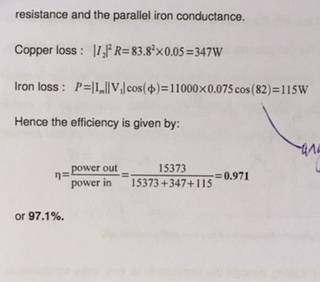
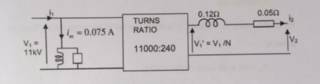
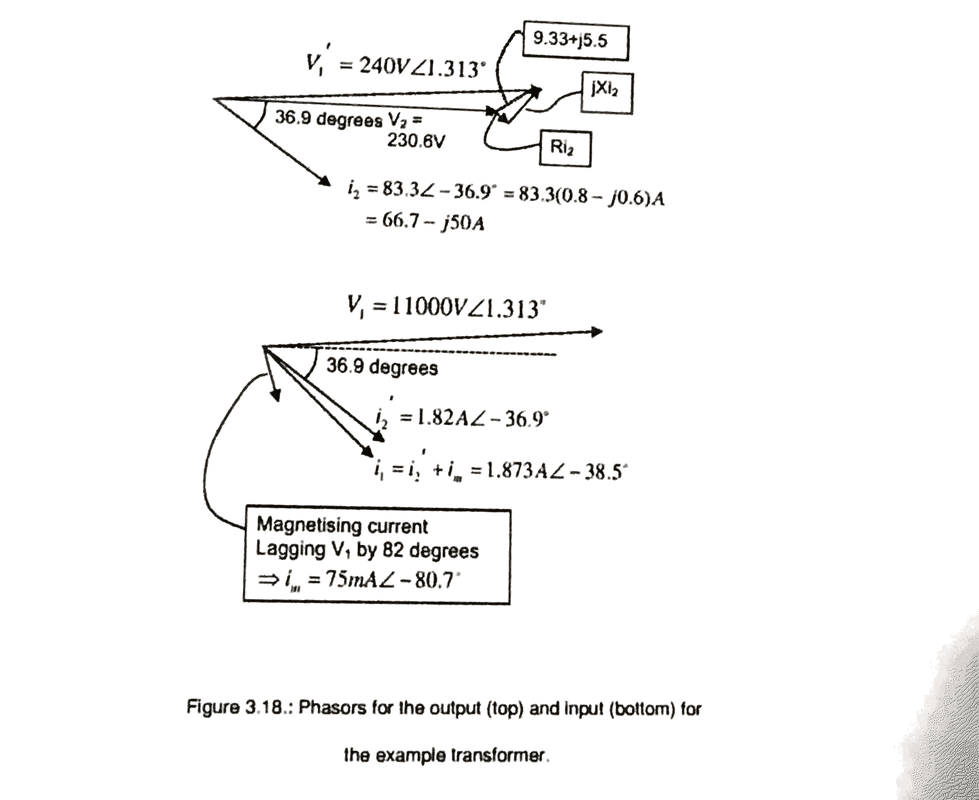
For context, when we are looking at a transformer (single phase) equivalent circuit (similar to the one in the image attached), we are asked to find the copper loss (power dissipated in R_2 = 0.05 \Omega) and the iron loss (power dissipated in R_0 in the primary). From earlier parts of my homework question, we find the phasor diagrams to be: (in the attached images)
IMG_9278.jpg

Scannable Document on 22 Jul 2020 at 20_44_28.png
IMG_9277.jpg


We know that the secondary current I_2 is lagging behind V_2. P_{R_2} = |I_2|^2 R_2 is used even though there is a phase difference. Why is this the case - doesn't this include reactive power as well as active power?

Also, when finding the iron loss, we use the formula P_{R_0} = |I_m||V_1| cos(\phi), where \phi is the power factor.

I can't seem to understand why these formulae are accounting for complex parts of the power as well (or maybe I am misunderstanding them?).

Any help is greatly appreciated.
 
Last edited:
Physics news on Phys.org
Master1022 said:
We know that the secondary current ##I_2## is lagging behind V_2. ##P_{R_2}=|I_2|^2R_2## is used even though there is a phase difference. Why is this the case - doesn't this include reactive power as well as active power?
##I_2## is not lagging behind the voltage over ##R_2##, which -- of course -- is ##I_2R_2##
 
Last edited:
BvU said:
##I_2## is not lagging behind the voltage over ##R_2##, which -- of course -- is ##I_2R_2##
Thank you very much for your fast reply. Yes, that makes sense to me. How about the core loss? The diagram on the web-page has slightly different labeling (as you have probably picked up), such that I_m is defined to be the sum of the currents going into the parallel components. Doesn't IVcos(\phi) project I_m (as defined in my image) onto V_1, which has imaginary components? Why isn't there another projection onto the real axis (i.e. using a cos(1.313 degrees)) ?
 
o0) Confused -- don't remember your circuit diagram being there when I replied.

Master1022 said:
##V_1##, which has imaginary components
Seems it does. What's the full problem statement ?
 
BvU said:
o0) Confused -- don't remember your circuit diagram being there when I replied.

Seems it does. What's the full problem statement ?
Sorry, it wasn't - I edited the post recently to include it in order to avoid future confusion when referring to variable names. The original problem overall was:
"A single phase 11kV to 240V transformer is "rated" as 20 kVA. Its magnetising current is 75 mA lagging the supply voltage by 82 degrees. X is 0.12 \Omega and R is 0.05 \Omega, both referenced to the secondary. " This final part is about calculating the efficiency and we need the aforementioned power losses.

However, upon second thought, it seems wrong for me to suggest the complex nature of the voltage V_1 as all the phasors are drawn relative to V_2, which was probably chosen as there was an intermediate question voltages at the secondary terminals (and comparing it to our theoretical expectation of 240 V). Therefore, that arbitrary choice of phasor drawing shouldn't change the physics of the power dissipated, it should always be IVcos(\phi) between the respective current and voltage. I am not sure if I have conveyed that thought in the most comprehensible manner, please let me know if that doesn't make sense (or if it is incorrect).
 
  • Like
Likes hutchphd

Similar threads

  • · Replies 7 ·
Replies
7
Views
3K
  • · Replies 9 ·
Replies
9
Views
2K
  • · Replies 5 ·
Replies
5
Views
2K
  • · Replies 16 ·
Replies
16
Views
3K
  • · Replies 1 ·
Replies
1
Views
2K
  • · Replies 11 ·
Replies
11
Views
2K
  • · Replies 5 ·
Replies
5
Views
2K
  • · Replies 9 ·
Replies
9
Views
2K
  • · Replies 8 ·
Replies
8
Views
3K
  • · Replies 6 ·
Replies
6
Views
2K