Calculating the flux through the spherical surfaces at certain radius

Click For Summary
SUMMARY

The forum discussion focuses on calculating the electric flux through spherical surfaces at specific radii, particularly at r=1. Participants clarify that the total enclosed charge (Q_enc) for r=1 is zero, as the charge distribution is centered at the origin. The discussion emphasizes the importance of understanding the relationship between charge and electric flux, and the correct interpretation of the problem statement to avoid unnecessary complications.

PREREQUISITES
  • Understanding of electric flux and its SI units (Coulombs).
  • Familiarity with the concept of enclosed charge (Q_enc) in electrostatics.
  • Basic knowledge of spherical coordinates and their application in physics.
  • Proficiency in using LaTeX for mathematical expressions.
NEXT STEPS
  • Study Gauss's Law and its application to electric flux calculations.
  • Learn about the concept of electric displacement field (D) and its relation to flux.
  • Explore spherical symmetry in electrostatics and its implications for charge distribution.
  • Practice problems involving electric flux through various geometrical surfaces.
USEFUL FOR

Students and professionals in physics, particularly those studying electromagnetism, electrical engineers, and anyone involved in solving electrostatic problems related to electric flux and charge distributions.

falyusuf
Messages
35
Reaction score
3
Homework Statement
Point charges 5 uC, -3 uC, 2 uC and 10 uC are located at (-12, 0,5). (0, 3,-4),(2, -6, 3) and (3, 0, 0), respectively. Calculate the flux through the spherical surfaces at:
i) r= 1
ii) r= 10
iii) r=15

* u = 10^-6 *
Relevant Equations
Attached below.
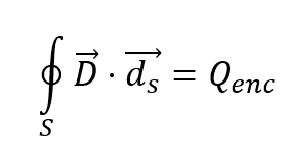
Relevant Equation:
1637442267037.png

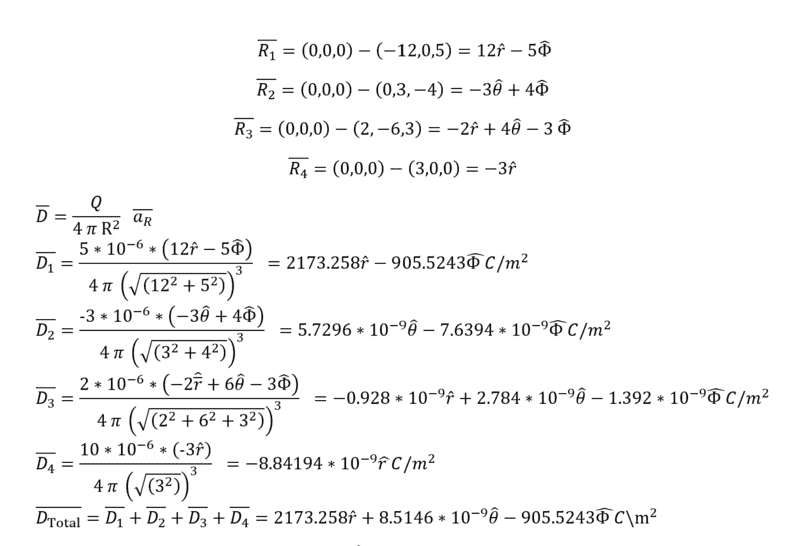
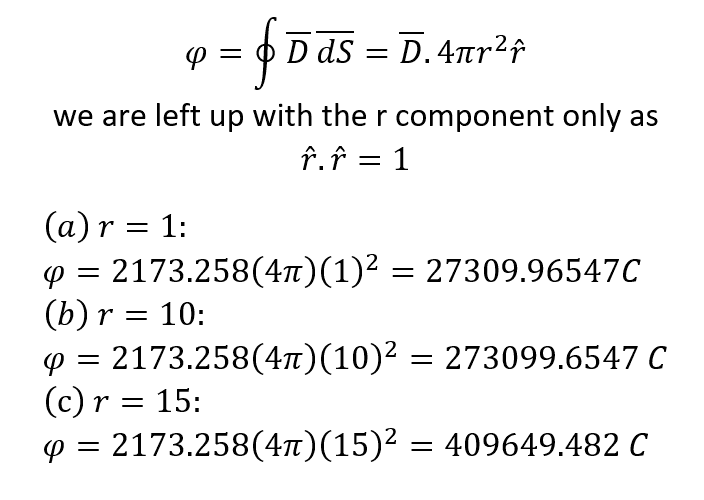
My attempt:
1637444699332.png

1637444677296.png

Could someone please confirm my answer?
 

Attachments

  • 1637444649520.png
    1637444649520.png
    20.4 KB · Views: 168
Physics news on Phys.org
You can't magically greate 10 digit accuracy results from 1 digit givens !

What is ##Q_{enc}## for ##r= 1## ?

##\ ##
 
BvU said:
You can't magically greate 10 digit accuracy results from 1 digit givens !

What is ##Q_{enc}## for ##r= 1## ?

##\ ##
Yes the answers I got were not reasonable and tried to figure out my mistakes but I couldn't.

I think it's -3 uC as r in the point (0, 3,-4) is 0, which is less than r=1.
so, the total charge enclosed is -3 uC.
 
I must asssume you have correctly given the problem statement
Calculate the flux through the spherical surfaces at:
i) r= 1
etc. And my interpretation is that such spheres are centered at the origin. So that the enclosed charge is zero for ##r=1##.
And that you are making a fairly simple exercise quite complicated unnecessarily.

Like in the other problem: what are the units for flux in your textbook ?

##\ ##
 
BvU said:
Like in the other problem: what are the units for flux in your textbook ?
It's Coulomb.

1637580341128-png.png
 
BvU said:
And my interpretation is that such spheres are centered at the origin. So that the enclosed charge is zero for r=1.
Sorry, I didn't get it. Could you explain further?
 
falyusuf said:
It's Coulomb.

View attachment 292834
Confusing (for me, at least). SI unit for electric flux is different.

falyusuf said:
Sorry, I didn't get it. Could you explain further?
The exercise asks for the flux through a spherical shell with radius 1 around the origin (then 10, then 15).

I don't understand what you do with your ##\overline{R_1}## etc.

* u = 10^-6 *
There is a ##\mu## under the 'insert symbol' button:
1637581967289.png


But (much better): with a little ##\LaTeX## you can do all kinds of math. ##\mu## becomes ##\mu##

There is a guide button at lower left:

1637582094065.png


##\ ##
 
BvU said:
I don't understand what you do with your R1― etc.
I assume that R1 is the vector between point 1 and the origin and found it by
1637583076411.png
 
What would you need that vector for ?

##\ ##
 
  • #10
BvU said:
What would you need that vector for ?

##\ ##
Get its length and substitute it in this formula:
1637584144098.png
 
  • #11
1637586213881.png

Seems to me ##\overline {a_R}## is a unit vector. Right ?

This formula calculates ##\overline D## at the origin. Not what you want. The exercise asks for a flux (in your case apparently an electric displacement flux).

##\ ##
 
  • #12
BvU said:
Seems to me aR― is a unit vector. Right ?
BvU said:
Seems to me aR― is a unit vector. Right ?
Yes. I think about it more and find that it'll be easier to get r from the given points using this formula:
1637589969545.png

and then simply;
1637595565755.png

Right?
 
  • #13
Makes much more sense to me than post #1 !
And no hassle with 10-digit numbers either :wink:

##\ ##
 
  • Like
Likes   Reactions: falyusuf
  • #14
BvU said:
Makes much more sense to me than post #1 !
And no hassle with 10-digit numbers either :wink:

##\ ##
Thank you so much. Appreciate your help
 
  • Like
Likes   Reactions: BvU

Similar threads

  • · Replies 5 ·
Replies
5
Views
2K
  • · Replies 1 ·
Replies
1
Views
1K
  • · Replies 9 ·
Replies
9
Views
1K
  • · Replies 6 ·
Replies
6
Views
2K
  • · Replies 4 ·
Replies
4
Views
2K
  • · Replies 10 ·
Replies
10
Views
2K
  • · Replies 2 ·
Replies
2
Views
1K
  • · Replies 3 ·
Replies
3
Views
4K
  • · Replies 6 ·
Replies
6
Views
2K
Replies
7
Views
2K