Calculation of Box's Acceleration on a Trailer with Friction

Click For Summary
SUMMARY

The discussion focuses on calculating the acceleration of a box on a trailer with friction, using the equation a=(F-2mg(μ))/(m+M), where F is the pulling force, m is the mass of the box, M is the mass of the trailer, and μ is the coefficient of friction. Participants emphasize the importance of using separate Free Body Diagrams (FBDs) for both the box and the trailer to accurately account for frictional forces. They also recommend using LaTeX for clearer mathematical representation and suggest fixing a coordinate system for better analysis. The final equation derived from the correct FBDs is confirmed as a valid representation of the system's dynamics.

PREREQUISITES
  • Understanding of Newton's laws of motion
  • Familiarity with Free Body Diagrams (FBDs)
  • Knowledge of frictional forces and coefficients (μ)
  • Basic proficiency in LaTeX for mathematical expressions
NEXT STEPS
  • Study the derivation of equations of motion using Free Body Diagrams
  • Learn how to effectively use LaTeX for mathematical notation
  • Research the effects of friction in multi-body systems
  • Explore advanced dynamics involving pulleys and inclined planes
USEFUL FOR

Students in physics or engineering, educators teaching dynamics, and anyone involved in mechanical system analysis will benefit from this discussion.

Heexit
Messages
10
Reaction score
3
Homework Statement
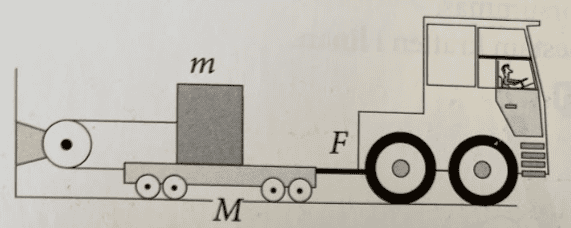
On a trailer (mass M), there is a box (mass m). A rope runs from the box over a fixed pulley to the back end of the trailer. A pulling force F acts on the trailer. There is friction between the box and the trailer. The trailer is considered to be moving easily on the ground. Calculate the acceleration of the box relative to the ground (see picture for better understanding of question under Attempt at a Solution).
Relevant Equations
f = (mu)*FN, f=ma
Question picture:
1684497141899.png

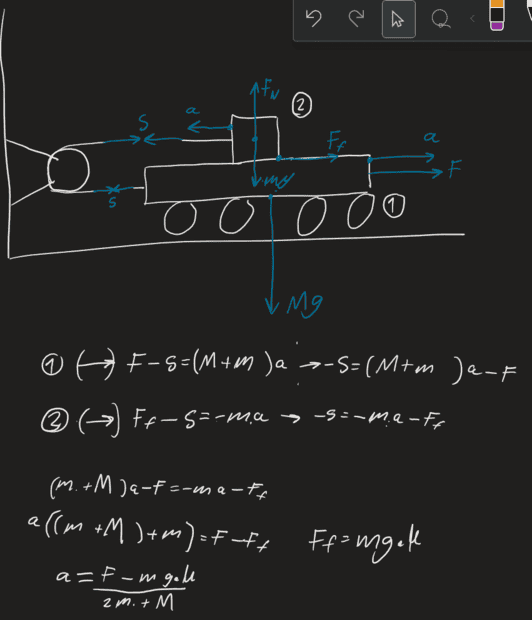
My solution:
1684497841441.png


Where:
S is the lineforce
Ff is the force as a result of friction
a is the resulting acceleration
F is the acting force

The answear is supposed to be a=(F-2mg(mu))/(m+M)

Any idea what i could have missed?

Thanks for your help on beforehand!
 

Attachments

  • 1684497428457.png
    1684497428457.png
    16.1 KB · Views: 95
Physics news on Phys.org
Heexit said:
Homework Statement: On a trailer (mass M), there is a box (mass m). A rope runs from the box over a fixed pulley to the back end of the trailer. A pulling force F acts on the trailer. There is friction between the box and the trailer. The trailer is considered to be moving easily on the ground. Calculate the acceleration of the box relative to the ground (see picture for better understanding of question under Attempt at a Solution).
Relevant Equations: f = (mu)*FN, f=ma

Question picture:
View attachment 326774
My solution:
View attachment 326779

Where:
S is the lineforce
Ff is the force as a result of friction
a is the resulting acceleration
F is the acting force

The answear is supposed to be a=(F-2mg(mu))/(m+M)

Any idea what i could have missed?

Thanks for your help on beforehand!
Please take a few moments to learn how to use Latex for posting the mathematics on this site. Your hand writing is not particularly neat. It also helps would be helpers quote where may be wrong directly. The pictures are ok for diagrams, not for the math.

Also you should have separate FBD's for the box and the trailer, and fix a coordinate system ( I would suggest at the pulley ).
 
Last edited:
  • Like
Likes MatinSAR, Heexit and kuruman
You seem to think that equation 1 is what you get for the trailer + box system. It is not because friction is not taken into account. Does it make sense that the equation for the two-component system is the same whether friction is there or not?

Write separate equations from separate FBDs as @erobz suggested. When you add them, you should get the correct equation for the trailer + box system and it will not be what you have now.
 
  • Like
Likes MatinSAR, Heexit and erobz
Remember that friction acts on both surfaces (the box and the trailer)
 
  • Like
Likes MatinSAR, Heexit and erobz
erobz said:
Please take a few moments to learn how to use Latex for posting the mathematics on this site. Your hand writing is not particularly neat. It also helps would be helpers quote where may be wrong directly. The pictures are ok for diagrams, not for the math.

Also you should have separate FBD's for the box and the trailer, and fix a coordinate system ( I would suggest at the pulley ).
Thanks for your help!

As per request, here comes the new improved FBD's:
1684500938700.png


And the following equations:
1. ##F_f-S=-ma\Rightarrow -S=-ma-F_f##
2. ##F-S-F_f=Ma\Rightarrow -S=Ma-F+F_f##
This gives:
##-ma-F_f=Ma-F+F_f##
##-a(M+m)=-F+2F_f##, where ##F_f=mg\mu##
##a=\frac {F-2mg\mu} {M+m}##

Thanks for your time and advice!
 
Heexit said:
Thanks for your help!

As per request, here comes the new improved FBD's:
View attachment 326781

And the following equations:
1. ##F_f-S=-ma\Rightarrow -S=-ma-F_f##
2. ##F-S-F_f=Ma\Rightarrow -S=Ma-F+F_f##
This gives:
##-ma-F_f=Ma-F+F_f##
##-a(M+m)=-F+2F_f##, where ##F_f=mg\mu##
##a=\frac {F-2mg\mu} {M+m}##

Thanks for your time and advice!
For future reference, you are "freeing" the trailer of the box, replacing the box with forces it produces on the trailer. There shouldn't be a partial box in the trailers FBD, nor should there be a partial trailer in the boxes FBD.
 
erobz said:
For future reference, you are "freeing" the trailer of the box, replacing the box with forces it produces on the trailer. There shouldn't be a partial box in the trailers FBD, nor should there be a partial trailer in the boxes FBD.
Meh. It's an artist's conception, intended to visually depict the source of the normal force ##F_n## on the bottom of the box and the [identically named] normal force ##F_n## on the top of the trailer.

I expect that is also the reason for depicting the string on the left of both drawings. I did find the arrow on the end of the string to be off-putting. However, I think I grasp the intended meaning. The depiction there is of an interface between string and box (or string and trailer). The string is being pulled rightward by the box/trailer. Hence the right arrows. The box/trailer is being pulled leftward by the string. Hence the left arrows.
 
jbriggs444 said:
Meh. It's an artist's conception, intended to visually depict the source of the normal force ##F_n## on the bottom of the box and the [identically named] normal force ##F_n## on the top of the trailer.

I expect that is also the reason for depicting the string on the left of both drawings. I did find the arrow on the end of the string to be off-putting. However, I think I grasp the intended meaning. The depiction there is of an interface between string and box (or string and trailer). The string is being pulled rightward by the box/trailer. Hence the right arrows. The box/trailer is being pulled leftward by the string. Hence the left arrows.
I get it’s just a drawing, but when we are examining internal forces in materials we slice them, making the internal forces external to the slice. To me, leaving part of the box (or part of the trailer) hasn’t properly externalized the internal force of friction in this system. That’s why I mentioned it.
 
erobz said:
I get it’s just a drawing, but when we are examining internal forces in materials we slice them, making the internal forces external to the slice. To me, leaving part of the box (or part of the trailer) hasn’t properly externalized the internal force of friction in this system. That’s why I mentioned it.
I would agree with @jbriggs444 on this one. Drawing part of the source as a reference becomes necessary especially in cases of circular motion on surfaces such as a mass sliding on a track. The contact force is centripetal or centrifugal depending on which side of the track the mass is riding. So the curvature of the track is needed for drawing the contact force and the acceleration consistently with the given physical situation. Personally, I draw such reference surfaces in dotted lines to indicate their evanescent nature.
 
  • #10
kuruman said:
I would agree with @jbriggs444 on this one. Drawing part of the source as a reference becomes necessary especially in cases of circular motion on surfaces such as a mass sliding on a track. The contact force is centripetal or centrifugal depending on which side of the track the mass is riding. So the curvature of the track is needed for drawing the contact force and the acceleration consistently with the given physical situation. Personally, I draw such reference surfaces in dotted lines to indicate their evanescent nature.
Dotted lines are a good compromise (in my opinion), I just wasn’t sure the OP was fully getting that concept given the first “FBD”. If they were just being "efficient" by not separating the bodies, it was that efficiency that lead to the error (I think).
 
Last edited:

Similar threads

  • · Replies 4 ·
Replies
4
Views
1K
  • · Replies 11 ·
Replies
11
Views
3K
  • · Replies 16 ·
Replies
16
Views
1K
  • · Replies 9 ·
Replies
9
Views
1K
  • · Replies 20 ·
Replies
20
Views
3K
Replies
15
Views
2K
Replies
43
Views
2K
  • · Replies 6 ·
Replies
6
Views
1K
Replies
17
Views
2K
Replies
6
Views
1K