green-fresh
- 14
- 0
hello there!
I was reading about ohm rule in a MIT physics course and they calculate the resistance of a nested spherical shells like this :
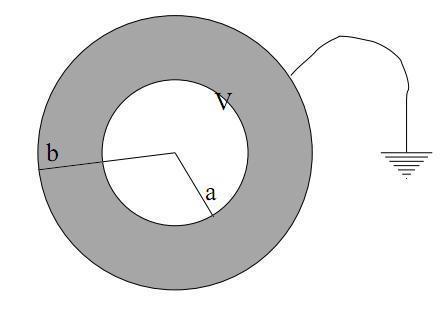
and they but the microscopic form of ohm's law which is :
[tex]J=\sigma_q E[/tex]
and
[tex]I=A J[/tex]
so
[tex]I=(4 \pi r^2 ) (\sigma_q E)[/tex]
and
[tex]E=-\frac{\partial V}{\partial r}[/tex]
and he said that the potential must be like this form
[tex]V=\frac{C}{r}+D[/tex]
where : C and D are constant .
so my question is what is this form and why he did that and i could calculate the potential easily :
[tex]V_{ab}=\int E . dr[/tex].
thank you
I was reading about ohm rule in a MIT physics course and they calculate the resistance of a nested spherical shells like this :
and they but the microscopic form of ohm's law which is :
[tex]J=\sigma_q E[/tex]
and
[tex]I=A J[/tex]
so
[tex]I=(4 \pi r^2 ) (\sigma_q E)[/tex]
and
[tex]E=-\frac{\partial V}{\partial r}[/tex]
and he said that the potential must be like this form
[tex]V=\frac{C}{r}+D[/tex]
where : C and D are constant .
so my question is what is this form and why he did that and i could calculate the potential easily :
[tex]V_{ab}=\int E . dr[/tex].
thank you
Attachments
