Calculation with this electric circuit (battery and resistors)

Click For Summary

Homework Help Overview

The discussion revolves around an electric circuit problem involving a battery and resistors, where participants are analyzing the correctness of various statements related to voltage and current in the circuit.

Discussion Character

  • Exploratory, Conceptual clarification, Assumption checking

Approaches and Questions Raised

  • Participants are attempting to determine the potential at various points in the circuit and are questioning the reasoning behind their voltage calculations. There is a focus on understanding the relationship between current, resistance, and voltage drops.

Discussion Status

The discussion is ongoing, with participants sharing their thought processes and calculations. Some guidance has been offered regarding the application of Ohm's law and the importance of current direction in determining voltage. Multiple interpretations of the circuit behavior are being explored.

Contextual Notes

There is mention of a multiple-choice format for the problem, which adds a layer of complexity as participants seek to identify the incorrect statement among several options. The discussion also touches on the distinction between conventional current and electron current, which may influence participants' understanding of the problem.

AnneX
Messages
21
Reaction score
2
Homework Statement
This is not homework, but a problem I came across while studying
Relevant Equations
None, as you have to find the wrong statement
Hey,

I am struggling a bit, als I try to solve this problem - I‘d say all five statements are correct, but it is said, that one must be incorrect
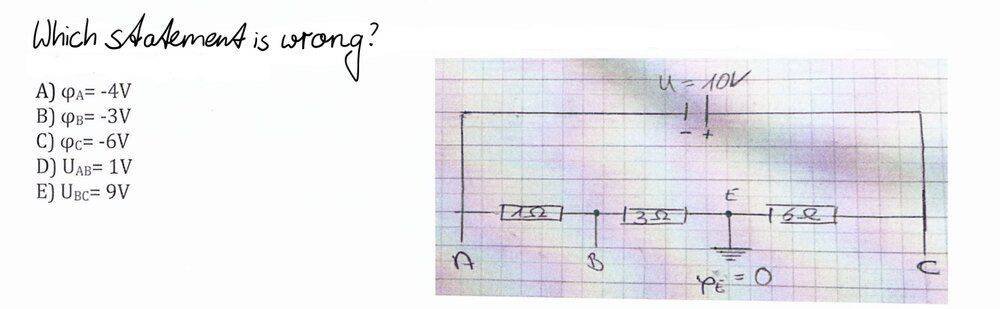
FE29A963-69FD-4FF7-83AA-86EE24C24F54.jpeg
 
Last edited by a moderator:
Physics news on Phys.org
Welcome to PF.

Please explain your reasoning for obtaining values for ##\varphi_A##, ##\varphi_B##, etc.
 
I marked it in the image
6E014F5D-7F6B-4E3C-93FF-5613F0D37157.jpeg

this is all I got for this problem
 
Why do you think that ##\varphi_A = -4## V? What is your thought process for deducing this?
 
That was my train of thought:
4E578F03-1FC0-4B5F-94AA-56D530C2D3B3.jpeg
 
1597170986430.png


How did you get from a resistance of 4 ##\Omega## to a voltage drop of -4 V? Does a resistance of 4 ##\Omega## always correspond to a voltage drop of -4 V?
 
No, it does not, but this is multiple choice and I am trying to find the incorrect statement while being very clueless... :(
 
Last edited:
We need to identify why you are having trouble with this problem.

Suppose you have 2 A of current through a 5 ##\Omega## resistor as shown below

1597171934231.png


The potential at point ##b## is given to be 12 V. Can you figure out the potential at point ##a##?
 
  • Like
Likes   Reactions: etotheipi
7V?
 
  • #10
Wait I think I got it, is that correct:
B3DA24F3-29BA-499E-BA21-53989B3A9E1A.jpeg
 
  • #11
AnneX said:
7V?
7 V is incorrect. Does the current play a role in determining the voltage at ##a##?

Hint: Ohm's law
 
  • #12
This is the point I got to
F40F6090-D855-4862-A11A-75B340621D1F.jpeg
to
 
  • #13
You correctly applied Ohm's law to find that there is a 10 V drop across the resistor. But how did you arrive at a value of 17 V for the potential at point ##a##?
 
  • #14
12+5... I am still not sure if a is 2V or 22V
 
  • #15
AnneX said:
I am still not sure if a is 2V or 22V
This is where the direction of the current is important. Whenever current flows through a resistor, the voltage is higher on the side of the resistor where the current enters the resistor. That is, voltage drops as you go through a resistor in the direction of the current.

An analogy might help (but, beware of analogies!). If you have a horizontal pipe full of water and you want the water to flow from left to right through the pipe, then you need a higher pressure at the left end of the pipe compared to the right end.

Likewise, in order for the current to flow from left to right in the 5 ##\Omega## resistor, the potential must be higher at the left side of the resistor compared to the right side.
 
  • #16
So it is 22V
 
  • #17
AnneX said:
So ist is 22V
Yes. Good. You can see that you had to know the current going through the resistor.

So, going back to the original question, what are you going to need to find first before you can determine the voltage drop across each resistor? And, how are you going to do that?
 
  • Like
Likes   Reactions: AnneX, DaveE and etotheipi
  • #18
The current, to calculate the voltage drop
5A4FBFF9-0407-4343-B52A-11D66D5E8B38.jpeg
 
  • #19
Good. You're almost home.

Yes, the potential is given to be 0 at point E.

Note: We prefer posters to type their work rather than post pictures, if possible. This makes it easier for helpers to quote specific parts of a post. On the toolbar there are various tools for typing superscripts, subscripts, math symbols, etc.
 
Last edited:
  • Like
Likes   Reactions: AnneX
  • #20
B139D2D5-1461-4EBC-BEC7-54575900E12E.jpeg

That is what I got: potential a is -4V potential b -3V and potential c +6V, as the flow of current goes from the positive pole to the negative pole - at least that is what I read about it, but I find it kinda confusing
 
  • #21
AnneX said:
That is what I got: potential a is -4V potential b -3V and potential c +6V
Looks correct. Now you can tell which option is incorrect.
AnneX said:
as the flow of current goes from the positive pole to the negative pole - at least that is what I read about it, but I find it kinda confusing
Look up "conventional current" vs "electron current".
 
  • #22
So c is incorrect. But how do I know which one of these two currents applies to a problem?
 
  • #23
AnneX said:
But how do I know which one of these two currents applies to a problem?
You can use any. Conventional current is just opposite to the electron current. As long as you are consistent with polarities and sign conventions in circuit laws, you will be okay.
I will suggest you stick to the conventional current approach, as the electon-current approach is now almost non-existent in circuit analysis.
(..though I remember some standard textbooks explicitly mentioning "conventional current edition" on their cover, so I am not sure).
 
  • Like
Likes   Reactions: AnneX

Similar threads

Replies
10
Views
1K
Replies
4
Views
2K
  • · Replies 3 ·
Replies
3
Views
2K
  • · Replies 3 ·
Replies
3
Views
2K
Replies
22
Views
4K
Replies
3
Views
2K
  • · Replies 21 ·
Replies
21
Views
2K
  • · Replies 5 ·
Replies
5
Views
2K
  • · Replies 4 ·
Replies
4
Views
2K
  • · Replies 5 ·
Replies
5
Views
2K