Discussion Overview
The discussion revolves around modeling pressure variations in tillage tools, specifically focusing on the dynamic pressure changes experienced during operation. Participants explore theoretical and practical approaches to accurately simulate these variations over time, considering factors such as soil conditions and measurement techniques.
Discussion Character
- Exploratory
- Technical explanation
- Debate/contested
- Experimental/applied
Main Points Raised
- One participant suggests using structural mechanics and Finite Element analysis (FEM) to model pressure variations, noting that traditional models often assume constant pressure.
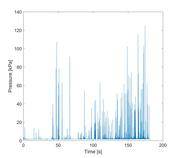
- Another participant mentions that pressure measurements were taken under varying conditions, including different soil types and speeds, leading to consistently spiky data, which they attribute to the granular behavior of soil.
- Concerns are raised about the accuracy of baseline pressure measurements, with one participant questioning whether the baseline should be zero when the plough is resting on the soil.
- Some participants propose that the pressure signals could be used to measure the total force acting on the plough blade, while others emphasize the complexity of accurately capturing these forces due to local soil variations.
- There is a discussion about the potential impact of vibrations and acoustic noise on pressure measurements, which could introduce false spikes in the data.
- One participant expresses a desire to understand the mechanisms generating pressure signals and their accuracy, while another suggests digitizing measurements for simulation purposes.
- The idea of testing in uniform soil conditions, such as fine sand, is mentioned as a way to better understand pressure variations.
Areas of Agreement / Disagreement
Participants express a range of views on the modeling approaches and the interpretation of pressure data. There is no consensus on the best method to model pressure variations, and several competing ideas are presented regarding the factors influencing pressure measurements.
Contextual Notes
Participants note limitations in their measurements, including the influence of soil composition and the dynamic nature of ploughing, which may affect the accuracy of pressure readings. The discussion highlights the complexity of modeling interactions between the plough and varying soil conditions.