Discussion Overview
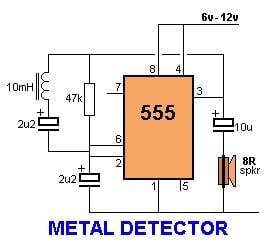
The discussion revolves around modifying a simple metal detector to detect pipes buried several feet underground, specifically exploring the feasibility of using a higher voltage (100V) power supply instead of the typical 6-12V. The scope includes technical modifications, sensitivity improvements, and the effectiveness of different detection technologies.
Discussion Character
- Technical explanation
- Debate/contested
- Exploratory
Main Points Raised
- One participant suggests that the circuit using an LM555 timer may not be suitable for a 100V input, as there is no 100V version of the timer and larger loops may be impractical for detecting pipes at depth.
- Another participant questions whether the intention is to power the detector from a wall socket or to enhance sensitivity, indicating that increasing voltage alone may not improve detection capabilities.
- Some participants argue that ground penetration depth is more dependent on frequency than voltage, suggesting that using a 120V circuit is not a practical solution.
- There are suggestions that to enhance detection capabilities, a larger coil is necessary, and that research into commercially available options may be more beneficial than modifying a simple detector.
- Participants mention that many underground pipes are made of non-metallic materials like PVC, which complicates detection efforts.
- Some propose alternative methods for locating pipes, such as energizing them with a low voltage audio frequency to create a detectable magnetic field.
- There is a mention of technologies like Ground Penetrating Radar and pulse induction as more effective means for detecting underground structures.
Areas of Agreement / Disagreement
Participants express a range of views on the feasibility of modifying the metal detector, with no consensus on the best approach. Some argue against the practicality of using higher voltage, while others emphasize the need for larger coils and alternative detection methods. The discussion remains unresolved regarding the best method for detecting underground pipes.
Contextual Notes
Participants highlight limitations in the proposed modifications, including the dependence on the type of pipes (metal vs. non-metal) and the need for a deeper understanding of detection technologies. There are also unresolved questions about the specific requirements for effective detection.