Can an ODE accurately model an RLC circuit with additional sources?

Click For Summary
An ordinary differential equation (ODE) can model RLC circuits, but adding current sources complicates the equation significantly. Each source introduces conditions that may conflict with one another, affecting circuit behavior. Enforcing a voltage drop across a circuit with an ideal current source in series presents challenges, as the current source dominates. Similarly, in a parallel configuration, an ideal voltage source may render the current source ineffective. These complexities highlight the limitations of ODEs in accurately modeling circuits with multiple sources.
Jhenrique
Messages
676
Reaction score
4
The equation for this physical model is:
http://upload.wikimedia.org/wikipedia/commons/f/fb/RLC_series_circuit_v1.svg

8a89f7d3622fc859d3bc910a8691b9e9.png


And for this is:
http://upload.wikimedia.org/wikipedia/commons/d/d0/RLC_parallel_circuit_v1.svg

8383fa6312eb5e0b7befb1b4172ae749.png


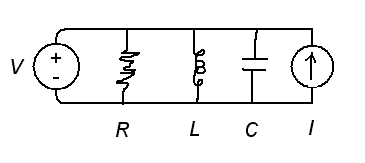
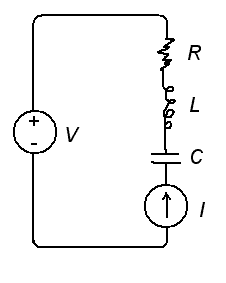
But and if now I add a source of current in those schemes, the ODE changes?
attachment.png

attachment.png
 

Attachments

  • x.PNG
    x.PNG
    1.1 KB · Views: 607
  • y.PNG
    y.PNG
    1.1 KB · Views: 566
Physics news on Phys.org
These circuits do not really work. Each of the sources are going to require conditions that are at odds to the other.

Plus, how do you enforce a voltage drop across a circuit with an ideal current source in series? How do you enforce a current source in parallel to an ideal voltage source?

In the former, at best the voltage source does not contribute. The current source acts like the only source. In the latter, the voltage source is the only effective source.
 
  • Like
Likes 1 person
Thread 'What is the pressure of trapped air inside this tube?'
As you can see from the picture, i have an uneven U-shaped tube, sealed at the short end. I fill the tube with water and i seal it. So the short side is filled with water and the long side ends up containg water and trapped air. Now the tube is sealed on both sides and i turn it in such a way that the traped air moves at the short side. Are my claims about pressure in senarios A & B correct? What is the pressure for all points in senario C? (My question is basically coming from watching...

Similar threads

  • · Replies 6 ·
Replies
6
Views
3K
  • · Replies 8 ·
Replies
8
Views
2K
  • · Replies 1 ·
Replies
1
Views
1K
  • · Replies 1 ·
Replies
1
Views
2K
  • · Replies 14 ·
Replies
14
Views
3K
  • · Replies 4 ·
Replies
4
Views
2K
  • · Replies 16 ·
Replies
16
Views
4K
  • · Replies 5 ·
Replies
5
Views
5K
Replies
2
Views
2K
  • · Replies 6 ·
Replies
6
Views
4K