RLC, RL, RC and LC circuits and ODE

Click For Summary

Discussion Overview

The discussion revolves around the combinations of RLC, RL, RC, and LC circuits, specifically focusing on which configurations are feasible or impossible in circuit simulation software. Participants explore the implications of these combinations on circuit behavior and the corresponding ordinary differential equations (ODEs) that describe voltage and current over time.

Discussion Character

  • Exploratory, Technical explanation, Debate/contested

Main Points Raised

  • One participant questions the validity of certain circuit combinations that are rejected by their simulation software, seeking clarification on what combinations are truly impossible.
  • Another participant suggests that many combinations may not be impossible but could lead to undesirable effects like sparks or heat.
  • A later reply highlights specific configurations that may cause issues, such as connecting an ideal inductor directly to a voltage source, which could result in a short circuit.
  • One participant explains the operational principles of SPICE-based simulators, noting that they analyze circuits by applying nodal analysis and replacing capacitors and inductors with open and short circuits, respectively, for DC analysis.
  • It is mentioned that certain configurations, like a capacitor in series with a voltage source or an inductor directly across a voltage source, are not analyzable in SPICE due to the resulting conditions of DC current.

Areas of Agreement / Disagreement

Participants express differing views on the feasibility of certain circuit combinations. While some argue that all combinations can be connected, others point out specific configurations that are problematic or impossible to analyze in simulation software. The discussion remains unresolved regarding which combinations are definitively impossible.

Contextual Notes

Participants reference limitations in circuit simulation software, particularly regarding how certain configurations can lead to non-analytical conditions in DC analysis. There is an emphasis on the assumptions made by simulators when determining circuit behavior.

Bruno Tolentino
Messages
96
Reaction score
0
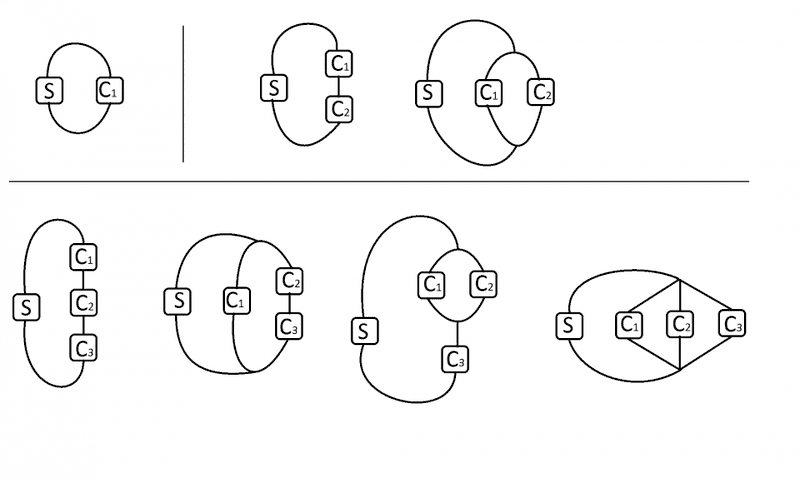
Look this schematic picture:

Esquemas.png


S means source and can be a current source or a voltage source. C_1, C_2 and C_3 are linear components, can be resistor, capacitor and inductor.

In the everycircuit, I tried set up all possible combination and the everycircuit denied some combinations, but, those denied combinations are displayed how possibles in the wiki page about RLC, RC, RL and LC circuits. So, my questions is: what combinations are really impossibles and what are possibles?

And about the possibles, how are the EDO of this system? In other words, I want to write the voltage in function of the time and the current in function of the time for each possible case. I don't know do it.
 
Physics news on Phys.org
Bruno Tolentino said:
In the everycircuit, I tried set up all possible combination and the everycircuit denied some combinations

It would probably help people to answer you if you give specific examples of these "denied" combinations.
 
Bruno Tolentino said:
So, my questions is: what combinations are really impossibles and what are possibles?
I cannot see any impossibilities. I mean, some of them could cause sparks and heat, but give a box with resistors, capacitors and inductors I can connect them any way I want.
 
All circuits below don't works, especially of two of the right...

asasda.png


Why?
 
It's very hard to read your circuits, but the two right ones seem to connect an ideal coil directly to a voltage source, which means you produce a short circuit, which I'd try to avoid ;-).
 
Só, what are the convenient combinations and inconvenient (using the parameters that I provided in first post, above) and why?
 
I don’t know what software you are using but most of the circuit simulators around today are descendents of SPICE (LTSpice, PSPice, etc.) and they all work the same way.

When you start a simulation in SPICE, it first calculates the DC operating point by running a nodal analysis using Kirchoff’s law. To do this, it replaces all the capacitors with open-circuits and the inductors with short-circuits, and then solves the nodal equations for the DC operating point. (At DC an open-circuit is a perfect approximation to a capacitor and a short is a perfect approximation to an inductor.)

If SPICE cannot get the DC operating point it bails out and refuses to go any further.

The circuits that your simulator is rejecting all have either:-

1) A capacitor in series with the voltage source. (The three on the left.) No DC current, therefore not possible to analyse in SPICE, or
2) An inductor directly across the voltage source. (The two on the right.) DC current infinite, therefore not possible to analyse in SPICE.

I’m guessing that your simulator works the same way.
 
  • Like
Likes   Reactions: Bruno Tolentino

Similar threads

Replies
152
Views
8K
  • · Replies 50 ·
2
Replies
50
Views
15K
  • · Replies 18 ·
Replies
18
Views
2K
  • · Replies 5 ·
Replies
5
Views
2K
  • · Replies 21 ·
Replies
21
Views
2K
  • · Replies 5 ·
Replies
5
Views
2K
  • · Replies 9 ·
Replies
9
Views
4K
  • · Replies 15 ·
Replies
15
Views
6K
  • · Replies 8 ·
Replies
8
Views
6K
  • · Replies 3 ·
Replies
3
Views
2K