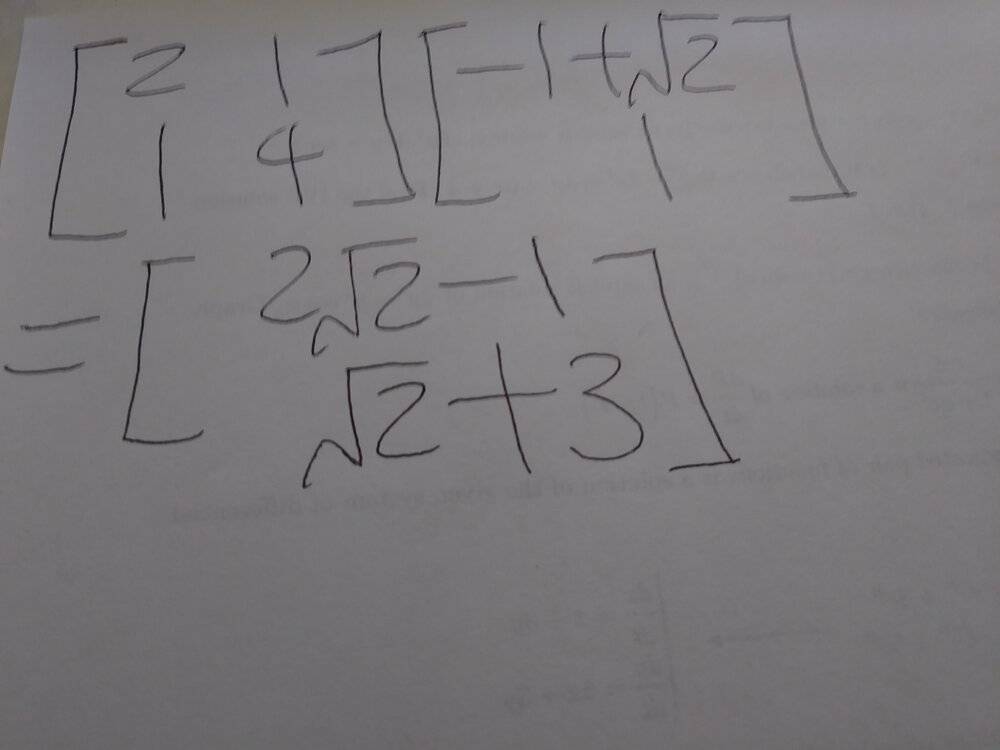
Can anyone please check my work and answer for this math problem?

Click For Summary

Homework Help Overview

The discussion revolves around determining whether a given vector is an eigenvector based on a specific mathematical condition involving scalar multiples. The subject area is linear algebra, particularly focusing on eigenvalues and eigenvectors.

Discussion Character

  • Exploratory, Conceptual clarification

Approaches and Questions Raised

  • The original poster seeks confirmation on their conclusion regarding the vector being an eigenvector. Some participants explore the relationship between the given vectors and question whether one is a scalar multiple of the other.

Discussion Status

The discussion includes attempts to clarify the concept of eigenvectors and scalar multiples. Some participants provide insights into the mathematical reasoning behind the relationship between the vectors, while others express uncertainty about the original poster's conclusion.

Contextual Notes

There is a mention of humor that may have caused confusion, and the original poster expresses uncertainty about their answer, indicating a need for further clarification on the topic.

Math100
Messages
823
Reaction score
234
Homework Statement
Is [-1+sqrt(2), 1] an eigenvector of [2, 1; 1, 4]? If so, find the eigenvalue.
Relevant Equations
None.
Can anyone please confirm and check my work with answer because I'm not 100% sure if my work with answer is 100% correct. The question is asking if the given vector is an eigenvector and I've answered no. What's the correct answer for this problem? It's Yes or No?
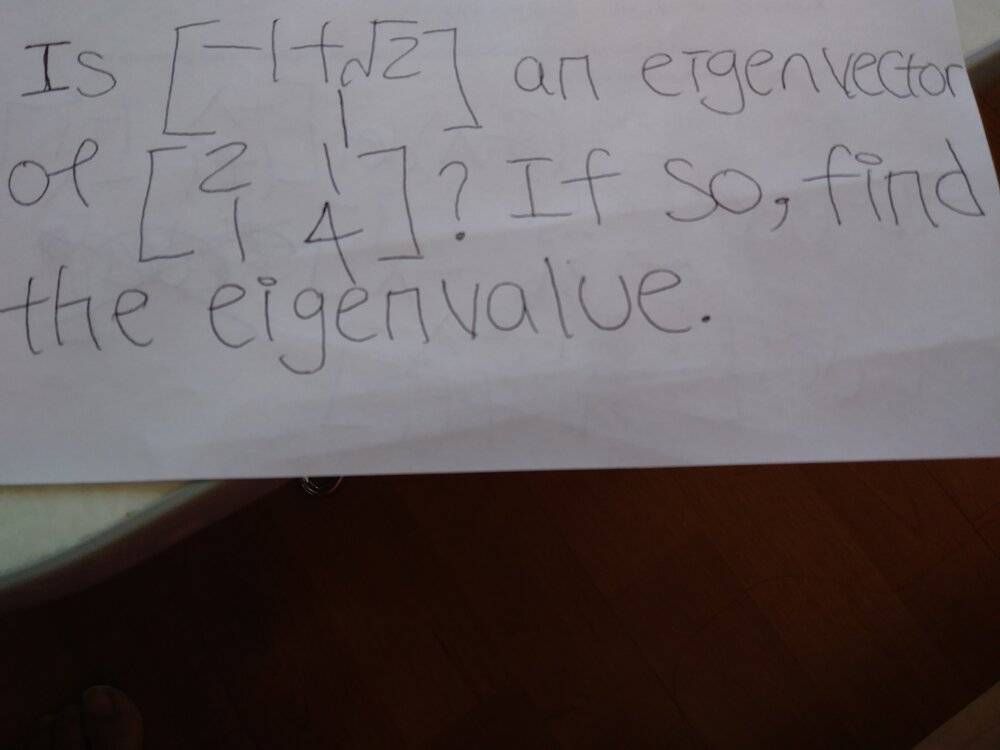
20200815_103202.jpg
20200815_104905.jpg
 
Physics news on Phys.org
I think you need to write a little bit larger. Got any A3 nearby?
 
Sorry, I don't understand. What do you mean about A3 nearby?
 
Nevermind, it was just a bad attempt at humour. As for your question, is the vector ##
\begin{pmatrix}
2\sqrt{2} - 1\\
\sqrt{2} +3
\end{pmatrix}## a scalar multiple of the vector ##
\begin{pmatrix}
\sqrt{2} - 1\\
1
\end{pmatrix}##?
 
I think the answer is Yes, because (√2-1)(√2+3)=2√2-1. Therefore, it's scalar multiple. Am I right?
 
Right. And and if the result is a scalar multiple of the first vector, as in ##Av = \lambda v##, then ##v## is an eigenvector. Does that answer your question? :smile:
 
  • Like
Likes   Reactions: Math100
Yes. Thank you so much for the help.
 
  • Like
Likes   Reactions: etotheipi

Similar threads

  • · Replies 2 ·
Replies
2
Views
2K
  • · Replies 5 ·
Replies
5
Views
2K
  • · Replies 19 ·
Replies
19
Views
3K
  • · Replies 21 ·
Replies
21
Views
2K
Replies
4
Views
2K
Replies
2
Views
1K
  • · Replies 25 ·
Replies
25
Views
2K
Replies
28
Views
2K
  • · Replies 7 ·
Replies
7
Views
2K
  • · Replies 9 ·
Replies
9
Views
2K