Can Bessel Functions be Simplified for Numerical Integration?

  • Context: Graduate 
  • Thread starter Thread starter Astaroth.
  • Start date Start date
  • Tags Tags
    Calculation Integral
Click For Summary

Discussion Overview

The discussion revolves around the simplification of Bessel functions for numerical integration, particularly in the context of modeling galaxy rotation and density profiles. Participants explore various mathematical approaches, including the use of Hankel transforms and different forms of density functions.

Discussion Character

  • Exploratory
  • Technical explanation
  • Mathematical reasoning
  • Debate/contested

Main Points Raised

  • One participant seeks assistance with Bessel functions J_1 and J_0 for numerical solutions.
  • Another mentions an analytic solution for S(k) derived from a Hankel transform, but notes the need for further research on V(R).
  • A participant describes modeling galaxy rotation using specific density profiles, referencing a journal article for context.
  • There is discussion about how different forms of the density function σ(r) affect the results, particularly when substituting exponential decay with linear functions.
  • Concerns are raised about the convergence of integrals when changing the form of σ(r), with one participant stating that a linear function leads to divergence.
  • Another participant suggests that using a truncated linear function for σ(r) complicates the integration process, leading to the need for splitting the integral into two parts.
  • One participant concludes that the analytical solution for S(k) is possible, but the integral V(R) becomes complicated, involving hypergeometric functions and Bessel functions.
  • There is a suggestion to avoid the truncated law of distribution for simplicity in computation.

Areas of Agreement / Disagreement

Participants express differing views on the implications of using various forms of σ(r) and the feasibility of analytical versus numerical solutions. No consensus is reached on the best approach to take.

Contextual Notes

Participants note limitations regarding the applicability of Hankel transforms and the complexity introduced by truncated density profiles. The discussion highlights unresolved mathematical steps and the dependence on specific definitions of density functions.

Astaroth.
Messages
9
Reaction score
0
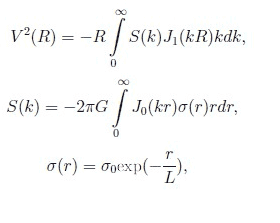
Hello, need your help.
11.png

J_1 and J_0 - Bessel function
Necessary to solve analytically or to be able to simplify the numerical solution.
 
Physics news on Phys.org
The analytic solution for S(k) is given in the joint page.
It was obtained thanks to a known Hankel transform.
Then, for the analytic computation of V(R), another Hankel transform is needed, which I have'nt available. This will require more research. Sorry, I have not enough time now. I will look again within a few days.
 

Attachments

  • Hankel integral.JPG
    Hankel integral.JPG
    36.7 KB · Views: 495
Thank you. I have been modeling the rotation of galaxies.
The journal «Freeman, K. C. Astrophysical Journal, vol. 160, p.811» http://articles.adsabs.harvard.edu//full/1970ApJ...160..811F/0000813.000.html described, but I need for different density profiles [itex]\sigma[/itex].
[itex]\sigma (r)) = \sigma_{0} \exp(-\frac{r}{L})[/itex]
and
[itex]\sigma (r) = \sigma (Rt)*(1+(Rt-r)/SCL)= \sigma_{0} * \exp(-\frac{Rt}{L})*(1+(Rt-r)/SCL)[/itex]
Where Rt - radius of truncation. SCL - scale truncation
 
Finally, it was not so arduous than I thought first.
The result is expressed in terms of Bessel functions (in attachment)
 

Attachments

  • Hankel integral 2.JPG
    Hankel integral 2.JPG
    37.6 KB · Views: 453
Thank you very much.
And if the [itex]\sigma (r) = \sigma_ {0} * \ exp (- \frac {Rt} {L}) * (1 + (Rt-r) / SCL)[/itex]

The result will differ greatly?
 
Astaroth. said:
And if the [itex]\sigma (r) = \sigma_ {0} * \ exp (- \frac {Rt} {L}) * (1 + (Rt-r) / SCL)[/itex]
The result will differ greatly?

In the function sigma(r), if you replace the exopential function (which tends to zero when r tends to infinity) by a linear function which tends to -infinity when r tends to infinity), indeed, the result will differ greatly.
So greatly that the integral (from 0 to infinity) is no longer convergent.
 
JJacquelin said:
In the function sigma(r), if you replace the exopential function (which tends to zero when r tends to infinity) by a linear function which tends to -infinity when r tends to infinity), indeed, the result will differ greatly.
So greatly that the integral (from 0 to infinity) is no longer convergent.

What do I do?

The exponential law of density distribution [itex]\sigma (r)) = \sigma_{0} \exp(-\frac{r}{L})[/itex]
I want to apply a linear truncation for [itex]\sigma (r)[/itex]
[itex]\sigma (r) = <br /> \left\{\begin{matrix}\sigma (r),<br /> &r < Rt \\ \sigma (Rt)(1+(Rt-r)/SCL),<br /> & Rt < r < Rt+SCL\\ 0,<br /> & r > Rt+SCL<br /> \end{matrix}\right.[/itex]
 
Last edited:
Astaroth. said:
What do I do?

The exponential law of density distribution [itex]\sigma (r)) = \sigma_{0} \exp(-\frac{r}{L})[/itex]
I want to apply a linear truncation for [itex]\sigma (r)[/itex]
https://www.physicsforums.com/attachments/41402

OK, I understand : the linear function is truncated, which is very different regarding the Hankel integral.
Bur I cannot read the attachment : "Invalid Attachment specified"
 
[itex]\sigma (r) = <br /> \left\{\begin{matrix}\sigma (r),<br /> &r < Rt \\ \sigma (Rt)(1+(Rt-r)/SCL),<br /> & Rt < r < Rt+SCL\\ 0,<br /> & r > Rt+SCL<br /> \end{matrix}\right.[/itex]
 
  • #10
Well, I am afraid, this will be more complicated than with the previous sigma(r).
At first sight, solving analytically the integal S(k) seems possible.
Then, about the other integral V(R), I don't know yel. Now, I have not enough time available.
 
  • #11
Only you can help me.
 
  • #12
After more study in the case of the truncated law for sigma(r), I come to a conclusion :
Using the background provided by the Hankel transforms is no longer possible. We have to split the integral in two, each one on a limited range of integration. The background is less extended than in case of integration from zero to infinity.
Nevertheless, the integral S(k) can be analytically solved. In fact, it can be expressed in terms of a series of hypergeometric functions (this is of few interest for numerical calculus, since computing a lot of hypergeometric functions is not avantageous compare to a direct numerical integration).
Then, the other integral V(R) becommes very complicated, involving the product of hypergeometric functions and the Bessel function. I don't think that it could be analytically solved in present state of knowledge.
As a conclusion I suggest, if possible, to avoid the trucaded law of distribution : In is much simpler to apply the analytical solution found in case of the untruncated law.
If the truncated law is essential, my opinion is that there in no other way than the numerical computation of the integrals.
Sorry, that all I can do to help you concerning the particular case of truncated law of distribution.
 
  • #13
Thank you very much.
 

Similar threads

  • · Replies 5 ·
Replies
5
Views
2K
  • · Replies 3 ·
Replies
3
Views
3K
  • · Replies 3 ·
Replies
3
Views
2K
  • · Replies 1 ·
Replies
1
Views
1K
  • · Replies 1 ·
Replies
1
Views
952
  • · Replies 3 ·
Replies
3
Views
2K
  • · Replies 4 ·
Replies
4
Views
2K
  • · Replies 1 ·
Replies
1
Views
2K
  • · Replies 3 ·
Replies
3
Views
2K
  • · Replies 10 ·
Replies
10
Views
3K