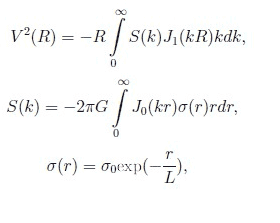
After more study in the case of the truncated law for sigma(r), I come to a conclusion :
Using the background provided by the Hankel transforms is no longer possible. We have to split the integral in two, each one on a limited range of integration. The background is less extended than in case of integration from zero to infinity.
Nevertheless, the integral S(k) can be analytically solved. In fact, it can be expressed in terms of a series of hypergeometric functions (this is of few interest for numerical calculus, since computing a lot of hypergeometric functions is not avantageous compare to a direct numerical integration).
Then, the other integral V(R) becommes very complicated, involving the product of hypergeometric functions and the Bessel function. I don't think that it could be analytically solved in present state of knowledge.
As a conclusion I suggest, if possible, to avoid the trucaded law of distribution : In is much simpler to apply the analytical solution found in case of the untruncated law.
If the truncated law is essential, my opinion is that there in no other way than the numerical computation of the integrals.
Sorry, that all I can do to help you concerning the particular case of truncated law of distribution.