Can Diagrams be Used as Circuits in Explaining Sensor Operations?

Click For Summary

Discussion Overview

The discussion revolves around the use of diagrams versus actual circuits in explaining the operational principles of various sensors, including pH meters, sound sensors, light sensors, and temperature sensors. Participants explore the requirements for constructing these representations and the challenges they face in finding suitable examples.

Discussion Character

  • Homework-related
  • Exploratory
  • Technical explanation

Main Points Raised

  • One participant questions whether diagrams can be considered circuits, expressing a preference for diagrams to simplify their task.
  • Another participant seeks clarification on whether "construct" implies creating functional circuits or if diagrams suffice.
  • Some participants mention the requirement to produce circuit diagrams and explain the operation and uses of the chosen sensors.
  • There is a suggestion that research is needed to find basic circuits for sound and pH sensors, with one participant indicating they found numerous examples online.
  • One participant provides a link to a sound sensor example, describing its connection to a preamp circuit and output device.
  • Concerns are raised about the complexity of graphs related to sensor operations, with a participant expressing difficulty in understanding some of the materials found.
  • A later reply emphasizes the need for a circuit that models the inner workings of the sensor, along with block diagrams for additional components like amplifiers and converters.

Areas of Agreement / Disagreement

Participants do not reach a consensus on whether diagrams can replace actual circuits. There are varying opinions on the requirements for the assignment, with some suggesting that diagrams are sufficient while others emphasize the need for detailed circuit representations.

Contextual Notes

Participants express uncertainty regarding the definitions of "circuit" and "diagram," as well as the expectations for their assignments. There are references to specific examples and resources, but the applicability of these resources to the participants' needs remains unresolved.

Daniel2244
Messages
125
Reaction score
5
I have to construct suitable circuits to show the operational principles of some sensors: pH meter, sound, light and temperature. Would these count as circuits? or diagrams? (I'd say diagrams).
https://www.electronics-tutorials.ws/io/io45.gif
I am finding it hard to find circuits showing how sound sensors and pH sensors work etc and the ones I do find are beyond my level such as:
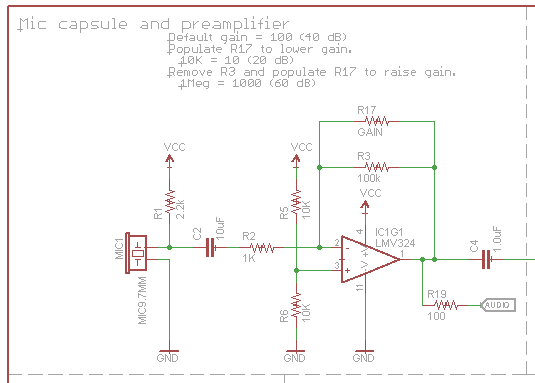
schem1.png

I under stand how the sound sensors work, such as the diaphragm microhphone (shown in first picture). Just wanting to know if I could use diagrams as circuits it would make my life easier.
 

Attachments

  • schem1.png
    schem1.png
    3.7 KB · Views: 1,095
Physics news on Phys.org
When you say construct, do you mean circuits that actually work?

Is this homework?

Edit: Can you use instruments like meters or an oscilloscope instead of circuits you build yourself?
 
anorlunda said:
When you say construct, do you mean circuits that actually work?

Is this homework?

Edit: Can you use instruments like meters or an oscilloscope instead of circuits you build yourself?
I don't think it really matters, it just says "Learners will produce circuit diagrams of the transducer/sensor chosen and explain their operation anduses".
And yes but I didn't think I should put in the homework part due to only wanting to know if the first one counts as a circuit.mb
 
Daniel2244 said:
"Learners will produce circuit diagrams of the transducer/sensor chosen and explain their operation and uses".

I think they mean that they will teach you how to do that.
 
anorlunda said:
I think they mean that they will teach you how to do that.
We have to research it but for some of the sensors such as sound and pH I can't find any basic circuits
 
Daniel2244 said:
some of the sensors such as sound and pH I can't find any basic circuits

Honestly ? Do you know of Google/Bing ?

I typed pH meter circuits into Bing/Google and got dozens of circuits

https://www.bing.com/search?q=pH+me...s=n&sk=&cvid=aec1ef5562ac4a0aaf5c6f26fbc0448aA sound sensor can be as simple as a microphone ( the most common sound sensor)
it will be connected to a preamp circuit and then outputted to your recording device ( PC etc)

I will let you google microphone and preamplifier circuitsDave
 
  • Like
Likes   Reactions: phinds
I can't see the first image in the OP.
 
The link works and I believe it's a good example of what they are asking for. You need to add words explaining how it works and uses.
 
  • Like
Likes   Reactions: Daniel2244
  • #10
CWatters said:
The link works and I believe it's a good example of what they are asking for. You need to add words explaining how it works and uses.
I have explained how every sensor I used works such as the pH meter, sound, temperature, light just the graphs I was strugling on as the graphs I got for some way beyond my learning level.
 
  • #11
CWatters said:
The link works and I believe it's a good example of what they are asking for. You need to add words explaining how it works and uses.
Could you please take a look at this? https://www.physicsforums.com/threa...ion-principle-of-the-ldr.949307/#post-6011157
If you do the circuit I constructed isn't how I measured light. but I have to construct a circuit and using my data to illustarte how an LDR works among other sensors.
 
  • #12
If I understand correctly your task is mainly to explain how sensors work and are used. So you need a circuit that models the inner workings of the sensor and block diagrams for the rest (amplifiers, A-D converters, meters etc)

If they expect you to build and test the circuits you need detailed circuits for the rest as well.
 
  • Like
Likes   Reactions: Daniel2244

Similar threads

  • · Replies 4 ·
Replies
4
Views
2K
  • · Replies 14 ·
Replies
14
Views
3K
  • · Replies 7 ·
Replies
7
Views
5K
  • · Replies 75 ·
3
Replies
75
Views
7K
  • · Replies 152 ·
6
Replies
152
Views
11K
  • · Replies 3 ·
Replies
3
Views
5K
  • · Replies 3 ·
Replies
3
Views
3K
  • · Replies 21 ·
Replies
21
Views
7K
Replies
24
Views
8K
  • · Replies 2 ·
Replies
2
Views
21K