HeJind
- 5
- 0
So just some background info...I'm in a summer engineering program. We're all high school students (with little to no engineering experience), and we've only been in the program for two weeks now.
Just recently our professor assigned my group an assignment to create a spring-assisted magnetic motor. He drew a diagram for us on how to build it, but I simply don't understand how it works. To make it worse, our professor is from another country and speaks imperfect English with a strong accent. Needless to say, he's not the best at explaining things.
So the diagram is as follows:
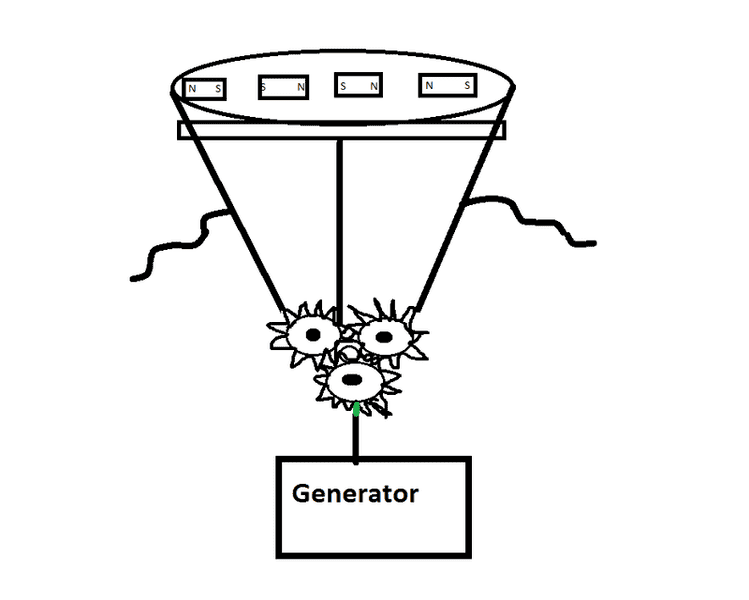
From what I understand, the topmost magnets exert force on each other, which then sends a force down the middle pole. This somehow turns the gears at the bottom, which turn each other. The gears then force the left & right poles upward, which does something to the magnets, which keeps them turning. There are also springs on the left & right to control the speed of the left & right rods?
Is this even possible, let alone for high school kids? From what I gathered on the internet, over-unity designs have never worked and go against the laws of thermodynamics.
Can someone explain this to me? Thanks.
Just recently our professor assigned my group an assignment to create a spring-assisted magnetic motor. He drew a diagram for us on how to build it, but I simply don't understand how it works. To make it worse, our professor is from another country and speaks imperfect English with a strong accent. Needless to say, he's not the best at explaining things.
So the diagram is as follows:
From what I understand, the topmost magnets exert force on each other, which then sends a force down the middle pole. This somehow turns the gears at the bottom, which turn each other. The gears then force the left & right poles upward, which does something to the magnets, which keeps them turning. There are also springs on the left & right to control the speed of the left & right rods?
Is this even possible, let alone for high school kids? From what I gathered on the internet, over-unity designs have never worked and go against the laws of thermodynamics.
Can someone explain this to me? Thanks.